

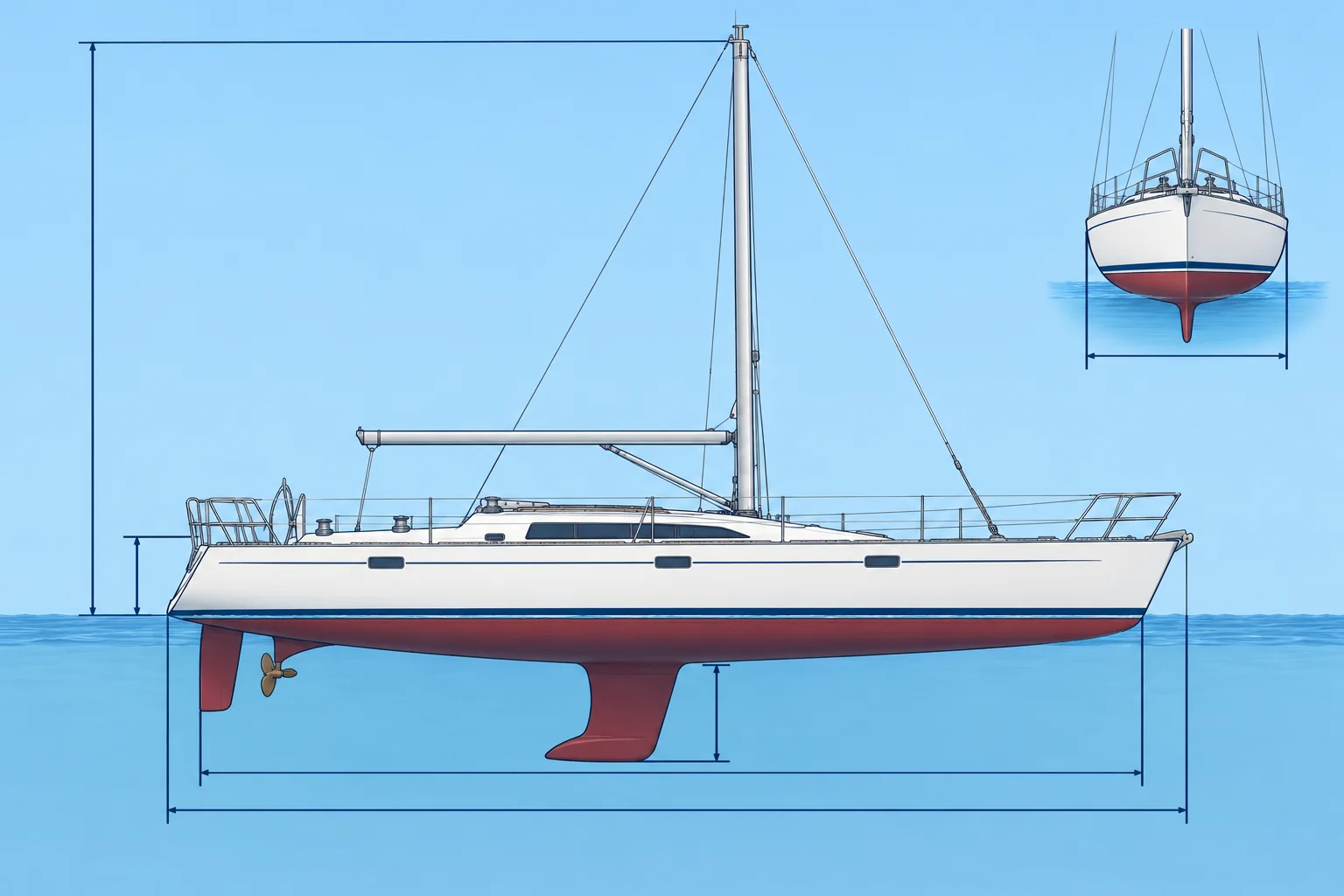
Length, beam, draught, freeboard, displacement and tonnage
1The lesson in plain words
Marinas charge by length, bridges limit air draught and the chart limits draught. Know your boat’s numbers, and that tonnage is not weight.
Lengths
LOA, length overall, is the extreme length including fixed fittings; marinas usually charge by it. LWL, length on the waterline, is measured at the water surface for the stated loading condition. LH, hull length under ISO 8666, excludes detachable fittings; structural extensions remain included. Check the boat’s technical documentation.
Width and depth
Beam is the greatest width; BOA overall, BWL at the waterline. Draught is the depth from the waterline to the lowest point, usually the keel. Freeboard is the height of the deck edge above the water. Air draught is the height from the waterline to the highest point, such as the masthead or antenna. Allow a safe margin under bridges; under power lines, current can arc across a gap, so keep the published safe clearance.
Displacement
Displacement is the boat’s weight, equal to the weight of water she pushes aside, in tonnes or kilograms. Light displacement includes the fitted-out boat and machinery, before variable loads such as people, stores, fuel and fresh water. Loaded displacement includes those loads. Deadweight is carrying capacity: the difference between maximum permitted loaded displacement and light displacement. It includes cargo, fuel, water, stores and people.
Tonnage indices
Gross tonnage (GT) is a unitless index calculated from enclosed volume under the 1969 Tonnage Convention. Net tonnage (NT) reflects earning capacity, using cargo-space volume with draught and passenger factors. Neither measures weight or directly states cubic metres. Rules, fees and crew qualifications often go by GT.
2Key data
- LOA
- Extreme length overall: marina fees
- LWL
- Length at the waterline for the stated loading condition
- Air draught
- Waterline to highest point: bridges, power lines
- Gross tonnage
- Unitless index based on enclosed volume
- Displacement
- Weight of the boat = weight of water displaced
3Key points
- 1
LOA: overall length; LWL: waterline length; LH: hull length under ISO 8666.
- 2
Draught is below the water; air draught above it.
- 3
Freeboard is your margin before water comes on deck.
- 4
Displacement measures weight; GT and NT are unitless indices based on volume.
- 5
Draught grows when loaded and in fresh water.
4Frequent mistakes
Wrong: A 300 GT yacht weighs 300 tonnes.
Right: GT is a unitless index calculated from enclosed volume. Her displacement in tonnes is a different number.
Wrong: Air draught is measured from the deck to the masthead.
Right: It is measured from the waterline, and includes antennas and lights on top of the mast.
5Practice case & exam keys
Your masthead is 15.5 m above the mast step. The mast step is 1.2 m above the waterline. A VHF antenna adds 0.9 m above the masthead. A fixed bridge has 16.0 m clearance at the current tide. Can you pass?
Show the answer
No. Air draught is from the waterline: 1.2 + 15.5 + 0.9 = 17.6 m, more than 16.0 m. Find the bridge’s reference level on the chart, the tide height and your exact air draught. Wait for lower water only if the margin is ample, or take another route.
Exam keys
- LOA, LWL, LH (ISO 8666), beam, draught, freeboard, air draught.
- Displacement = weight. Deadweight = carrying capacity of a ship.
- GT: index from enclosed volume. NT: earning-capacity index using cargo volume, draught and passenger factors. Neither is weight.
- Air draught from the waterline, including antennas.
Finish this unit
When you've read it, answer three questions. Get all three right to finish the unit; opening the page alone doesn't count.
My notes for this unit
No notes