

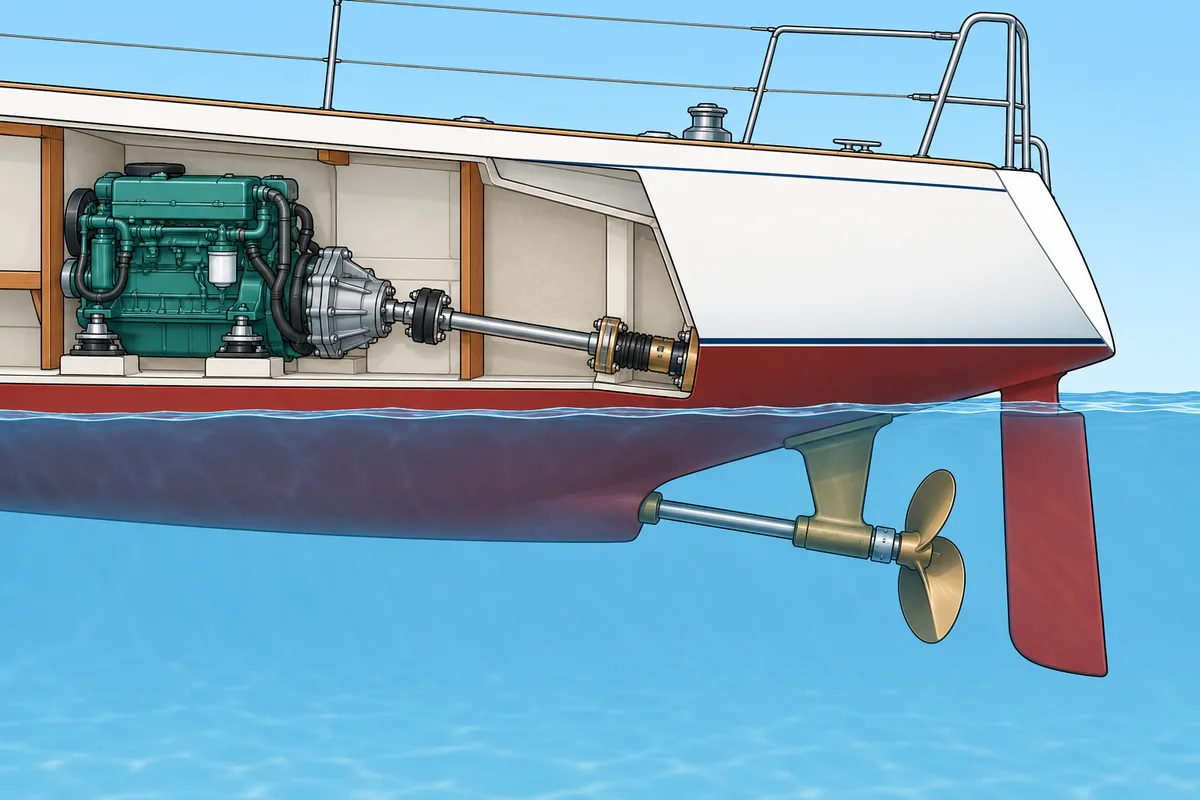
From engine to propeller: gears, shaft and seals
1The lesson in plain words
The gearbox, shaft, bearings and seal pass engine power to the propeller and keep water out. Check them before you leave.
Gearbox and reduction
The gearbox selects ahead, neutral or astern without reversing the engine itself. It usually reduces shaft speed, often by 2:1 to 3:1. With 2:1 reduction, two engine turns give one propeller turn. This lets the engine drive a larger, slower propeller efficiently. Neutral disconnects engine drive; it does not stop the boat.
Shaft and bearings
A coupling joins the gearbox to the shaft, which carries rotation to the propeller. The thrust bearing transfers the propeller’s push to the hull, often through the gearbox and engine mounts. The shaft passes through a stern tube, a tube through the hull. A cutless bearing, usually rubber-lined and lubricated by seawater, supports the shaft near the propeller. Alignment means keeping engine and shaft correctly in line; poor alignment causes vibration and wear.
Keeping water out
A stuffing box, or stern gland, compresses soft packing rings around the shaft. Conventional water-lubricated packing needs a slight drip while the shaft turns, often a few drops a minute; follow its instructions. A dripless seal uses sealing faces or a lip and should not leak. Either seal’s failure can let seawater in. Inspect without touching rotating parts. Stop and secure the shaft before any adjustment.
Galvanic corrosion
Dissimilar metals electrically connected in water can act like a battery. The more reactive metal corrodes: this is galvanic corrosion. A sacrificial anode is a deliberately more reactive metal that corrodes instead of protected parts. Replace it when about half worn. It needs clean electrical contact; never paint it. Unexpectedly rapid loss needs investigation. Keep copper-based antifouling paint off aluminium underwater parts, because it can cause severe corrosion.
Choosing anodes
Zinc suits salt water but protects poorly in fresh water, where a coating can form. Aluminium suits salt and brackish water, meaning partly salty water; many makers also approve it for fresh water. It is the usual choice for boats moving between them. Magnesium is for fresh water only. Follow the maker’s anode chart for your installation.
Changing gear
Idle is the engine’s lowest running speed. Reduce to idle, move through neutral, pause as the gearbox maker specifies, then select the opposite gear and increase power gradually. A pause of about a second is common. Slamming from full ahead to full astern can damage the gearbox or stall the engine just when you need it.
2Step by step
Drive-line check before you go
- 1
Check gearbox oil by the maker’s specified method.
The correct level and oil condition help the gearbox engage and stay lubricated.
- 2
Look for water or oil beneath the gearbox, coupling and shaft seal.
A new leak needs attention before you leave.
- 3
With the engine stopped and secured, inspect accessible coupling fastenings, mounts and seal hose clips.
Loose or damaged parts can cause vibration, loss of drive or water entry.
- 4
Start in neutral at idle, with the boat secured and the area clear.
The propeller must not drive the boat unexpectedly.
- 5
If safe at the berth, test ahead and astern gently at idle, pausing in neutral.
Confirm both directions engage before you need them.
- 6
Observe the seal from a safe distance while the shaft turns; listen for new vibration as you leave.
Conventional packing should drip slightly; a dripless seal should stay dry. Keep hands, hair and clothing clear.
3Key points
- 1
The gearbox selects ahead, neutral and astern and reduces shaft speed.
- 2
The thrust bearing carries push to the hull; the cutless bearing supports the shaft in seawater.
- 3
Conventional packing drips slightly while running; a dripless seal should stay dry.
- 4
Keep anodes unpainted and electrically connected. Replace them when about half worn.
- 5
Shift through neutral at idle. Check oil, leaks, fastenings and engagement before leaving.
4Frequent mistakes
Wrong: Tighten a conventional stuffing box until it is dry while running.
Right: Water cools and lubricates conventional packing. A dry, hot gland may be too tight. Stop and secure the shaft before adjustment.
Wrong: You can change directly from full ahead to full astern.
Right: Reduce to idle, pass through neutral and pause as specified before reversing. Then add power gradually.
Wrong: Paint the anode so it lasts longer.
Right: Paint prevents protection. Keep clean electrical contact, choose the specified material and replace the anode when about half worn.
5Practice case & exam keys
Before departure, you see a few drops a minute from a conventional packed stern gland while the shaft turns. Another boat’s dripless seal is dry. Does either observation alone show a fault?
Show the answer
Both can be normal. Conventional water-lubricated packing needs a slight running drip; a dripless seal should stay dry. Compare with the maker’s specified rate and your usual observations. A steady stream, new leakage or overheating needs attention. Keep clear of rotating parts and stop and secure the shaft before any adjustment.
Exam keys
- Gearbox: ahead, neutral, astern and reduction. Thrust bearing: carries propeller push into the hull.
- Cutless bearing: seawater-lubricated shaft support. Poor engine/shaft alignment causes vibration and wear.
- Conventional stuffing box: slight running drip. Dripless seal: dry. Shift through neutral at idle.
- Anodes: zinc for salt; aluminium for salt/brackish and approved fresh-water use; magnesium for fresh only. Follow the maker’s chart.
Finish this unit
When you've read it, answer three questions. Get all three right to finish the unit; opening the page alone doesn't count.
My notes for this unit
No notes