

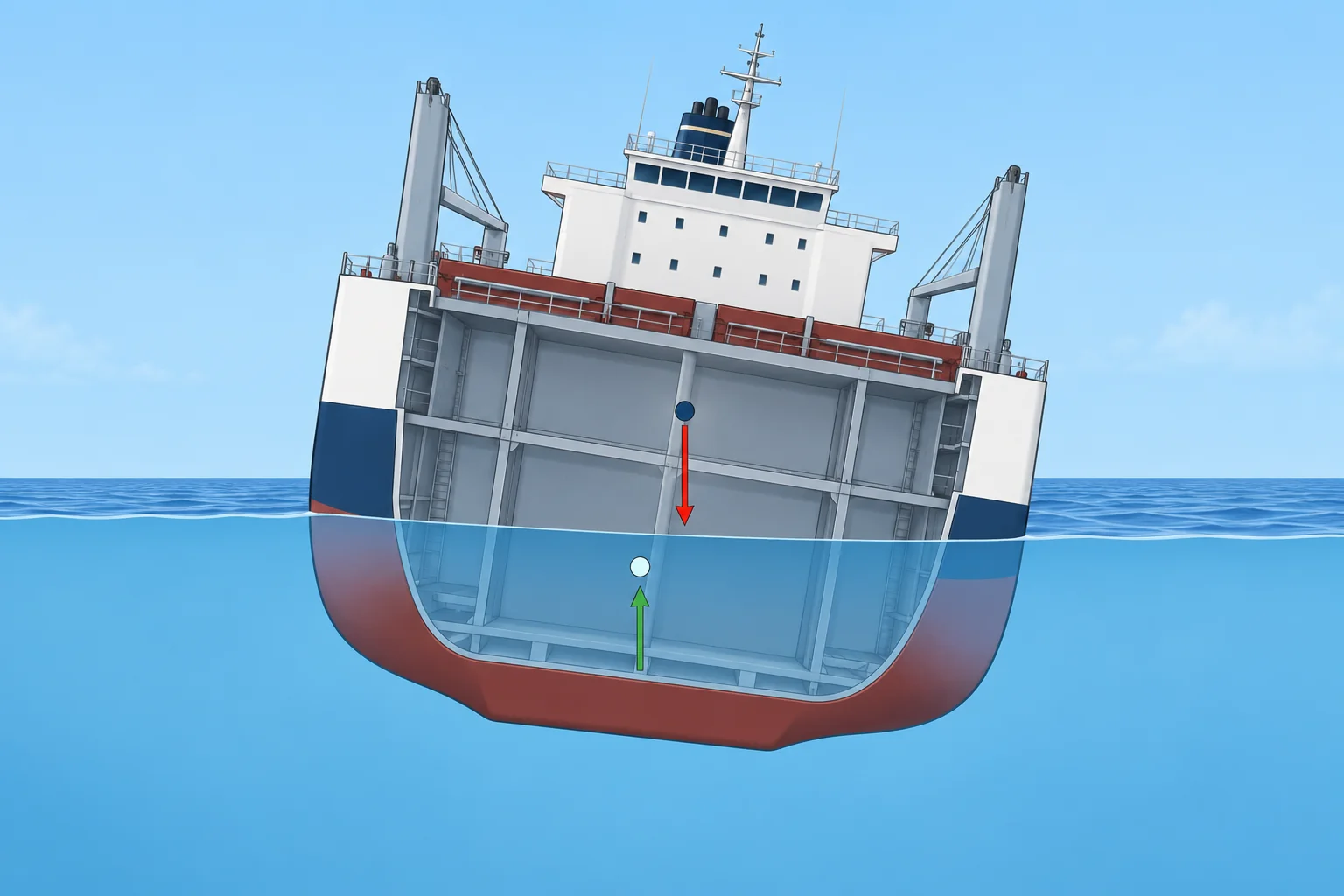
GZ at small angles and the wall-sided formula
1The lesson in plain words
Near upright, GZ ≈ GM × sin θ. It is a good start, but the real curve soon leaves it, so know where the shortcut ends.
From yacht to ship
You already know that GZ ≈ GM × sin θ at small heel. On a ship you use the same idea with booklet numbers. Displacement Δ and KM come from the hydrostatic tables, and KG from your table of moments. Use GM fluid, the metacentric height after the free surface correction. The righting moment is Δ × GZ, in t·m.
Why the shortcut stops working
GM × sin θ assumes the metacentre M stays fixed. That is close enough for only a few degrees, usually quoted as up to about 7–10°. Beyond that the waterplane changes shape, B no longer moves on a circle, and M moves. The real GZ can then be larger or smaller than GM × sin θ.
The wall-sided formula
A wall-sided ship has vertical sides where the waterline moves as she heels. For her, a better lever is GZ = sin θ × (GM + ½ × BM × tan² θ). BM is the height of M above B, or KM − KB. It holds only until the deck edge immerses or the bilge comes out of the water. Do not use it where the sides slope outward or inward at the moving waterline.
Conditional wall-sided comparison
Assume vertical sides throughout the moving waterline. Take GM 0.55 m and BM 5.0 m. At 10°, GM × sin θ gives 0.096 m and the wall-sided formula 0.109 m. At 20° they give 0.188 m and 0.301 m. These comparison values are not our ship’s approved GZ values. Her deck edge immerses at 18°, so the 20° wall-sided result is outside the formula’s limit.
Righting moment
GZ is a length; the ship's resistance to heeling is a moment. A ship of 15,000 t with GZ 0.096 m at 10° has a righting moment of about 1,440 t·m. For a static balance, compare the heeling moment with this righting moment; during a roll, motion can carry her farther.
2Key data
- Small-angle lever
- GZ ≈ GM × sin θ, up to about 7–10°
- Righting moment
- RM = Δ × GZ (t·m)
- Wall-sided formula
- GZ = sin θ × (GM + ½ × BM × tan² θ)
- BM
- BM = KM − KB
- Wall-sided limit
- Until the deck edge immerses or the bilge emerges
3Key points
- 1
GZ ≈ GM × sin θ works for a few degrees only, about 7–10°.
- 2
Use GM fluid, corrected for free surface, in every lever and moment.
- 3
Righting moment = Δ × GZ in t·m.
- 4
The wall-sided formula adds ½ × BM × tan² θ and holds until deck edge immersion or bilge emergence.
- 5
For any larger angle, use the booklet's cross curves.
4Frequent mistakes
Wrong: GM tells you how stable the ship is at 30°.
Right: GM describes only the start of the curve. At 30° use GZ from the cross curves.
Wrong: The wall-sided formula works at any angle.
Right: It assumes vertical sides at the waterline. It fails once the deck edge immerses or the bilge emerges.
Wrong: Use the solid GM because it is the ship's real GM.
Right: Slack tanks reduce effective GM. Use GM fluid for levers, moments and criteria.
5Practice case & exam keys
Your ship displaces 15,000 t with GM fluid 0.55 m. The second officer estimates the righting lever at 25° as 0.55 × sin 25° = 0.23 m and says the ship is fine. What do you tell him?
Show the answer
GM × sin θ is only a small-angle estimate, so 0.23 m at 25° is not reliable. Use the approved booklet's GZ curve for this loading condition. One estimated lever cannot establish that the ship is safe. The next part shows how to obtain the correct levers.
Exam keys
- GZ ≈ GM sin θ only at small angles (about 7–10°).
- Righting moment = Δ × GZ, in t·m.
- Wall-sided: GZ = sin θ (GM + ½ BM tan² θ), until deck edge immersion or bilge emergence.
- Always use GM corrected for free surface.
Finish this unit
When you've read it, answer three questions. Get all three right to finish the unit; opening the page alone doesn't count.
My notes for this unit
No notes