

Correcting and reading the ship's GZ curve
1The lesson in plain words
Free surface and an off-centre G both cut into the curve. Correct it, then read GM, maximum GZ, range and the angles that matter.
Free surface first
The IS Code requires a free surface correction in every loading condition. The usual hand method is the fluid KG: add ΣFSM ÷ Δ to KG, then GZ = KN − fluid KG × sin θ. That lowers each lever by FSC × sin θ. Some booklets correct each angle with the actual liquid shift instead. Use only the method your booklet describes.
An off-centre G
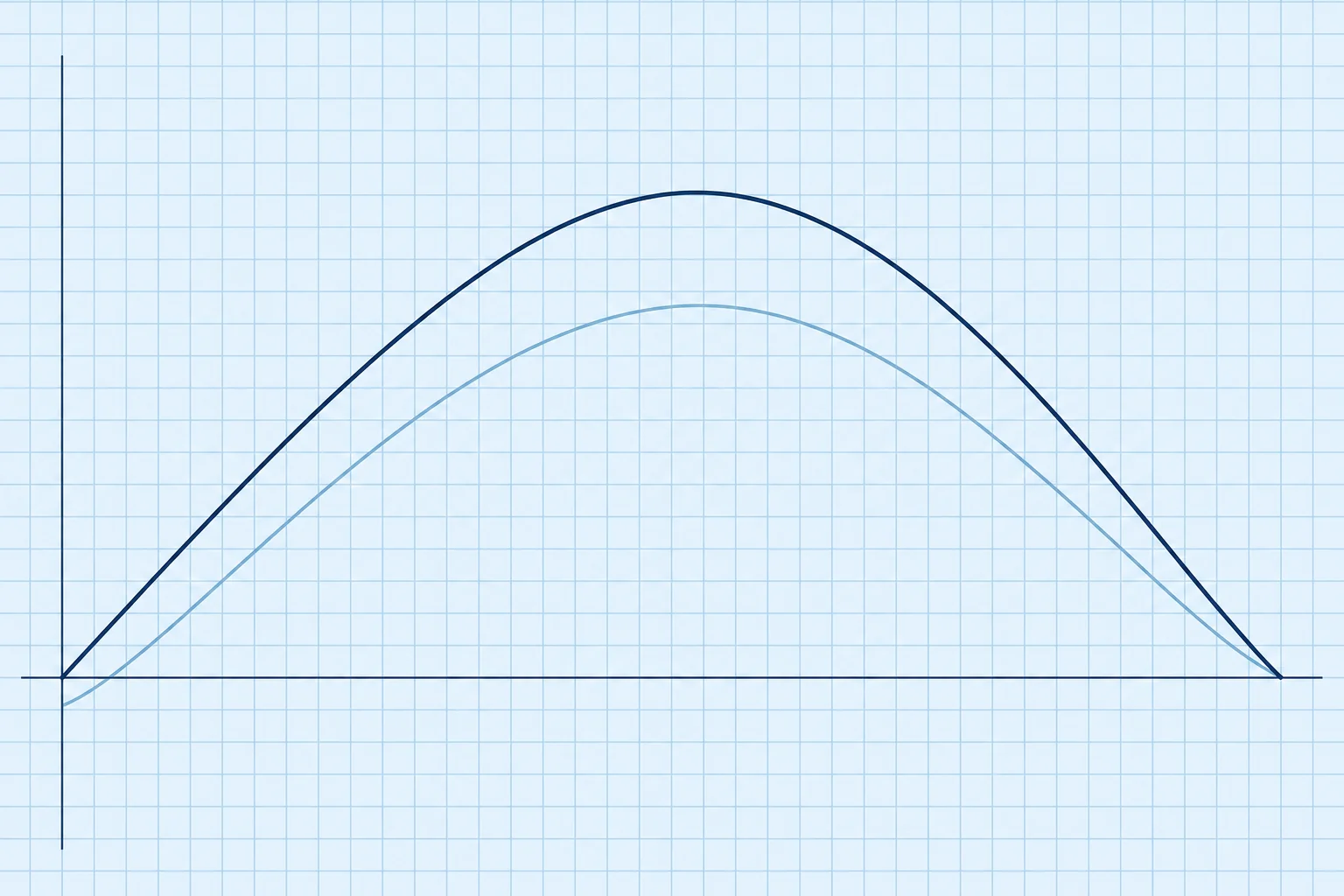
If G lies off the centreline by GGH, the horizontal shift of G, each lever towards that side shrinks by GGH × cos θ: GZ corrected = GZ − GGH × cos θ. The curve now starts below zero. The ship lists to where it crosses zero. She has less maximum GZ, range and area on the listed side.
Negative GM and loll
Negative GM fluid makes upright equilibrium unstable. She can settle at an angle of loll only if GZ recovers through zero with a positive slope before downflooding. Otherwise, capsize may follow. For a wall-sided hull within its validity limits, tan θ = √(2 × |GM| ÷ BM). She can loll to either side. See the trim lesson for safe correction.
Reading the curve
Read GM from the starting slope, then maximum GZ, its angle and GZ at 30°. The angle of vanishing stability (AVS) is the later zero crossing, where GZ changes from positive to negative. Positive GZ extends from the stable zero crossing to AVS; with a list, it does not start upright. Take labelled deck edge immersion and downflooding angle θf from the booklet. A bend alone does not reliably identify deck edge immersion. Openings may immerse while GZ is still positive.
Moments and energy
GZ × Δ gives the righting moment in t·m. Multiply Δ by the area under the corrected GZ curve from stable equilibrium to the chosen heel, using radians. This gives dynamical stability: the work needed to heel the ship slowly, in t·m·rad. Start at 0° for an upright stable ship, or at the stable zero-GZ crossing for a listed or lolling ship. This ideal calculation assumes no downflooding. The IS Code area checks follow in the next lesson.
2Step by step
Worked example: correcting the curve for a list
- 1
Data: the GZ table from the cross-curves example, with G 0.08 m to port (GGH = 0.08 m).
A tank imbalance has moved G off the centreline.
- 2
Work out 0.08 × cos θ: 0.080, 0.079, 0.075, 0.069, 0.061, 0.051 m at 0–50°.
The loss is largest near upright.
- 3
Subtract: corrected GZ = −0.080, 0.018, 0.160, 0.336, 0.363, 0.245 m.
These are the levers for heel to port.
- 4
Read the list: the curve crosses zero at about 8° to port.
Check: tan θ = 0.08 ÷ 0.55, θ ≈ 8.3°.
- 5
Compare: maximum GZ to port drops from about 0.42 m to about 0.36 m.
Less reserve on the listed side; correct the list before sea.
3Key data
- Free surface
- KG fluid = KG + ΣFSM ÷ Δ; lever loss = FSC × sin θ
- List correction
- GZ corrected = GZ − GGH × cos θ
- Loll (wall-sided)
- tan θ = √(2 × |GM| ÷ BM)
- Dynamical stability
- Δ × GZ area from stable equilibrium (t·m·rad)
- Downflooding angle θf
- Heel where openings that cannot close weathertight immerse
4Key points
- 1
Correct for free surface first: use the fluid KG, or the booklet's own method.
- 2
An off-centre G subtracts GGH × cos θ from every lever on the listed side.
- 3
Negative GM makes upright unstable; loll needs a stable nonzero GZ crossing.
- 4
Read maximum GZ, its angle, GZ at 30°, AVS, deck edge immersion and θf.
- 5
Dynamical stability = Δ × GZ area from stable equilibrium to the chosen heel; use radians.
5Frequent mistakes
Wrong: Correct a list by subtracting GGH × sin θ.
Right: The lever lost to an off-centre G is GGH × cos θ: largest upright, smaller at large heel.
Wrong: A ship lying at 8° with negative GM has a list.
Right: That is loll. A list comes from an off-centre G with positive GM; loll from negative GM.
Wrong: The AVS is the limit to watch for flooding.
Right: Water can enter through openings at θf, often well before AVS. Read both.
6Practice case & exam keys
Leaving port, your ship lies 7° to starboard. There is no off-centre weight in the plan. She rolls slowly and once leans 7° to port instead. The calculation shows a slack double bottom and slack deep tanks. What is happening?
Show the answer
The change of side without a weight shift points to loll rather than a list. Check the calculated GM fluid and tank states: negative GM makes upright equilibrium unstable. Do not sail until the condition meets the approved stability criteria. Follow the trim lesson and approved onboard instructions for safe correction.
Exam keys
- GZ corrected for list = GZ − GGH cos θ.
- Free surface: use KG fluid; the lever loss is FSC × sin θ.
- Loll: negative GM; wall-sided tan θ = √(2|GM| ÷ BM).
- Key values: GM, max GZ and angle, GZ at 30°, AVS, θf.
Finish this unit
When you've read it, answer three questions. Get all three right to finish the unit; opening the page alone doesn't count.
My notes for this unit
No notes