

The 2008 IS Code general criteria and the area check
1The lesson in plain words
Part A 2.2 sets six numbers that every loading condition must meet. You check them with GZ values and Simpson's rules.
Where the rules sit
The 2008 IS Code, resolution MSC.267(85), has a mandatory Part A and a recommendatory Part B. SOLAS and the 1988 Load Line Protocol make Part A compulsory for cargo and passenger ships of 24 m and over. Part A 2.1.1–2.1.2 require the loading-condition and free-surface provisions they reference in Part B. Amendments in force since 1 January 2020 (MSC.413(97)) added rules for towing, lifting and anchor handling; the general criteria stayed the same.
The general criteria
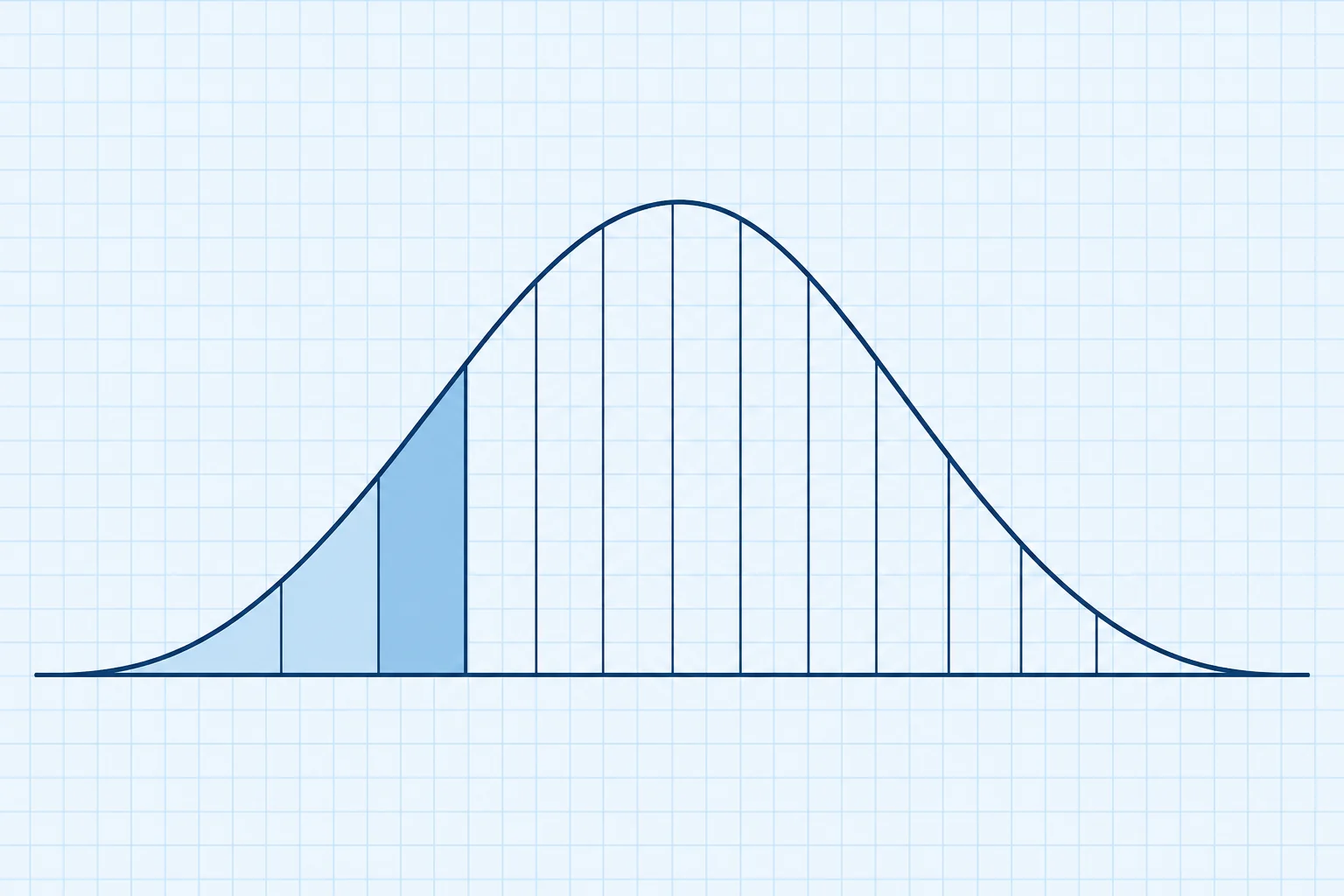
Part A 2.2 asks, with free surface included: area under GZ up to 30° at least 0.055 m·rad; up to 40°, or θf if less, at least 0.090 m·rad; between 30° and 40°, or θf, at least 0.030 m·rad; GZ at least 0.20 m at 30° or more; maximum GZ at 25° or more; and initial GM at least 0.15 m.
Why radians
Area is lever times angle, so the angle must be in radians: 10° = 0.1745 rad. An area worked in metre-degrees is 57.3 times too large and seems to pass everything. Convert the angle step h to radians before you start.
Simpson's rules
Use GZ at equal steps h. Simpson's first rule needs an even number of steps: area = h ÷ 3 × (y0 + 4y1 + 2y2 + 4y3 + y4). Simpson's second rule suits three steps: area = 3h ÷ 8 × (y0 + 3y1 + 3y2 + y3). With 10° steps, use the first for 0–40° and the second for 0–30°. Subtract for 30–40°.
Every condition
The four standard cargo-ship cases are fully loaded departure and ballast departure, both with full fuel and stores, and corresponding arrivals with 10% remaining. In the fully loaded cases, cargo is homogeneously distributed: spread evenly through the cargo spaces. Also check intermediate voyage stages. Fuel use, tank changes and free surface may make one of those stages worse than departure or arrival. Use the approved booklet or loading computer and retain the required safe margin.
2Step by step
Worked example: the Part A 2.2 check
- 1
Data: GZ at 0°, 10°, 20°, 30°, 40° = 0, 0.097, 0.235, 0.405, 0.424 m; θf beyond 40°; GM 0.55 m.
The fluid-KG curve from the cross-curves example.
- 2
Step h = 10° = 0.1745 rad.
Areas must come out in m·rad.
- 3
0–30°, second rule: 3 × 0.1745 ÷ 8 × (0 + 0.291 + 0.705 + 0.405) = 0.092 m·rad.
At least 0.055 m·rad: passes.
- 4
0–40°, first rule: 0.1745 ÷ 3 × (0 + 0.388 + 0.470 + 1.620 + 0.424) = 0.169 m·rad.
At least 0.090 m·rad: passes.
- 5
30–40°: 0.169 − 0.092 = 0.077 m·rad.
At least 0.030 m·rad: passes.
- 6
Levers: GZ at 30° is 0.405 m; maximum about 0.42 m near 40°; GM 0.55 m.
≥ 0.20 m, ≥ 25° and ≥ 0.15 m: all six criteria met. Then check the weather criterion.
3Key data
- Area 0–30°
- At least 0.055 m·rad
- Area 0–40° (or θf)
- At least 0.090 m·rad
- Area 30–40° (or θf)
- At least 0.030 m·rad
- GZ at 30° or more
- At least 0.20 m
- Maximum GZ
- At an angle of heel of 25° or more
- Initial GM
- At least 0.15 m, corrected for free surface
4Key points
- 1
Part A of the 2008 IS Code is mandatory for cargo and passenger ships of 24 m and over.
- 2
Areas: 0.055 to 30°, 0.090 to 40° or θf, 0.030 between; all in m·rad.
- 3
Levers: GZ ≥ 0.20 m at 30° or more, maximum at ≥ 25°, GM ≥ 0.15 m.
- 4
Work areas with h in radians and Simpson's first or second rule.
- 5
Check every stage of the voyage, with free surface included.
5Frequent mistakes
Wrong: Run Simpson's rule with h = 10.
Right: Convert h to radians, 0.1745 for 10°. Metre-degrees are 57.3 times too large.
Wrong: Always take the second area to 40°.
Right: If θf is below 40°, stop the 0–40° and 30–40° areas at θf.
Wrong: Check only the departure condition.
Right: Fuel burn, ballast changes and slack tanks can make the arrival or a mid-voyage stage the worst.
6Practice case & exam keys
A loading computer printout shows all areas passing, but GZ peaks at 22°. The other levers pass. The second officer says one miss among six does not matter. What do you say?
Show the answer
Every criterion must be met. Part A 2.2.3 requires the maximum GZ at 25° or more. Only the Administration can approve alternative criteria of equivalent safety, and those would be in the approved booklet. If they are not there, the condition does not comply. Change the loading, for example by lowering G or reducing free surface, and recheck before sailing.
Exam keys
- 0.055 m·rad to 30°, 0.090 to 40° or θf, 0.030 from 30° to 40° or θf.
- GZ ≥ 0.20 m at 30° or more; maximum GZ at ≥ 25°; GM ≥ 0.15 m.
- Simpson first rule 1-4-2-4-1 × h/3; second rule 1-3-3-1 × 3h/8; h in radians.
- Free surface is included in every condition.
Finish this unit
When you've read it, answer three questions. Get all three right to finish the unit; opening the page alone doesn't count.
My notes for this unit
No notes