

Cross curves (KN) and building the GZ table
1The lesson in plain words
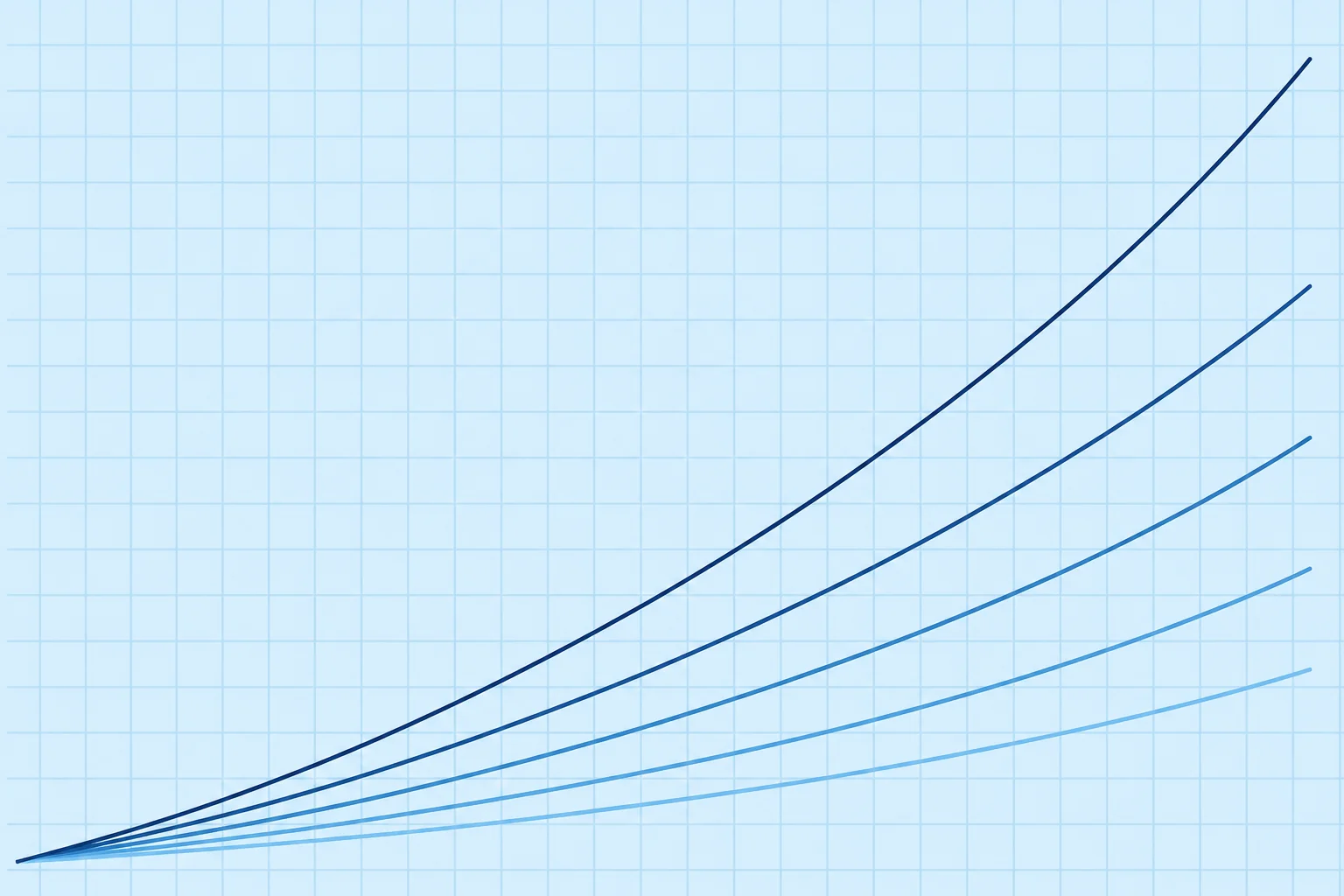
The cross curves give KN for each heel and displacement. Subtract KG × sin θ and you have the GZ curve for this loading condition.
Why KN
The naval architect cannot know your KG in advance. So the booklet gives KN, the righting lever measured from the keel point K, as if G were at K. KN depends on hull form, displacement and heel, and strictly on trim. Curves or tables of KN against displacement, one line per heel angle, are the cross curves of stability (pantocarenas in Spanish).
From KN to GZ
G lies KG above K. When the ship heels θ, the lever lost to the height of G is KG × sin θ. So GZ = KN − KG × sin θ. Use the fluid KG: solid KG plus the free surface correction (FSC), ΣFSM ÷ Δ. Here ΣFSM is the sum of the tanks' free surface moments, in t·m. With the solid KG every GZ comes out too large.
Reading the tables
Enter the cross curves with the condition's displacement and interpolate between rows. Read KN at each tabulated angle, often every 10° from 10° to 60° or more. Some booklets tabulate levers for an assumed KG instead of K. Then GZ = GZ assumed + (KG assumed − KG) × sin θ. Read the booklet's note on its datum.
Plot and check
Plot GZ against heel and draw a smooth curve. Draw its tangent at 0°. Extended to 57.3° (one radian), that tangent should reach the fluid GM. Check the slope at the origin, not the curve’s distance above the line at larger angles.
Trim matters
Cross curves are computed for a stated trim, or with the ship free to trim as she heels. At a large trim the levers can differ. An approved loading computer calculates them for your actual draughts; by hand, use the trim tables the booklet provides.
2Step by step
Worked example: GZ table from the cross curves
- 1
Data: Δ 15,000 t, KM 8.40 m, solid KG 7.70 m, ΣFSM 2,231 t·m.
FSC ≈ 0.15 m; fluid KG = 7.70 + 0.15 = 7.85 m; fluid GM = 0.55 m. Use these rounded values throughout.
- 2
Read KN at 15,000 t: 10° 1.46, 20° 2.92, 30° 4.33, 40° 5.47, 50° 6.31, 60° 6.90 m.
Interpolate between displacement rows where needed.
- 3
Work out 7.85 × sin θ: 1.363, 2.685, 3.925, 5.046, 6.013, 6.798 m.
The same fluid KG at every angle.
- 4
Subtract: GZ = 0.097, 0.235, 0.405, 0.424, 0.297, 0.102 m.
The lever at each heel for this condition.
- 5
Check the start: GM = 8.40 − 7.85 = 0.55 m; 0.55 × sin 10° = 0.096 m.
Close to GZ at 10°, so the table agrees with GM.
- 6
Read off: maximum GZ about 0.42 m near 40°; GZ still positive at 60°.
The curve is now ready for the IS Code checks.
3Key data
- GZ from KN
- GZ = KN − KG × sin θ (fluid KG)
- Fluid KG
- KG fluid = KG solid + ΣFSM ÷ Δ
- Assumed-KG tables
- GZ = GZ assumed + (KG assumed − KG) × sin θ
- Start check
- Tangent at 0° reaches GM at 57.3° (1 rad)
- KN depends on
- Hull form, displacement, heel and trim; not on KG
4Key points
- 1
KN is the lever measured from the keel; it does not depend on your KG.
- 2
GZ = KN − KG × sin θ, with the fluid KG.
- 3
Enter the cross curves with the actual displacement and interpolate.
- 4
Check the start of the curve against GM drawn at 57.3°.
5Frequent mistakes
Wrong: Subtract the solid KG × sin θ from KN.
Right: Use the fluid KG, including ΣFSM ÷ Δ. The solid KG overstates every lever.
Wrong: Subtract KG × cos θ.
Right: The horizontal lever of a height above K at heel θ is KG × sin θ.
Wrong: Use assumed-KG levers as they are.
Right: Correct them by (KG assumed − KG) × sin θ before you plot.
6Practice case & exam keys
The chief officer's GZ table shows 0.48 m at 30°. KN at 30° is 4.33 m, solid KG 7.70 m and ΣFSM 2,231 t·m at Δ 15,000 t. Is the table right?
Show the answer
No. 4.33 − 7.70 × 0.5 = 0.48 m uses solid KG. FSC = 2,231 ÷ 15,000 ≈ 0.15 m, so fluid KG = 7.85 m. GZ = 4.33 − 7.85 × 0.5 = 0.405 m. Recalculate the table with fluid KG before checking the criteria.
Exam keys
- KN = lever from K; GZ = KN − KG sin θ.
- Use KG fluid = KG + ΣFSM ÷ Δ.
- Assumed-KG tables: correct by (KGa − KG) sin θ.
- Check the start: tangent at 0° reaches GM at 57.3°.
Finish this unit
When you've read it, answer three questions. Get all three right to finish the unit; opening the page alone doesn't count.
My notes for this unit
No notes