

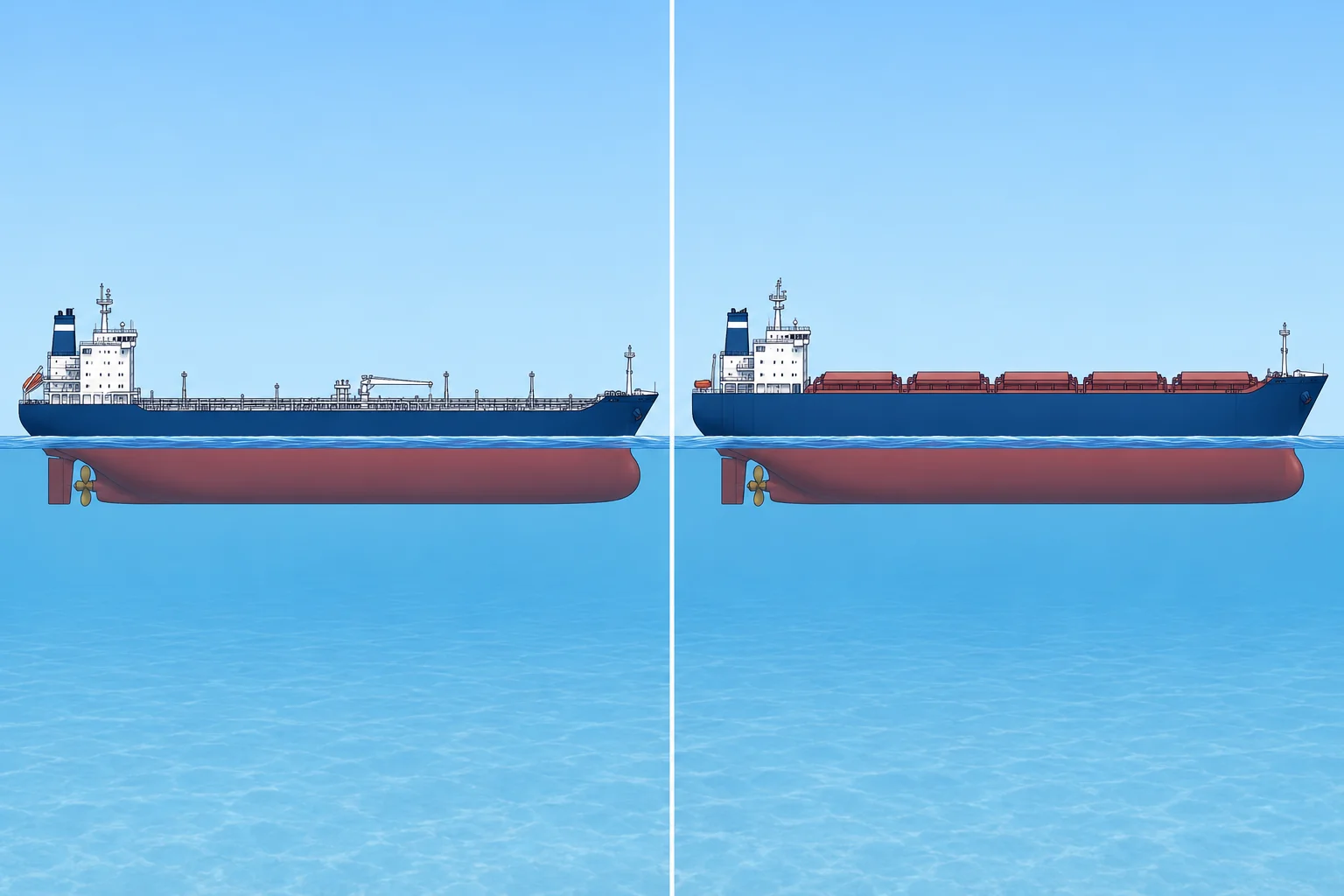
Freeboard, the deck line and ship types A and B
1The lesson in plain words
Freeboard is measured amidships from the deck line down to the load line. Its value depends on the ship’s type, length and form.
Freeboard
Freeboard is the vertical distance amidships from the deck line’s upper edge to the load line’s upper edge. The freeboard deck is normally the uppermost complete deck exposed to weather and sea, with weathertight closures in its exposed part and watertight closures for side openings below it. The deck line is 300 × 25 mm on both sides. Its upper edge normally follows the deck’s upper surface continued to the outside of the shell plating.
Why it matters
Freeboard helps preserve reserve buoyancy, the enclosed watertight volume above the waterline. More freeboard generally delays deck-edge immersion, when the deck edge reaches the water as the ship heels. This helps preserve stability at larger heel angles and keeps the deck drier. Freeboard alone does not prove adequate stability. Check the approved stability information.
Type A and Type B
A Type A ship is designed to carry only liquid cargo in bulk, with small, well-sealed openings and a highly watertight exposed deck. It receives the smaller tabular freeboard. Other ships are Type B. Approved B-60 and B-100 assignments reduce the Type B tabular freeboard by 60% or 100% of the difference between the B and A values, subject to additional requirements. Weaker hatch covers can require increased freeboard.
How it is assigned
The assigning authority, usually a classification society acting for the flag State, starts with a table value for the ship’s length and type. It adjusts this tabular freeboard for hull fullness (block coefficient), depth, enclosed structures above deck (superstructures and trunks), the deck’s rise towards the ends (sheer), and minimum bow height. The result is the summer freeboard; the other seasonal and fresh-water freeboards follow from it.
Freeboard and draught
With the deck line in its usual position, summer draught plus summer freeboard equals the height from the top of the keel to the upper surface of the freeboard deck at the ship’s side. On the bridge you usually work in draughts; freeboard is the same limit seen from the deck down. Measure it by tape from the deck line when a check is needed.
2Key data
- Freeboard
- Deck line upper edge to load line upper edge, amidships
- Deck line
- 300 mm × 25 mm, amidships, both sides
- Type A
- Liquid bulk cargo only, small sealed openings: smaller freeboard
- Type B
- All other ships; B-60/B-100 reductions possible
- Draught + freeboard
- Top of keel to upper surface of freeboard deck at side
3Key points
- 1
Freeboard is measured amidships, from the upper edge of the deck line to the upper edge of the load line.
- 2
The deck line is 300 × 25 mm, its upper edge level with the freeboard deck at the side.
- 3
Type A: tankers, smaller freeboard. Type B: all others; B-60/B-100 may reduce it.
- 4
Summer freeboard comes from tabular freeboard plus corrections; the others follow from it.
- 5
More freeboard generally helps preserve reserve buoyancy and delays deck-edge immersion.
4Frequent mistakes
Wrong: Freeboard is measured from the main deck at the bow.
Right: It is measured amidships, from the upper edge of the deck line to the upper edge of the load line.
Wrong: A bulk carrier is Type A because it carries bulk cargo.
Right: Type A is for ships designed for liquid cargo in bulk only, with small sealed openings. Dry bulk carriers are Type B, often B-60 or B-100.
5Practice case & exam keys
Your bulk carrier has an ordinary Type B assignment. An operator proposes using a smaller freeboard because a similar ship has B-60. Can you accept that proposal?
Show the answer
No. Use your ship’s assigned marks and certificate. B-60 and B-100 are approved reductions for ships meeting additional requirements; similarity to another ship is not approval. Type A is for qualifying liquid-bulk ships, not dry bulk carriers.
Exam keys
- Freeboard: amidships, deck line upper edge to load line upper edge.
- Deck line 300 × 25 mm at the freeboard deck’s upper surface at side.
- Type A = liquid bulk only, smaller freeboard; Type B = others, B-60/B-100 reductions.
Finish this unit
When you've read it, answer three questions. Get all three right to finish the unit; opening the page alone doesn't count.
My notes for this unit
No notes