

Load line zones, seasonal areas and passage planning
1The lesson in plain words
Which mark you load to depends on where the ship is and the date. Plan the voyage so she is never deeper than the mark for the zone she is in.
Zones and seasons
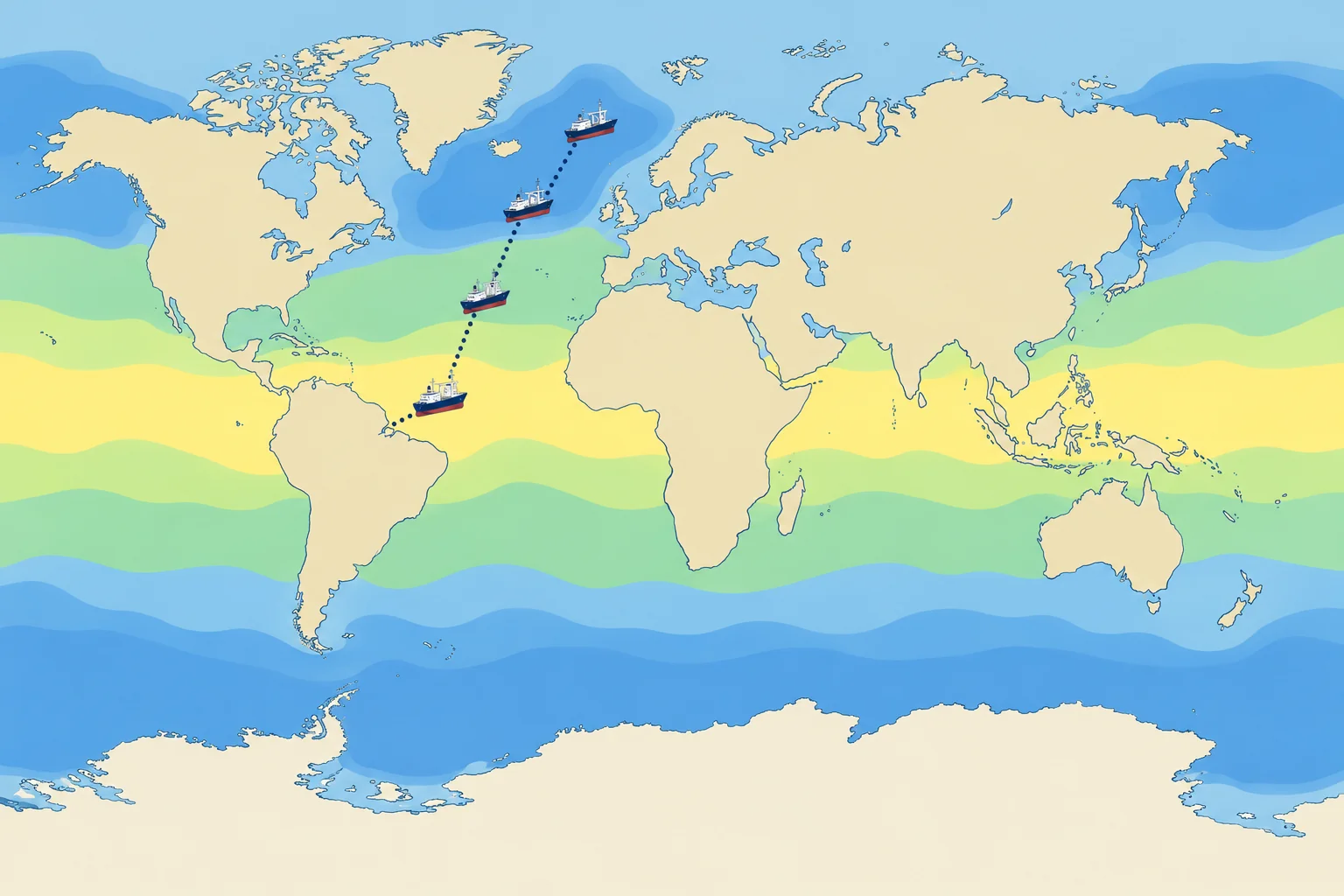
Annex II of the Convention divides the seas into zones and seasonal zones and areas. In a tropical zone you may load to T, in a summer zone to S, and in a seasonal zone to the mark for its current season: for example W in a winter seasonal zone during its winter. The official text defines every boundary by latitude, longitude or coast; the chart of zones shows them.
What they are based on
Boundaries come from weather statistics. A summer zone has no more than 10 % of winds of force 8 or above. A tropical zone has no more than 1 % and few tropical storms. Seasonal zones change with the date: the North Atlantic Winter Seasonal Zone I is winter from 16 October to 15 April and summer from 16 April to 15 October.
Small ships
Ships of 100 m or less get extra protection. They use WNA in the North Atlantic winter area in winter, and some enclosed seas, such as parts of the Mediterranean, have a winter season only for them. Always check the length limit in each area’s rule.
Planning across zones
Check every zone and season you will encounter, including date changes while you remain in one area. For each later limit, add only the consumables you will use before it applies. Your maximum departure displacement is the lowest of those values and the present limit. A less strict zone never permits deeper loading before you cross its boundary. Mark boundaries, season dates and expected crossing dates on your passage plan.
Worked example
At assigned summer draught dS, Δ is 16,500 t; sea-water TPC is 25.3 t/cm. You leave a tropical zone and reach a summer zone after 4 days at 30 t/day. The T limit exceeds 16,620 t; no later limit controls. Departure Δ is 16,500 + 120 = 16,620 t. Extra draught = 120 ÷ 25.3 ≈ 4.74 cm, giving dS + 0.0474 m. For a loading target in whole centimetres, allow at most 4 cm above dS.
2Key data
- Summer zone basis
- ≤ 10 % winds of force 8 or more
- Tropical zone basis
- ≤ 1 % winds of force 8 or more, few tropical storms
- N Atlantic Winter Seasonal Zone I
- Winter 16 Oct – 15 Apr; summer 16 Apr – 15 Oct
- Departure limit (t)
- Lowest of present limit and each later limit + consumption to it
- WNA
- Ships ≤ 100 m, North Atlantic winter area, in winter
3Key points
- 1
Load to the mark for the zone and season the ship is in: T, S or W (WNA for small ships).
- 2
Zones come from wind statistics; seasonal zones change with the date.
- 3
Check every later limit plus consumption to it; the lowest value, including the present limit, controls departure.
- 4
Into a less strict zone: the stricter mark governs until you cross.
- 5
Put zone boundaries and season dates on the passage plan.
4Frequent mistakes
Wrong: We load in a tropical zone, so we load to T.
Right: Check all later limits plus consumption before loading to T. If she enters a summer zone, her draught must not exceed the S draught on entry.
Wrong: The season is fixed for the whole voyage by the departure date.
Right: Seasonal zones change with the date. Use the date you expect to be in each zone.
5Practice case & exam keys
You load in a summer zone on 10 October for a 9-day passage that enters the North Atlantic Winter Seasonal Zone I on 17 October. The chief mate plans to load to S. What do you point out?
Show the answer
On 17 October Zone I is in winter (16 October to 15 April). The W line’s upper edge must be at or above the waterline on entry. Check every later limit plus consumption to it, including Δ at W plus the fuel and fresh water used before the boundary; compare with the present S limit. If she is 100 m or less and enters the WNA area, check WNA instead.
Exam keys
- Mark by zone and season; seasonal zones change by date.
- Check every later limit plus consumption to it; the lowest value, including the present limit, controls departure.
- NA Winter Seasonal Zone I: winter 16 Oct – 15 Apr.
Finish this unit
When you've read it, answer three questions. Get all three right to finish the unit; opening the page alone doesn't count.
My notes for this unit
No notes