

Loading in dock water and the checks before sailing
1The lesson in plain words
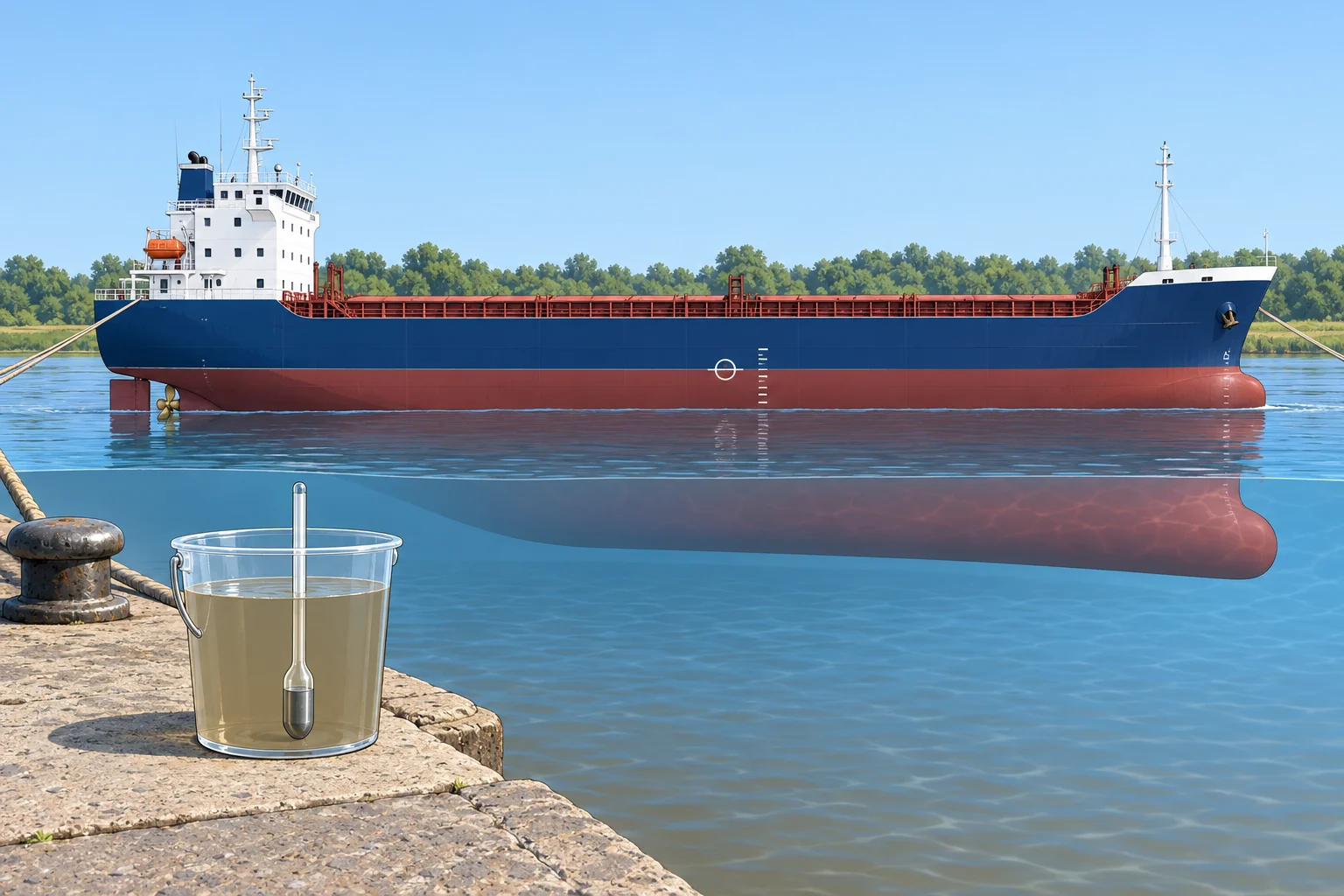
In a river or dock berth the water is lighter, so the ship may sink past her mark by the dock water allowance and rise to it at sea.
The idea
In a river or dock the water is lighter than sea water, so the ship floats deeper. When she reaches the sea she rises. You may load until the mark is submerged by the dock water allowance (DWA), so that she floats at the mark in sea water. DWA = FWA × (1.025 − ρ) ÷ 0.025, with ρ the dock water density in t/m³ (Hydrostatics derives it).
Measuring density
Take water samples at several depths alongside amidships, away from discharges, using a depth-sampling bottle. Transfer them to a clean hydrometer jar. A hydrometer is a floating density gauge; follow its instructions for reading the meniscus (the curved liquid surface). River density changes with tide and rain, so sample again near completion.
River passage
Article 12(3): a ship leaving a port in a river or inland waters may load deeper by the weight of fuel and other consumables used between the berth and the sea. Divide that weight by the dock-water TPC to get the allowance in centimetres. Her applicable load line must not be submerged when she reaches the sea.
Reading the marks
Average both sides to estimate mean amidships draught. A list is a lean to one side. Bring the ship upright for the final compliance check and verify both appropriate load lines against the permitted immersion. Allow for DWA and any river consumption allowance. Read in calm water or average repeated readings. For cargo estimates, dock-water TPC = sea-water TPC × ρ ÷ 1.025.
Timber deck cargo
Use timber lines only if they are assigned and the Convention’s timber conditions of assignment are met. Follow the approved Cargo Securing Manual and applicable flag requirements. The 2011 Timber Deck Cargo (TDC) Code gives guidance on stowage and securing. Timber deck cargo stability belongs to Cargo planning.
2Step by step
Worked example: loading in dock water
- 1
Given: summer Δ 16,500 t, sea-water TPC 25.3 t/cm, dock density 1.010 t/m³. FWA = 16,500 ÷ (4 × 25.3) ≈ 163.043 mm; DWA = FWA × (1.025 − 1.010) ÷ 0.025 ≈ 97.826 mm.
Only 60% of the fresh water allowance applies here. Keep unrounded values until the final cargo estimate.
- 2
Summer mark applies. Allowed dock draught ≈ assigned summer draught dS + 0.0978 m.
At unchanged displacement in sea water she will rise about 97.8 mm to the summer mark.
- 3
Present mean amidships draught dS − 0.050 m, near even keel. Sinkage still allowed ≈ 0.097826 + 0.050 = 0.147826 m = 14.7826 cm.
This is how far the ship may still sink in the dock.
- 4
TPC in dock water = 25.3 × 1.010 ÷ 1.025 ≈ 24.930 t/cm.
Lighter water gives fewer tonnes per centimetre.
- 5
Cargo still to load ≈ 14.7826 × 24.9298 ≈ 368.53 t, about 369 t. Treat TPC as constant over this small change.
Sinkage times TPC gives the weight.
- 6
Recheck density and both load lines with the ship upright; stop at dS + 0.0978 m in this example.
Density may change during loading; recheck while you can still correct the load.
3Key points
- 1
DWA = FWA × (1.025 − ρ) ÷ 0.025; load until the mark is submerged by the DWA.
- 2
Sample dock water from several depths at the ship’s side; resample near completion.
- 3
River allowance (cm) = consumables used from berth to sea (t) ÷ dock TPC (t/cm).
- 4
Average readings estimate mean draught; make the final load-line check upright, on both sides.
- 5
Timber lines require assigned timber freeboards and compliance with the Convention’s timber conditions.
4Frequent mistakes
Wrong: Use the full FWA in any dock water.
Right: The full FWA is for fresh water of 1.000 t/m³. In brackish water use the DWA, a proportion of the FWA.
Wrong: Use the sea-water TPC to find the cargo still to load.
Right: In dock water use sea-water TPC × ρ ÷ 1.025. With sea-water TPC the example gives about 374 t instead of 369 t.
Wrong: Read one side only; the other is hard to reach.
Right: Average both sides for mean-draught estimates. A list can hide an immersed mark; bring the ship upright and check both load lines for final compliance.
5Practice case & exam keys
In the worked example the agent says density on the morning sample was 1.000 t/m³ after heavy rain, so you can use the full FWA. Your own sample alongside, from three depths, reads 1.010 t/m³. What do you load to?
Show the answer
Use your representative sample: 1.010 t/m³ gives DWA ≈ 97.8 mm. With the ship upright, stop at dS + 0.0978 m and check both load lines. Using the full 163 mm would allow dS + 0.163 m and leave about 6.5 cm excess immersion at sea. Sample again near completion and record the density in the log book.
Exam keys
- DWA = FWA × (1.025 − ρ) ÷ 0.025.
- River allowance (cm) = river consumables (t) ÷ dock TPC (t/cm); add allowances to mark draught using matching units.
- Dock TPC = TPC × ρ ÷ 1.025; cargo = sinkage (cm) × dock TPC.
Finish this unit
When you've read it, answer three questions. Get all three right to finish the unit; opening the page alone doesn't count.
My notes for this unit
No notes