

Ballast operations and the BWM Convention
1The lesson in plain words
Ballast gives a light ship draught, trim and stability. Moving it changes stability and hull stress, and discharging it is controlled by the BWM Convention.
Why ballast
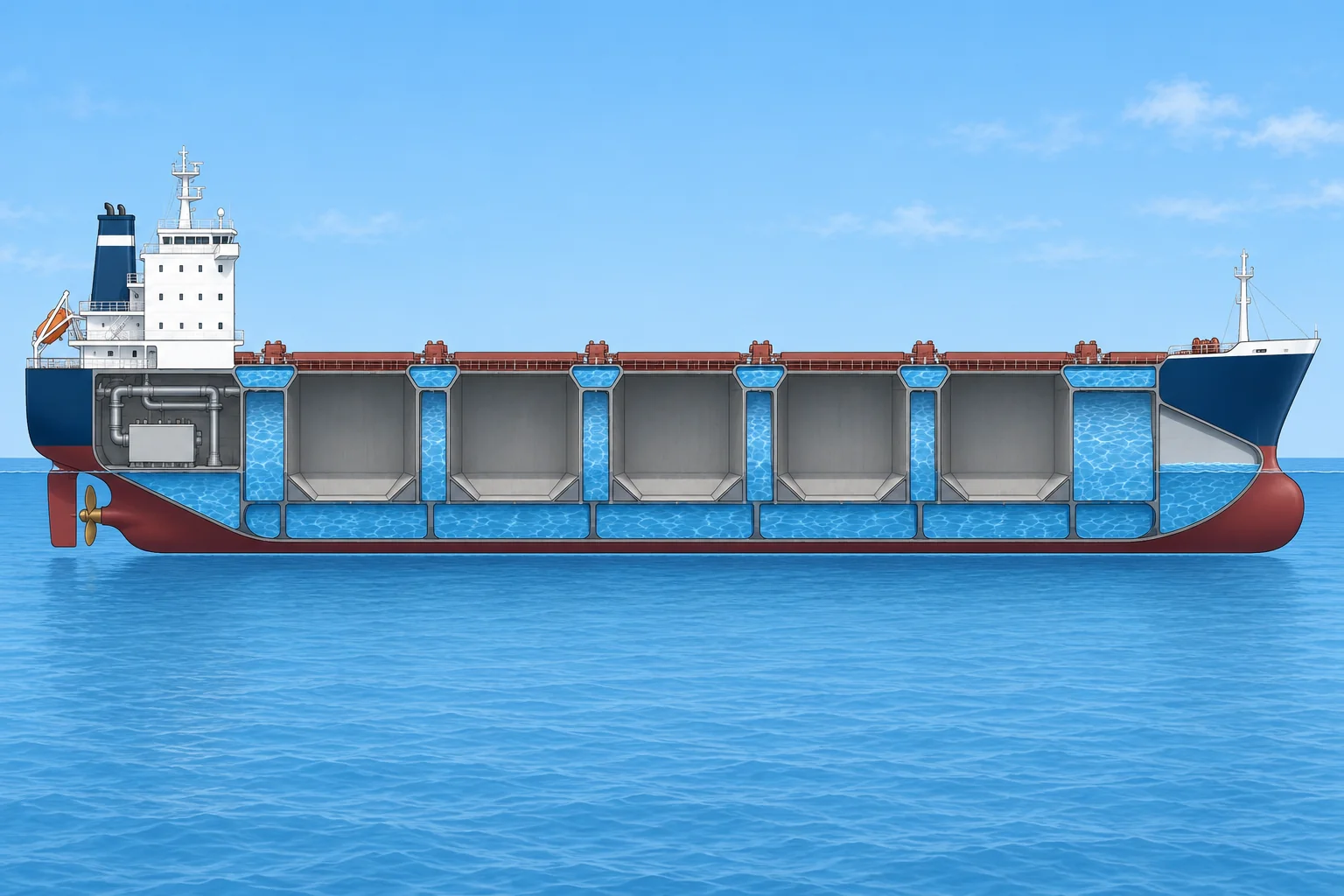
Ballast water in double-bottom, wing, peak and topside tanks gives a light ship enough draught to immerse the propeller and rudder, a safe trim, a clear view ahead and adequate stability. Ballast below the ship’s existing centre of gravity lowers KG; ballast above it raises KG. Some bulk carriers have a ballast hold for heavy weather. Every operation follows the ship’s ballast plan.
Free surface while ballasting
A tank that is filling or emptying is slack: it has a free surface that reduces effective GM (Trim, list and free surface gives the calculation). Work as few slack tanks at once as you can, and port and starboard pairs together so the ship stays upright. Check GM at the worst moment of the operation, not only at the start and finish. Wide slack tanks can cause large free-surface losses; use the booklet’s values.
Strength while ballasting
Ballast changes the shear forces and bending moments along the hull as much as cargo does. During cargo work, ballast must keep pace with the loading or discharge rate. Pump only in the planned order and at the planned rate, and keep the loading instrument updated with actual soundings, the measured depths of liquid in tanks.
The BWM Convention
Ballast carries organisms between ports. The IMO Ballast Water Management (BWM) Convention requires an approved plan and record book; international certification normally applies from 400 GT. D-2 sets discharge limits, normally met using an approved treatment system. Its final phase-in deadline was 8 September 2024; Convention exceptions, exemptions and approved alternatives still apply. D-1 exchange is now mainly a contingency, subject to port-State acceptance. Organism sizes use micrometres (µm); microbe limits use cfu, colony-forming units.
Exchange and stability
D-1 requires at least 95% volumetric exchange; pumping through three tank volumes is accepted. Under B-4, exchange ≥200 nautical miles (nm) from nearest land in water ≥200 m deep; otherwise, as far away as possible, ≥50 nm and ≥200 m, or in a designated area. You need not deviate or delay your voyage. Sequential exchange empties and refills tanks: check stability, draught, trim and strength throughout. Follow the approved sequence. Omit unsafe exchange; record why and notify authorities. Flow-through keeps tanks full but risks overpressure.
2Key data
- D-2: viable organisms
- ≥50 µm: <10/m³; 10–<50 µm: <10/mL (viable)
- D-2: toxigenic V. cholerae O1/O139
- <1 cfu/100 mL or <1 cfu/g wet zooplankton
- D-2: indicator microbes
- E. coli < 250 cfu/100 mL; enterococci < 100 cfu/100 mL
- D-1 exchange
- 95 % by volume, or 3 × tank volume pumped through
- Where to exchange (B-4)
- ≥200 nm/≥200 m; otherwise ≥50 nm/≥200 m, or designated area
- Final D-2 phase-in deadline
- 8 September 2024; applicable exceptions and exemptions remain
3Key points
- 1
Ballast gives draught, trim, propeller immersion, a clear view ahead and stability to a light ship.
- 2
Every slack tank cuts effective GM: work few tanks at once, in port and starboard pairs.
- 3
Ballast changes shear forces and bending moments; keep pace with cargo and follow the plan.
- 4
BWM: approved plan and record book; D-2 discharge limits normally met by treatment. D-1 contingencies need port-State acceptance.
- 5
Exchange: normally ≥200 nm/≥200 m; fallback ≥50 nm/≥200 m or designated area. Every stage must be safe; omit unsafe exchange.
4Frequent mistakes
Wrong: Open all the double-bottom tanks at once to finish deballasting faster.
Right: Many slack tanks together add their free surface moments. Work a few tanks at a time, in pairs, and check GM at the worst stage.
Wrong: The treatment system has failed, so we exchange the ballast tank by tank on the way.
Right: Report the failure and agree an accepted contingency before discharge. Exchange needs port-State acceptance and safe conditions at every stage; it is not automatic permission to discharge.
Wrong: Ballast is only water; the stress calculation is about cargo.
Right: Ballast is weight like cargo. A wrong ballast sequence can overstress the hull as easily as a wrong loading sequence.
5Practice case & exam keys
During cargo loading, deballasting falls behind the planned rate. The terminal wants to continue. Actual tank soundings differ from the loading instrument. What do you do?
Show the answer
Tell the chief mate and arrange to slow or stop loading. Update the instrument with actual soundings and check the present and next stages. Resume only at a rate and sequence that keep draught, stability and hull stresses within limits.
Exam keys
- Slack tanks reduce effective GM; work few at once, in pairs.
- D-2: viable ≥50 µm <10/m³; 10–<50 µm <10/mL. Final phase-in: 8 Sep 2024 for ships subject to it; exceptions and exemptions apply.
- D-1: 95% exchange; 3 volumes pumped through accepted. B-4: normally ≥200 nm/≥200 m; fallback ≥50 nm/≥200 m or designated area. Omit unsafe exchange, record why and notify the relevant authority.
Finish this unit
When you've read it, answer three questions. Get all three right to finish the unit; opening the page alone doesn't count.
My notes for this unit
No notes