

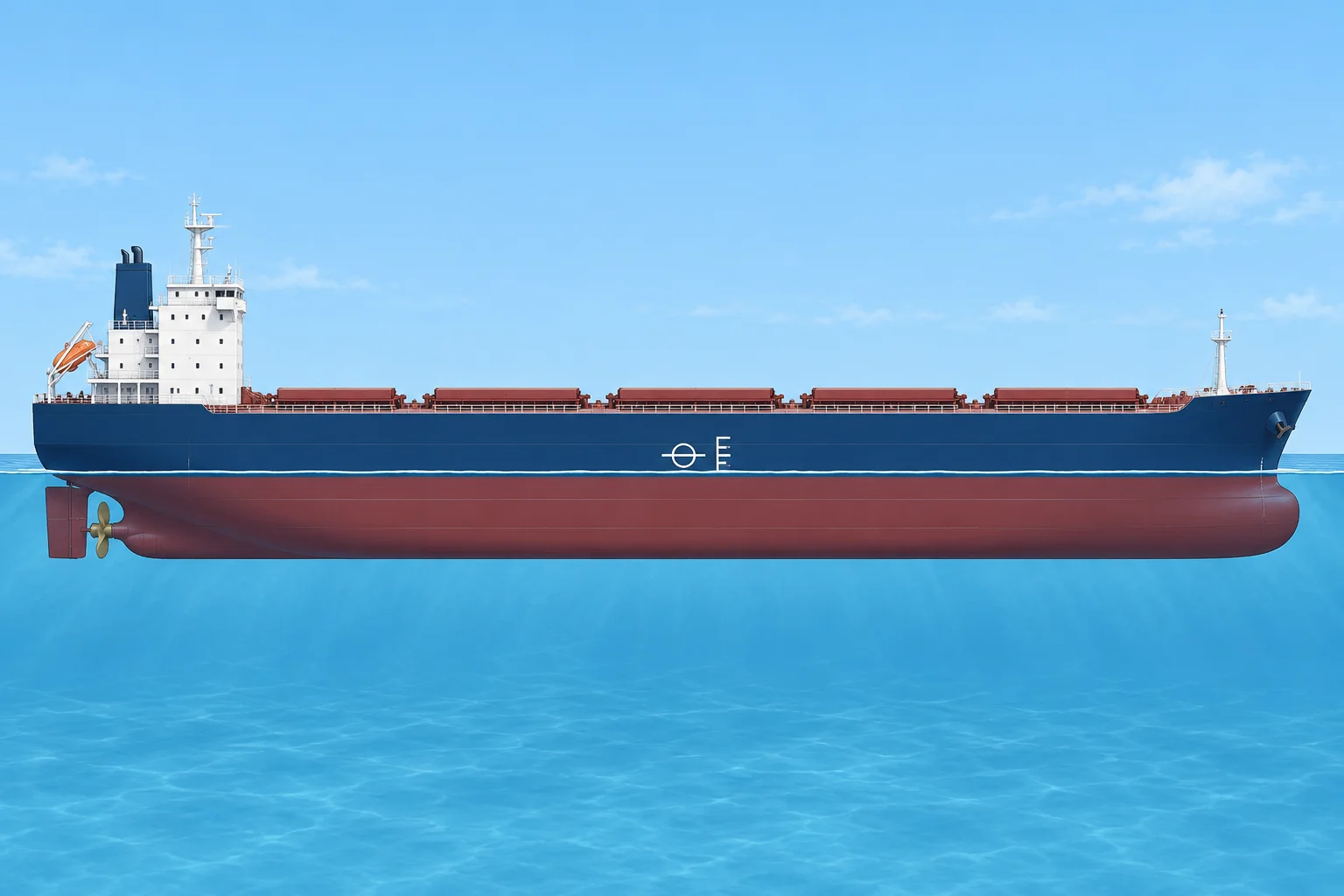
Deadweight: how much cargo can you load?
1The lesson in plain words
Cargo = allowed displacement − lightship − all non-cargo deadweight. Check load line, voyage limits, volume, stability and strength.
The terms
Displacement (Δ) is the ship’s total mass in tonnes. Lightship is the empty ship with machinery and system liquids, as approved in the stability booklet. Deadweight (DWT) is everything else: cargo, fuel, fresh water, ballast, stores, crew, personal effects and the constant. The constant is residual weight left after subtracting approved lightship and all separately accounted weights from surveyed displacement. It can include unrecorded sediment or extra gear. Use the latest verified value from a cargo-free draught survey.
What limits displacement
The load line for the zone and season limits displacement (see Load lines). Port or canal depth, berth limits, hull strength and stability may impose a lower maximum. Use the lowest applicable maximum. Check air draught, the height above water, separately: floating deeper usually reduces it. Bridge clearance may require a minimum draught, so the lightest passage condition may be critical. Meet every limit throughout the voyage.
Zones on passage
If the ship will enter a stricter zone, say from a summer zone into a winter seasonal zone in winter, the winter load line’s upper edge must not be submerged when she enters. The fuel burnt and water used before then may be loaded as extra. Allowed departure displacement is the smaller of: Δ at the departure zone’s mark, or Δ at the stricter mark plus the consumption until that zone.
Bunkers and ballast
Fuel, water, ballast, stores, crew, personal effects and the constant are non-cargo deadweight. Take the fuel, water and stores the voyage needs plus the reserve your company requires; at the load-line limit, each extra tonne replaces a tonne of cargo. Sail with as little ballast as stability, trim, propeller immersion and the view ahead allow.
Three limits
Cargo by weight = allowed displacement − lightship − all non-cargo deadweight. Then check volume: do the holds take it at the cargo’s stowage factor? Check final stability and strength on the loading instrument too. The smallest of these limits is the cargo you can take.
2Step by step
Worked example: cargo limited by a winter zone
- 1
Use the supplied permissible displacements: summer 16,500 t; winter 16,048 t. Lightship is 4,500 t.
Take permissible displacements from the ship’s approved information.
- 2
Add consumption before the winter zone: 6 days × 36 t/day fuel and water = 216 t. 16,048 + 216 = 16,264 t.
That weight will be gone when she crosses into the winter zone.
- 3
Compare with Δ at S, 16,500 t. Take the smaller: 16,264 t.
Both marks must be respected; the stricter result governs.
- 4
Subtract lightship 4,500 t; fuel 1,150 t; water 210 t; stores, crew and personal effects 40 t; retained ballast 0 t; constant 180 t. Total 6,080 t. Cargo = 16,264 − 6,080 = 10,184 t.
Everything aboard that is not cargo comes off the allowed displacement.
- 5
Check that 10,184 t fits by volume and that stability and strength pass for departure and arrival.
Weight is only one of the three limits.
3Key data
- Deadweight
- DWT = Δ − lightship
- Departure Δ, stricter zone ahead
- Smaller of Δ at mark, or stricter mark Δ + consumption
- Cargo by weight
- Allowed Δ − lightship − all non-cargo deadweight
- Constant
- Residual weight after lightship and all known weights are deducted
4Key points
- 1
Deadweight = displacement − lightship; subtract all non-cargo deadweight to find cargo by weight.
- 2
Use the lowest displacement ceiling; check bridge clearance separately at the lightest passage condition.
- 3
At entry to a stricter zone, its load line must not be submerged; allow only consumption before entry.
- 4
At the load-line limit, each extra tonne of fuel or ballast replaces a tonne of cargo. Keep required reserves.
- 5
Cargo = the smallest of the weight, volume and stability/strength limits.
5Frequent mistakes
Wrong: We depart in a summer zone, so we load to the summer mark.
Right: If the voyage enters a stricter zone, the limit is that zone’s mark plus the consumption before you reach it, when that is less.
Wrong: The constant is zero; the booklet’s lightship is exact.
Right: Use the verified constant from the latest cargo-free draught survey: residual weight after lightship and all known weights are deducted. Otherwise your cargo figure may be too high.
Wrong: If the deadweight allows it, the cargo fits.
Right: Check volume by stowage factor and the final stability and strength too. The smallest limit is the cargo.
6Practice case & exam keys
Your ship departs a summer zone and enters a winter seasonal zone in winter after 6 days, using 36 t of fuel and water a day. The charterer wants 10,420 t: the cargo weight allowed at the summer mark. The worked example gives 10,184 t. What do you tell the master?
Show the answer
With the stated non-cargo weights, the weight ceiling is 10,184 t, subject to volume, stability and strength checks. Loading 10,420 t with those weights would exceed the winter limit by 236 t at entry. Reduce cargo, or recalculate with fewer bunkers only if voyage needs and reserves still pass. The master decides and informs the charterer.
Exam keys
- DWT = Δ − lightship; constant = residual weight after approved lightship and all separately accounted weights are deducted.
- Stricter zone ahead: departure Δ ≤ Δ at that mark + consumption before it, and ≤ Δ at the departure mark.
- Cargo is the smallest of the weight, volume and stability/strength limits.
Finish this unit
When you've read it, answer three questions. Get all three right to finish the unit; opening the page alone doesn't count.
My notes for this unit
No notes