

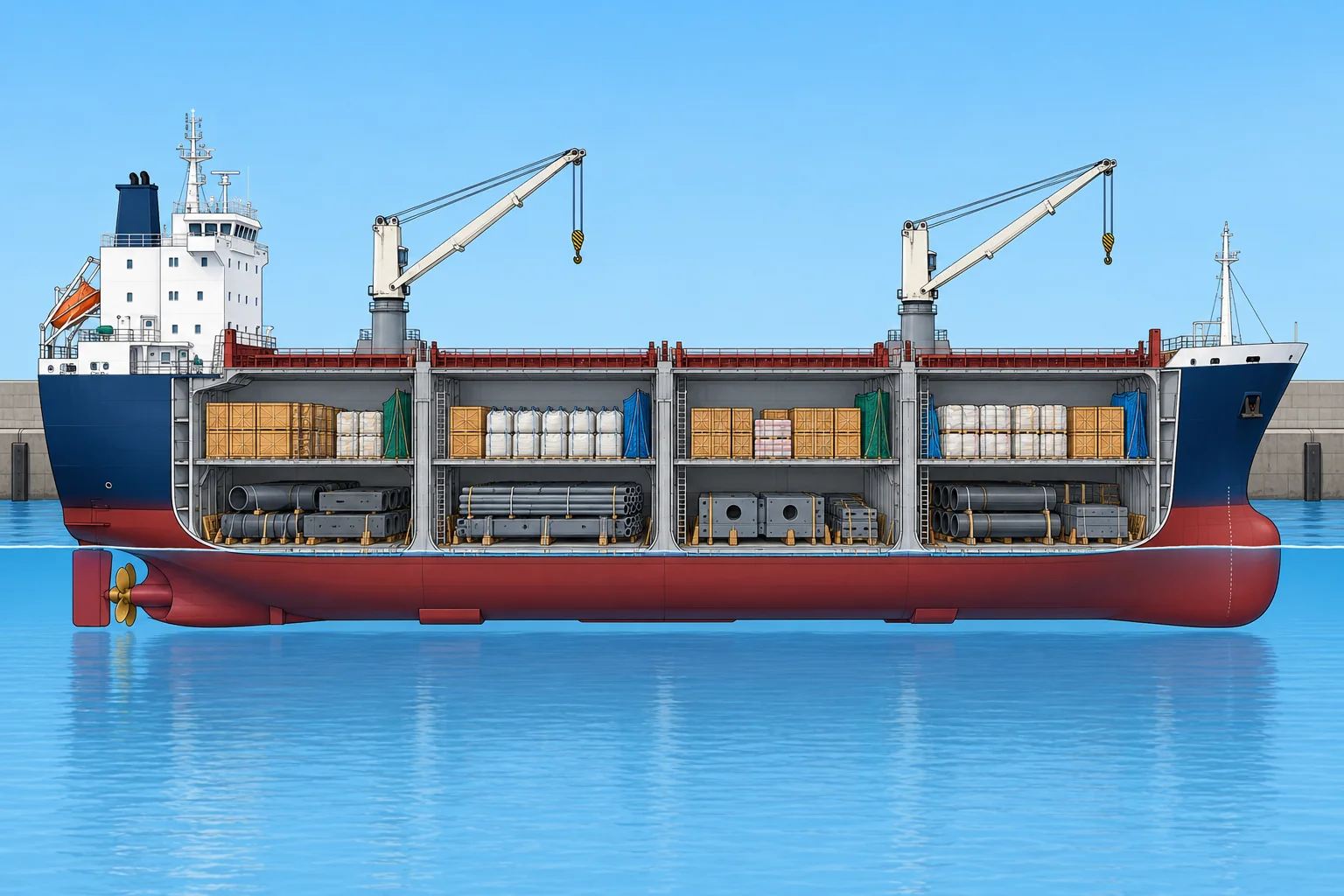
The stowage plan: where each cargo goes and why
1The lesson in plain words
A stowage plan shows where every cargo lot sits aboard. A good plan keeps the ship safe, the cargo sound and each port’s cargo easy to reach.
What the plan shows
The stowage plan, or cargo plan, is a drawing of the holds and decks showing every lot: port of loading and discharge, weight, quantity and position. On a container ship, a bay plan locates each slot by bay (along the ship), row (across it) and tier (height). On general cargo and bulk ships it is often a hold plan, a profile and a plan view of each hold. The chief mate prepares it; on cargo watch you load to it.
Port rotation
The port rotation is the order of the ports. Where compatibility and safety limits allow, stow cargo for the last port first and deepest, and cargo for the first port on top or nearest the hatch. Avoid overstowing: cargo for a later port sitting on top of cargo for an earlier one. Then you must restow, move cargo to reach what lies below, which costs time and money and can upset stability and hull stresses mid-voyage.
Weight and stability
Heavy cargo low keeps KG, the height of the centre of gravity above the keel, low. Too much GM, the metacentric height that measures initial stability, makes a stiff ship: quick, violent rolls that strain lashings. Small positive GM makes a tender ship: slow rolls and weak initial righting. Distribute weight along the ship for suitable trim, the difference between forward and aft draughts, and hull stresses within the loading manual’s limits. Balance port and starboard weights to avoid list, a sideways lean.
Separation and space
Keep cargoes that harm each other apart: wet from dry, smelly from food, dusty from clean. Separation of lots of the same cargo, by nets, sheets or paint marks, stops them mixing at discharge. Dangerous goods follow the IMDG Code segregation rules (see Cargo securing). The stowage factor is the volume one tonne of cargo needs, in m³/t; it tells you whether a hold fills by weight or by volume first.
Planning order
Work in this order: what the ship may carry (load line, deadweight), what the cargo needs (compatibility, segregation, access, port rotation), then stability and strength. Run the plan on the loading instrument before loading starts and again for every change. Keep the final plan on the bridge: it is your reference for checks during the voyage and for the next port.
2Key data
- Stowage factor (SF)
- Volume per tonne of cargo, m³/t
- Tonnes a space takes by volume
- Space volume ÷ stowage factor
- Example
- 6,000 m³ hold, SF 1.5 m³/t → 4,000 t, if weight limits allow
- Last port’s cargo
- Normally lowest, where compatibility and safety limits allow
- Bay plan
- Bay, row and tier of every container
3Key points
- 1
The stowage plan shows every lot’s port, weight and position; you load to it on cargo watch.
- 2
Plan discharge access; last-port cargo normally goes deepest, subject to compatibility, stability and strength.
- 3
Too much GM gives quick, violent rolls; too little gives slow rolls and weak initial righting.
- 4
Keep incompatible cargoes apart and separate lots of the same cargo.
- 5
Check the plan on the loading instrument before loading and after every change.
4Frequent mistakes
Wrong: Put all the heaviest cargo in the bottom of the holds; the more GM the better.
Right: Too much GM gives violent rolling that breaks lashings and damages cargo. Aim for the GM the booklet and the voyage need, not the maximum.
Wrong: Load whatever arrives first into the nearest empty hold.
Right: Follow the plan and the port rotation. Random loading leads to overstowed cargo, restows and unplanned stresses.
5Practice case & exam keys
Loading is under way when the terminal offers 300 t of cargo for the first discharge port, ready now. The only free space is the bottom of No. 2 hold, under cargo still to come for the last port. What do you do?
Show the answer
Do not load it there without the chief mate’s decision: it would be overstowed and need a restow at the first port. Report it. The chief mate can rearrange the plan, for example by holding the cargo until a suitable space is free or using another hold, and must recheck stability and stresses on the loading instrument for the new plan.
Exam keys
- Stowage plan: port, weight, quantity and position of every lot; bay plan for containers.
- Port rotation: last-port cargo normally goes first and deepest; overstowing forces a restow.
- Space by volume = volume ÷ stowage factor; the smaller of weight and volume limits governs.
Finish this unit
When you've read it, answer three questions. Get all three right to finish the unit; opening the page alone doesn't count.
My notes for this unit
No notes