

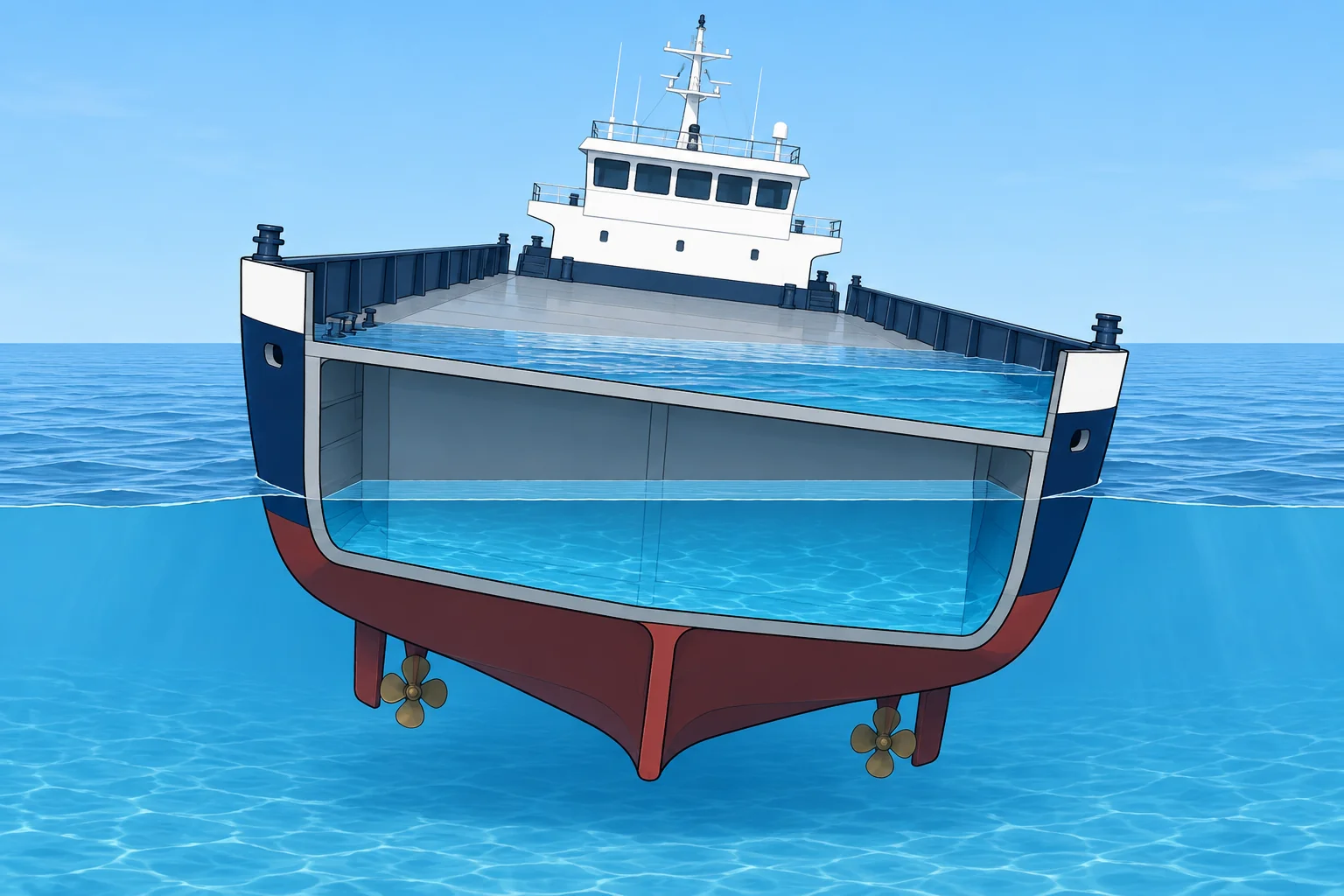
Free surface on a small ship: tanks, fish holds and water on deck
1The lesson in plain words
Slack liquid acts like a rise of G. On a small ship one wide slack tank or a flooded deck can take away much of the GM.
Recall
Liquid that can move in a part-filled space flows to the low side when she heels. The effect is a virtual rise of G, the free surface correction (FSC). Solid GM is GM before this correction. Fluid GM = solid GM − FSC. For a rectangular tank with vertical sides at small heel, the free surface moment (FSM) depends on breadth cubed, not liquid depth, while the surface spans its full breadth. For shaped tanks, use the tank tables.
The numbers
Tank tables give each tank's FSM in t·m. Add them and divide by displacement: FSC = ΣFSM ÷ Δ. For a full-width rectangular surface at small heel, FSM = l × b³ ÷ 12 × ρ, with length l and breadth b in metres and density ρ in t/m³. On a ship of a few hundred tonnes one wide tank can cost tens of centimetres.
Where it hides
Slack tanks: fuel and fresh water in use, ballast being changed. Fish holds and tanks: catch in bulk, refrigerated sea water, melting ice. Water on deck in a well, or in a hold or engine room after a leak or firefighting. None of the last group is in any table, so treat them seriously.
Keeping it small
Keep tanks pressed up, completely full, or empty. Follow the booklet's filling and transfer sequence, limiting both slack tanks and list. Keep portable divisions, boards that split a fish hold, in place so catch cannot shift. Fish boards restrain catch; they do not isolate liquid unless liquid-tight. Pump bilges and clear deck water early. Never let several wide tanks go slack together when GM is small.
Firefighting water
Hose water can collect in holds and on decks. Its free surface reduces stability; water trapped high up also raises G. Arrange safe drainage or pumping while fighting the fire, and monitor heel and freeboard.
2Step by step
Worked example: small-angle deck-water estimate
- 1
Data: After adding the deck water and allowing for its height, Δ is 800 t and solid GM is 0.60 m. Model the water surface as a 10 m × 6 m rectangle (ρ 1.025 t/m³).
Small-angle estimate while water spans the full breadth.
- 2
FSM = 10 × 6³ ÷ 12 × 1.025 = 184.5 t·m.
Breadth cubed: 216.
- 3
FSC = 184.5 ÷ 800 = 0.23 m.
The water's added-weight effect is already included; FSC accounts for its movement.
- 4
Fluid GM ≈ 0.60 − 0.23 = 0.37 m: more than a third of the solid GM lost to free surface.
An estimate at small heel while water spans the full breadth.
- 5
With a liquid-tight centreline division: FSM = 2 × 10 × 3³ ÷ 12 × 1.025 = 46.1 t·m; FSC 0.06 m.
Two isolated lengthwise halves give one quarter of the original rectangular FSM.
3Key data
- Free surface correction
- FSC = ΣFSM ÷ Δ (m)
- Rectangular surface, small heel
- FSM = l × b³ ÷ 12 × ρ (t·m)
- Fluid GM
- Solid GM − FSC
- Two isolated lengthwise halves
- Rectangular FSM ÷ 4 (liquid-tight division)
4Key points
- 1
Free surface is a virtual rise of G: FSC = ΣFSM ÷ Δ.
- 2
Rectangular free surfaces at small heel: breadth cubed matters while the full breadth stays covered.
- 3
Follow the booklet's tank sequence; limit free surface and avoid an excessive list.
- 4
Fish holds need their divisions; deck and firefighting water must go overboard early.
5Frequent mistakes
Wrong: A nearly empty tank has hardly any free surface.
Right: A nearly empty tank can still have a large FSM. A shallow layer may span its full breadth. Use the tank tables; surface shape and filling level matter.
Wrong: Water on deck drains by itself, so ignore it.
Right: Water trapped in a well adds weight high up and a wide free surface. Clear the freeing ports, and reduce speed or alter course.
6Practice case & exam keys
Your 35 m ship has GM 0.45 m. At sea you plan to fill two empty double-bottom wing tanks and change the fresh water in a wide centre tank, all at the same time.
Show the answer
Check the booklet's sequence and stability at each stage before starting. Keep the wide fresh-water tank out of the operation until ballasting is complete. Use the approved sequence for the wing tanks so you limit free surface without creating an excessive list. Recheck fluid GM and freeboard before changing the centre tank.
Exam keys
- FSC = ΣFSM ÷ Δ; GM fluid = GM solid − FSC.
- At small heel, full-width rectangular FSM depends on breadth cubed; use tank tables for actual geometry and filling level.
- A liquid-tight lengthwise division into two equal halves reduces rectangular FSM to one quarter at small heel.
Finish this unit
When you've read it, answer three questions. Get all three right to finish the unit; opening the page alone doesn't count.
My notes for this unit
No notes