

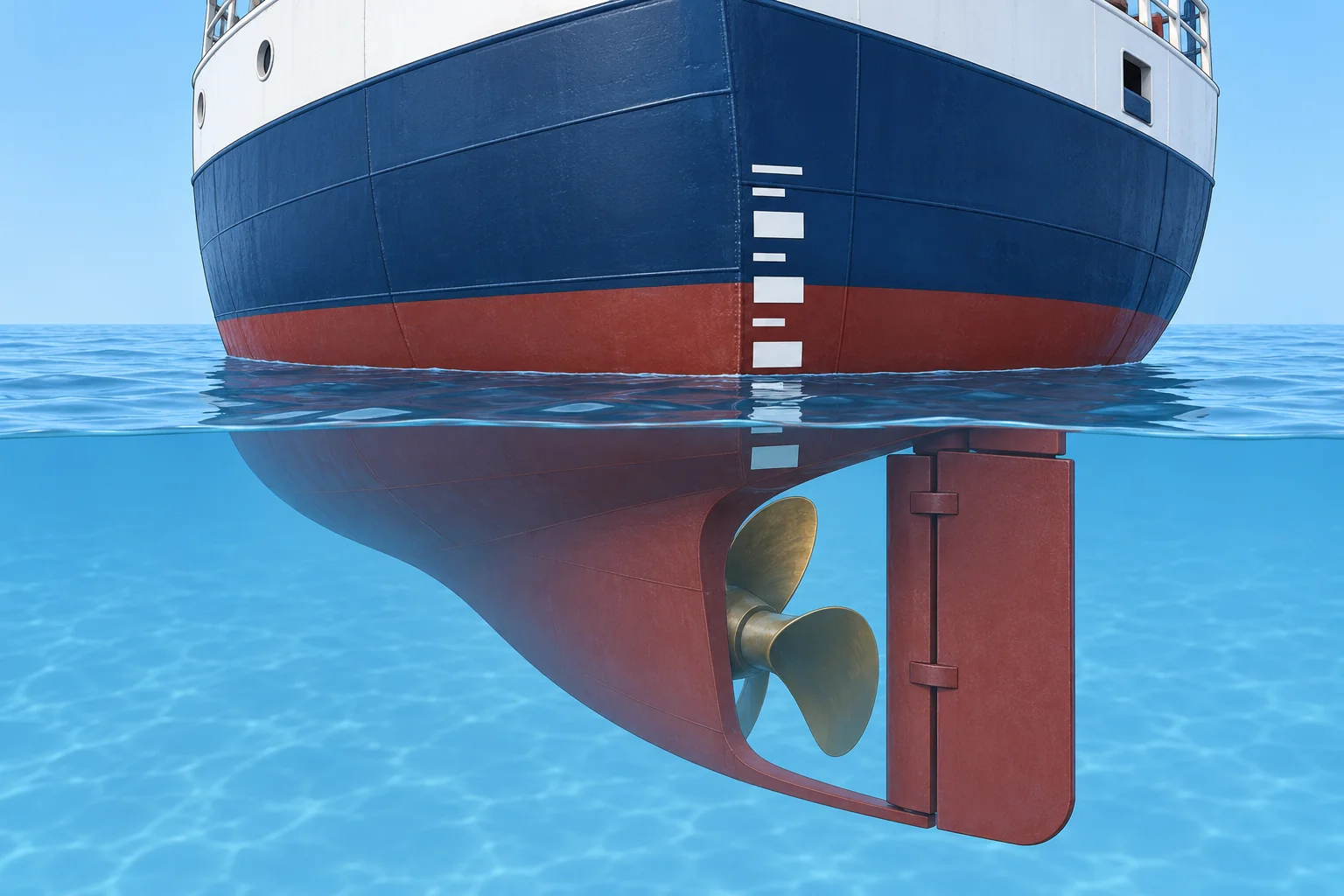
Trim and draughts on a small ship
1The lesson in plain words
Read your draughts and check trim before sailing. Stay within the permitted draught, using only the certified fresh/dock-water allowance where applicable.
Reading the marks
Draught marks at bow, stern and often amidships show how deep the ship's keel, or her lowest reference point, lies below the waterline. Metric figures are 10 cm high and the bottom of each figure is its draught. Read both sides and average them if she lists; in a swell, average several readings. Freeboard is measured from the deck line down to the water.
Trim
Trim is the draught aft minus the draught forward. Most small ships handle best slightly by the stern: propeller and rudder are deep and the bow lifts to the sea. Excessive trim by the head can make her wet forward and harder to steer, increasing the risk of broaching, swinging beam-on to the waves, in following seas. Keep trim within the booklet's limits.
How loading trims her
The centre of flotation (LCF) is the point she trims about. MCTC is the moment needed to change trim by 1 cm, in t·m/cm. Change of trim (cm) = w × d ÷ MCTC. Here w is weight in tonnes. For a transfer, d is the distance moved fore and aft. For weight added or removed, d is its distance from the LCF. Use metres. Adding weight also changes mean draught. The Trim unit covers the full calculation.
Catch, fuel and ice
On many fishing vessels the fish hold lies forward of the engine room, so she trims by the head as the hold fills. Fuel used from aft tanks does the same. Ice builds up forward first, where spray hits. Plan the order of filling holds and using tanks so the trim stays within the booklet's limits.
Freeboard and the load line
The load line marks the permitted loading level. Check the applicable load line on both sides. Do not exceed the permitted draught or go below the required freeboard; use only the certified fresh/dock-water allowance where applicable. Fresh or brackish water makes her float deeper. Check your certificate and booklet before sailing.
2Step by step
Worked example: moving catch aft
- 1
Data: MCTC 9 t·m/cm. 10 t of boxed fish moves 20 m aft, from the forward hold to the after hold.
Use the booklet's MCTC at your draught.
- 2
Trimming moment = 10 × 20 = 200 t·m by the stern.
Weight times distance moved.
- 3
Change of trim = 200 ÷ 9 = 22 cm by the stern.
This is the change in the difference between aft and forward draughts; recheck the actual marks.
3Key data
- Trim
- Draught aft − draught forward
- Change of trim (cm)
- w × d ÷ MCTC
- Metric figures
- 10 cm high; bottom of the figure = draught
- Best trim
- Usually slightly by the stern: check the booklet
4Key points
- 1
Read draughts on both sides, fore, aft and amidships, before sailing.
- 2
Trim = aft − forward; slightly by the stern is usually best.
- 3
Change of trim (cm) = w × d ÷ MCTC.
- 4
Stay within permitted draught and freeboard limits; use only the certified fresh/dock-water allowance where applicable.
5Frequent mistakes
Wrong: Trim by the head is harmless while the draughts are within limits.
Right: Excessive head trim can impair steering and increase broaching risk. Keep trim within the booklet's limits and assess the following-sea passage.
Wrong: Reading one side is enough.
Right: With a list one side reads deeper. Read both and average them.
6Practice case & exam keys
After a good trip your 24 m trawler sits 0.40 m by the head. Fuel has come from the aft tanks. A following sea is forecast for the run home.
Show the answer
Check the booklet before correcting the head trim. Prefer a permitted transfer or shift aft; for a shift, use the distance moved in w × d ÷ MCTC. If adding aft ballast, use its distance from the LCF and check the added draught, freeboard and free surface. Follow the approved tank sequence, then reassess trim, stability and the following-sea passage.
Exam keys
- Trim = draught aft − draught forward.
- Change of trim (cm) = w × d ÷ MCTC. For a shift, d is distance moved; for added or removed weight, distance from LCF.
- Check draughts and freeboard amidships on both sides before sailing.
Finish this unit
When you've read it, answer three questions. Get all three right to finish the unit; opening the page alone doesn't count.
My notes for this unit
No notes