

Loading a small ship: deck cargo, gear and ice
1The lesson in plain words
On a small ship a few tonnes high up matter. Keep heavy weights low, secure them, keep freeing ports clear and allow for ice.
Why small ships are sensitive
Loading a weight w at a height Kg above the keel moves G towards it: new KG = (Δ × KG + w × Kg) ÷ (Δ + w), where Δ is displacement. When Δ is a few hundred tonnes, a few tonnes of deck cargo, a full net drum or a loaded crane can use up much of the GM. On a large ship the same weight hardly shows.
Deck cargo and gear
Stow heavy items low and on the centreline; put light, bulky ones on deck. Secure everything: cargo that slides across moves G sideways and gives a list just when you need full stability. Respect the structural deck load limit in t/m². Separately check the total deck-cargo weight and height against the approved stability limits.
Lifting and hauling
A load hanging freely from a crane or derrick acts at the point of suspension. Gear resting on a net drum acts at its own centre of gravity; fishing-gear tension acts where the line leaves the ship. Keep that point low, deal with slack tanks before lifting, and know where the load will land. A trawl snagged on the seabed can heel a small ship dangerously: keep the release gear working.
Water on deck
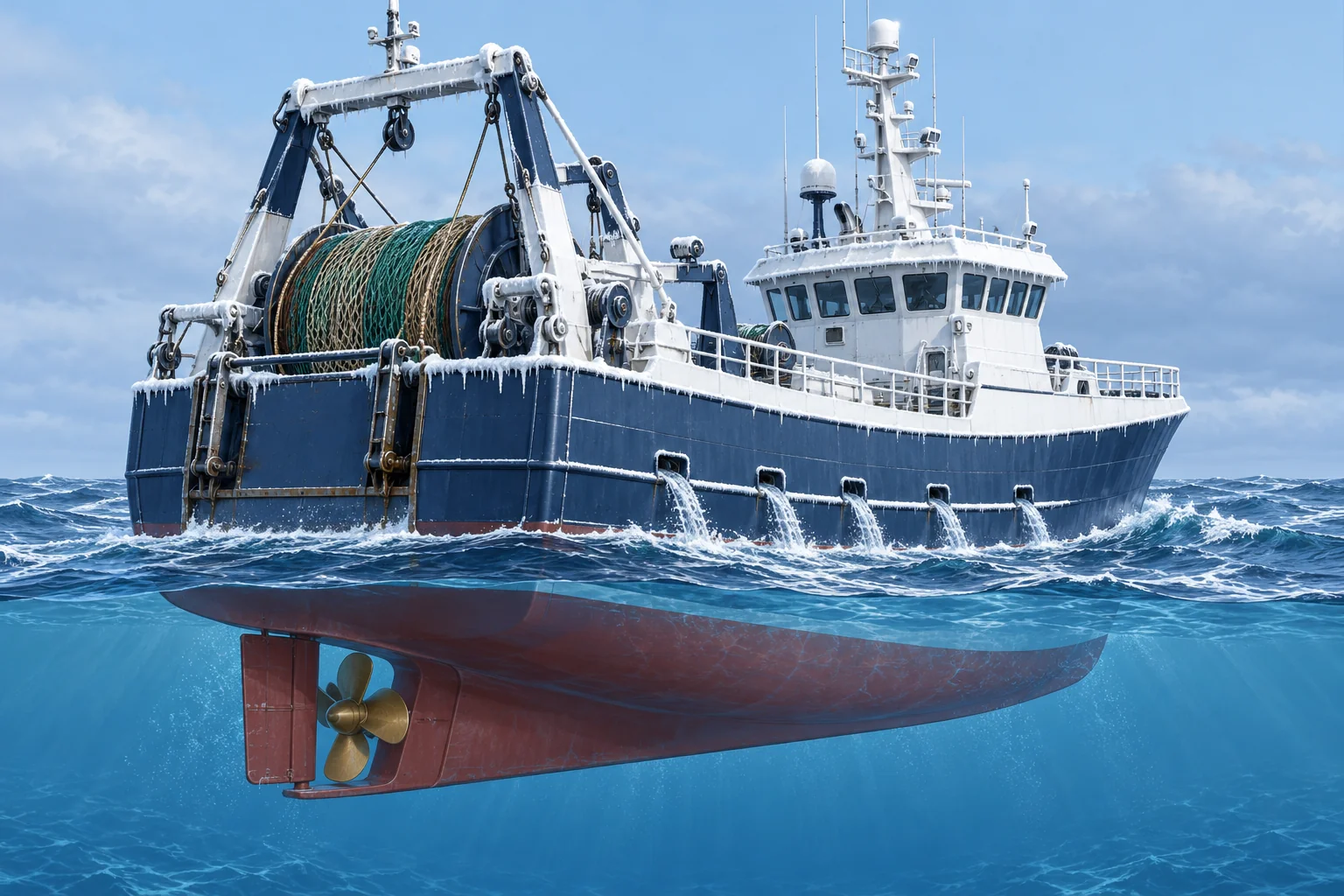
Bulwarks turn the deck into a well that can hold tonnes of water high up. Freeing ports, openings in the bulwarks that drain water overboard, must be clear and working. Never lock their flaps or block them with gear or fish boards. If the well does not drain, reduce speed or change course.
Ice
Spray ice on decks, rails and rigging adds weight high up and increases the area exposed to wind. For fishing vessels in icing areas, IS Code Part B 6.3 gives 30 kg/m² on exposed decks and gangways and 7.5 kg/m² on each side's projected lateral area above water: its outline seen from the side. Use your booklet's allowance for the operating area. Remove ice early where safe. A noticeably longer roll is a warning: act promptly.
2Step by step
Worked example: deck gear and ice
- 1
Data: Δ 800 t, KG 3.80 m. Load 20 t of gear on deck at Kg 6.00 m.
Kg is the weight's own height above the keel.
- 2
New KG = (800 × 3.80 + 20 × 6.00) ÷ 820 = 3,160 ÷ 820 = 3.854 m.
Moments about the keel, divided by the new displacement.
- 3
G has risen 0.054 m; with KM about the same, GM falls by about 0.05 m.
Check KM at the new draught in the booklet.
- 4
Ice: 200 m² of deck × 30 kg/m² = 6.0 t; 150 m² projected lateral area per side × 7.5 kg/m² × 2 = 2.25 t.
8.25 t in all, high up.
- 5
Add 8.25 t of ice at Kg 6.50 m to the loaded 820 t ship: KG = (3,160 + 53.625) ÷ 828.25 = 3.880 m.
Gear and ice together raise KG by 0.080 m from the original condition; ice also increases wind area.
3Key data
- Adding weight w at Kg
- New KG = (Δ × KG + w × Kg) ÷ (Δ + w)
- Ice on exposed decks
- 30 kg/m² (IS Code, fishing vessels)
- Ice on projected lateral area
- 7.5 kg/m², each side
- Suspended load or gear pull
- Acts at the point of suspension or lead
4Key points
- 1
A few tonnes high up use a large share of a small ship's GM.
- 2
Stow heavy low and central, secure it, and respect the deck load limit.
- 3
Suspended loads and gear pull act at the point of suspension or lead.
- 4
Keep freeing ports clear and working; never lock them.
- 5
Ice adds weight high up: remove it early where safe and watch the roll period.
5Frequent mistakes
Wrong: Deck cargo only matters if it is heavy compared with the hold cargo.
Right: What counts is weight × height above G against displacement. Light deck cargo high up can still cost much of a small ship's GM.
Wrong: Closing freeing ports keeps the deck drier in bad weather.
Right: Closed or blocked ports trap water on deck, high up and free to move. Keep them clear and working.
6Practice case & exam keys
Your 28 m stern trawler is hauling. The warp snags on a wreck and she heels to 15° towards the warp, with water reaching the deck edge.
Show the answer
Take the load off at once: ease the winch brake or use the release so the pull stops. The pull acts high up and off the centreline, at the block where the warp leaves the ship, so removing it is the cure. Close weathertight doors and hatches. Do not try to correct the heel with ballast while the warp is fast: when it parts she heels the other way.
Exam keys
- Adding weight: new KG = (Δ × KG + w × Kg) ÷ (Δ + w).
- Suspended weights and gear pull act at the point of suspension or lead.
- IS Code Part B 6.3, fishing vessels in icing areas: 30 kg/m² exposed decks and gangways, 7.5 kg/m² projected lateral area above water per side. Use the booklet's allowance for the operating area.
- Freeing ports clear and unlocked: trapped deck water adds weight high up and free surface.
Finish this unit
When you've read it, answer three questions. Get all three right to finish the unit; opening the page alone doesn't count.
My notes for this unit
No notes