

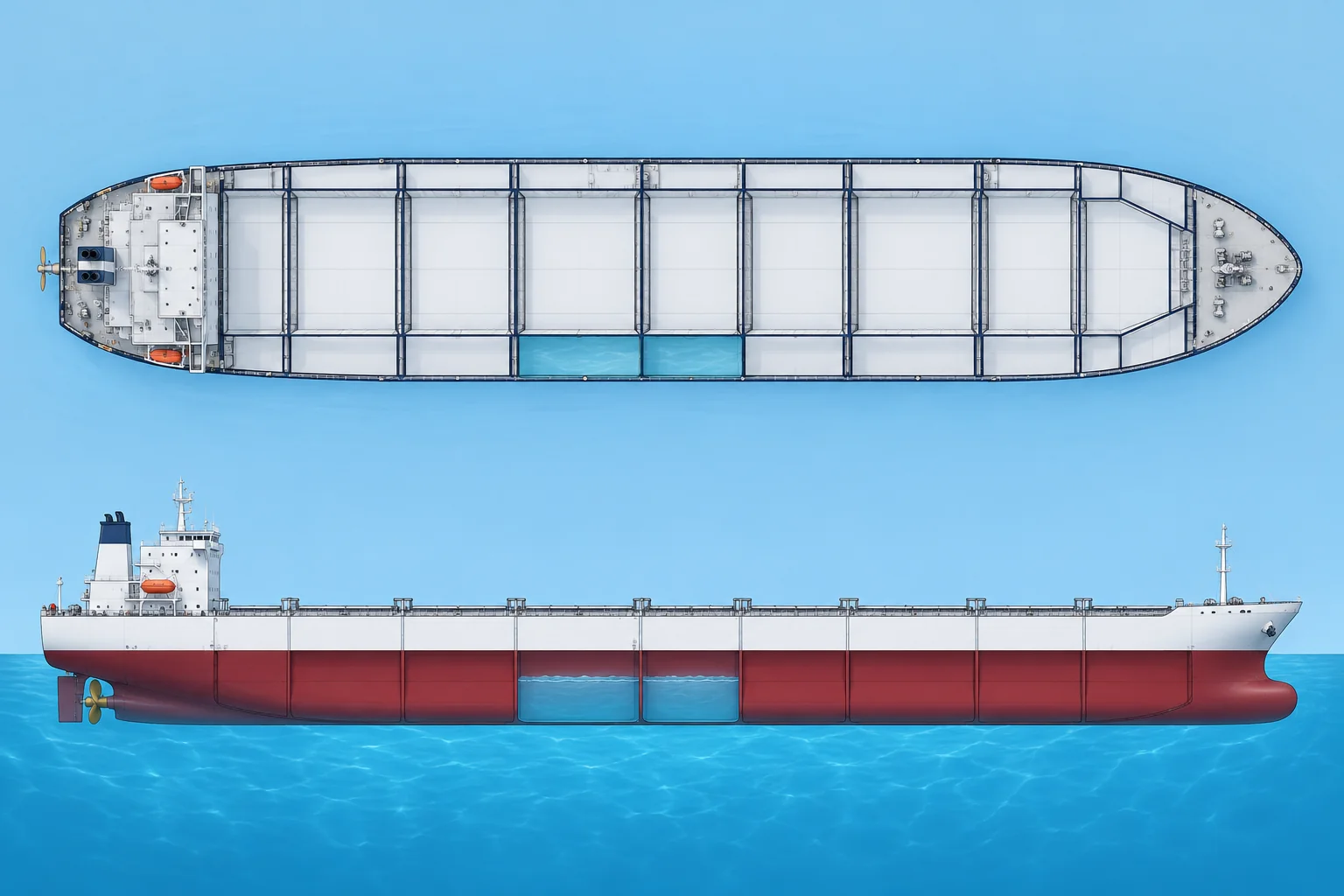
Damage stability rules: deterministic and probabilistic
1The lesson in plain words
SOLAS II-1 Part B-1 judges subdivision by the probability of surviving a collision. Learn what A ≥ R and the p, s and v factors mean for you as master.
Two approaches
A deterministic rule assumes set damage and requires the ship to survive it. MARPOL, IBC/IGC and reduced-freeboard Load Line rules use this approach. SOLAS II-1 Part B-1 is probabilistic: it estimates the chance of surviving a random collision. For ships built from 1 January 2009, the harmonised rules generally cover passenger ships and cargo ships 80 m and over, with specified alternative-rule exemptions.
The attained index A
For each compartment or group of adjacent compartments, the p factor is the probability that damage opens only that group, taken from damage statistics. The s factor is the probability she survives that flooding without capsizing or heeling dangerously. A v factor within s allows for watertight decks: the chance the damage stays below one. Each index is the sum of p × s over all damage cases.
Three draughts
Use three draughts: ds, the summer load-line draught; dl, the lightest expected service condition, including necessary ballast and, on passenger ships, all passengers and crew; and dp = dl + 0.6 × (ds − dl). Light service does not mean lightship. Combine their partial indices as A = 0.4As + 0.4Ap + 0.2Al. The approved minimum-GM curve uses the assessed GMs and trims and also accounts for intact stability.
The required index R
Compliance is A ≥ R. For cargo ships over 100 m, R = 1 − 128 ÷ (Ls + 152), where Ls is the subdivision length. Each partial index must also reach 0.5 R for cargo ships and 0.9 R for passenger ships. Since 2020, passenger ship R depends on the persons on board: 0.722 below 400, and higher above.
The s factor in practice
In final equilibrium, a larger remaining righting lever GZmax and wider positive-GZ range increase s until its calculation caps are reached: 0.12 m and 16°, or 0.20 m and 20° for ro-ro passenger ship damage involving a ro-ro space. These are calculation caps, not maximum permitted GZ or range. Heel reduces s above 25° on cargo ships (zero at 30°) and 7° on passenger ships (zero at 15°). Intermediate flooding and downflooding can govern. Use the approved minimum-GM curve.
2Key data
- Compliance
- A ≥ R; partial indices ≥ 0.5R (cargo), ≥ 0.9R (passenger)
- Attained index
- A = 0.4 As + 0.4 Ap + 0.2 Al
- Each partial index
- Sum of p × s over all damage cases
- R, cargo ships > 100 m
- R = 1 − 128 ÷ (Ls + 152)
- Partial draught dp
- dl + 0.6 × (ds − dl)
- s = 0 (final stage)
- Heel ≥ 30° cargo ships; ≥ 15° passenger ships
3Key points
- 1
Deterministic rules assume specified damage; SOLAS II-1 Part B-1 is probabilistic.
- 2
p = chance of that damage, s = chance of surviving it, v = effect of watertight decks.
- 3
A = 0.4 As + 0.4 Ap + 0.2 Al must reach R, each partial index ≥ 0.5 R on cargo ships.
- 4
The GM limit curve comes from the GMs assumed at ds, dp and dl.
4Frequent mistakes
Wrong: A ≥ R means she survives any two-compartment damage.
Right: A is a probability-weighted index. Some damage cases, even involving one compartment, may still sink the ship.
Wrong: Sailing below the minimum GM is fine if the intact criteria are met.
Right: The minimum GM curve combines intact and damage requirements. Below it, the A ≥ R result no longer holds.
5Practice case & exam keys
A bulk carrier with a subdivision length of 200 m has partial indices As 0.30, Ap 0.90 and Al 0.90. Can departure be approved from these results?
Show the answer
No. R = 1 − 128 ÷ (200 + 152) = 0.636 and A = 0.4 × 0.30 + 0.4 × 0.90 + 0.2 × 0.90 = 0.660, so the combined index passes. But each cargo partial index must reach 0.5R = 0.318. As is only 0.30. Passing A alone is insufficient.
Exam keys
- A = Σ p s per draught; A = 0.4As + 0.4Ap + 0.2Al; A ≥ R.
- Cargo ship over 100 m: R = 1 − 128 ÷ (Ls + 152); partial indices ≥ 0.5R.
- ds = summer draught; dl = lightest service condition, including necessary ballast; dp = dl + 0.6 × (ds − dl).
- s for cargo ships: reduced above 25° heel, zero at 30°.
Finish this unit
When you've read it, answer three questions. Get all three right to finish the unit; opening the page alone doesn't count.
My notes for this unit
No notes