

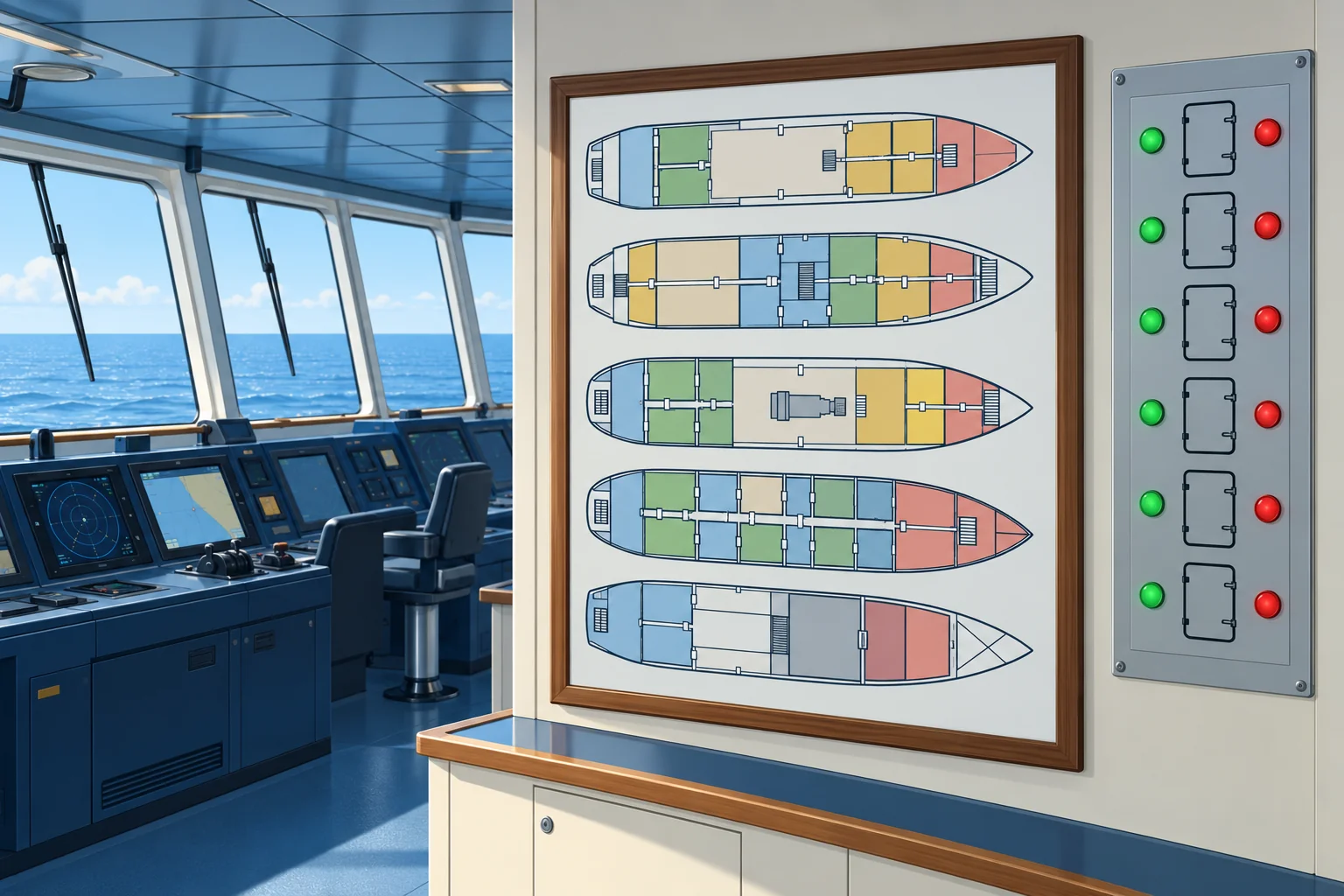
Damage control information, flooding tools and countermeasures
1The lesson in plain words
After a collision or grounding you need the damage control plan, a reliable stability tool and clear countermeasures, in that order.
Damage control plan
SOLAS II-1/19 requires plans, permanently exhibited or readily available on the bridge, showing for each deck and hold the watertight boundaries, the openings with their means of closure and control positions, and the arrangements for correcting a list due to flooding. Booklets with the same information go to the officers, with the precautions vital to watertight integrity.
Damage stability information
For ships under Part B-1, damage stability information gives you a simple way to judge survivability for damage to any compartment or group. A booklet gives pre-calculated cases. Under IACS UR L5, Type 3 calculates pre-programmed damage cases for the loading condition; Type 4 assesses actual flooding. Passenger ships covered by SOLAS II-1/8-1 must have an onboard stability computer or shore-based support; check the provisions applicable to your ship.
First assessment
Repeat soundings in damaged and neighbouring spaces and compare them with heel and draughts. A steady level may mean equilibrium with the sea; rising levels may reflect inflow or changing heel or trim. Rising water in a previously dry adjacent space at unchanged heel and trim indicates progressive flooding. Close the watertight doors, hatches, vents and valves shown on the plan. Use a matching approved damage case or actual-flooding tool to check GZ, heel and downflooding margin.
Countermeasures
List is a lean from unequal weight or buoyancy; loll is an equilibrium heel with negative upright GM. Both can coexist. Pumping or transferring liquids can worsen stability. Check each stage for residual GZ, free surface and downflooding. With confirmed loll, lower G; fill a low, divided tank on the low side only if the approved damage assessment supports every stage. Counter-flooding adds water to reduce asymmetric heel, consuming reserve buoyancy. Cross-flooding equalises flooding between sides; use the approved arrangements.
Help ashore
Shore-based emergency response services, run by class societies, can model damage with your ship’s hull data. Enrol beforehand; keep soundings, draughts and damage details ready. Notify the coastal state. Passenger-ship drills rehearse assessment, closures, equipment and stability information at least every three months. Each drill establishes the ship–shore communications link if support is provided. At least annually, activate that support to assess simulated damage.
2Step by step
After damage: the first hour
- 1
Sound the alarm, muster, and close the watertight doors and openings on the damage control plan.
Keeps the flooding to the damaged compartments.
- 2
Sound all tanks and voids near the damage and repeat the soundings regularly.
Repeated soundings help track flooding; compare them with adjacent spaces, draughts and heel.
- 3
Read the draughts forward, aft and amidships, and the list.
Gives the real condition to compare with the calculation.
- 4
Use a Type 4 tool for actual flooding, or verify that a pre-programmed Type 3/booklet case matches the damage.
Shows heel, GZ and the margin to downflooding.
- 5
Assess each proposed countermeasure through its intermediate stages before acting.
Reducing heel alone does not prove that residual stability and buoyancy improve.
- 6
Call the shore-based emergency response service and report to the coastal state.
An independent calculation and early help.
3Key data
- SOLAS II-1/19
- Damage control plans on the bridge; booklets for officers
- The plan shows
- Watertight boundaries, openings, closures, list correction
- IACS UR L5 Type 3
- Intact stability plus pre-programmed damage cases
- SOLAS II-1/8-1
- Applicable passenger ships: onboard computer or shore support
- SOLAS II-1/19-1
- Passenger ships: damage control drill every three months
4Key points
- 1
Use the damage control plan to close boundaries before you calculate.
- 2
Compare repeated soundings with heel and draughts; a steady level alone does not prove containment.
- 3
List and loll can coexist; assess every stage before pumping, transferring or adding liquid.
- 4
Enrol in a shore-based emergency response service before you need it.
5Frequent mistakes
Wrong: Correct any list at once by filling a tank on the high side.
Right: List and loll can coexist. With negative upright GM, filling the high side can cause a sudden roll. Check each stage before acting.
Wrong: One sounding after the damage is enough.
Right: Repeat soundings in damaged and adjacent spaces. A steady level may mean equilibrium with the sea, not containment. At unchanged heel and trim, rising levels in previously dry adjacent spaces indicate progressive flooding.
6Practice case & exam keys
After a grounding your ship lists 6° to port. Soundings show No. 2 port double bottom flooded, with a steady level. The starboard double bottom tanks are empty. The second officer wants to pump fuel into them. What do you check first?
Show the answer
Do not infer GM from the tank’s position; asymmetric flooding and loll can coexist. Check the actual condition and each transfer stage, including the source tank, free surface, GZ, heel, downflooding, draughts and hull loads. Positive GM alone does not prove safety. Transfer only if the approved assessment shows safe improvement, using tanks approved for fuel. Establish whether she is still aground, seek shore support and keep sounding No. 2 port and adjacent spaces.
Exam keys
- II-1/19: damage control plans and booklets; boundaries, openings, list correction.
- Compare repeated soundings with heel and draughts; check adjacent spaces for progressive flooding.
- List and loll can coexist; check residual stability through every countermeasure stage.
- Type 3: pre-programmed damage cases; Type 4: actual flooding; verify a booklet/Type 3 case matches.
Finish this unit
When you've read it, answer three questions. Get all three right to finish the unit; opening the page alone doesn't count.
My notes for this unit
No notes