

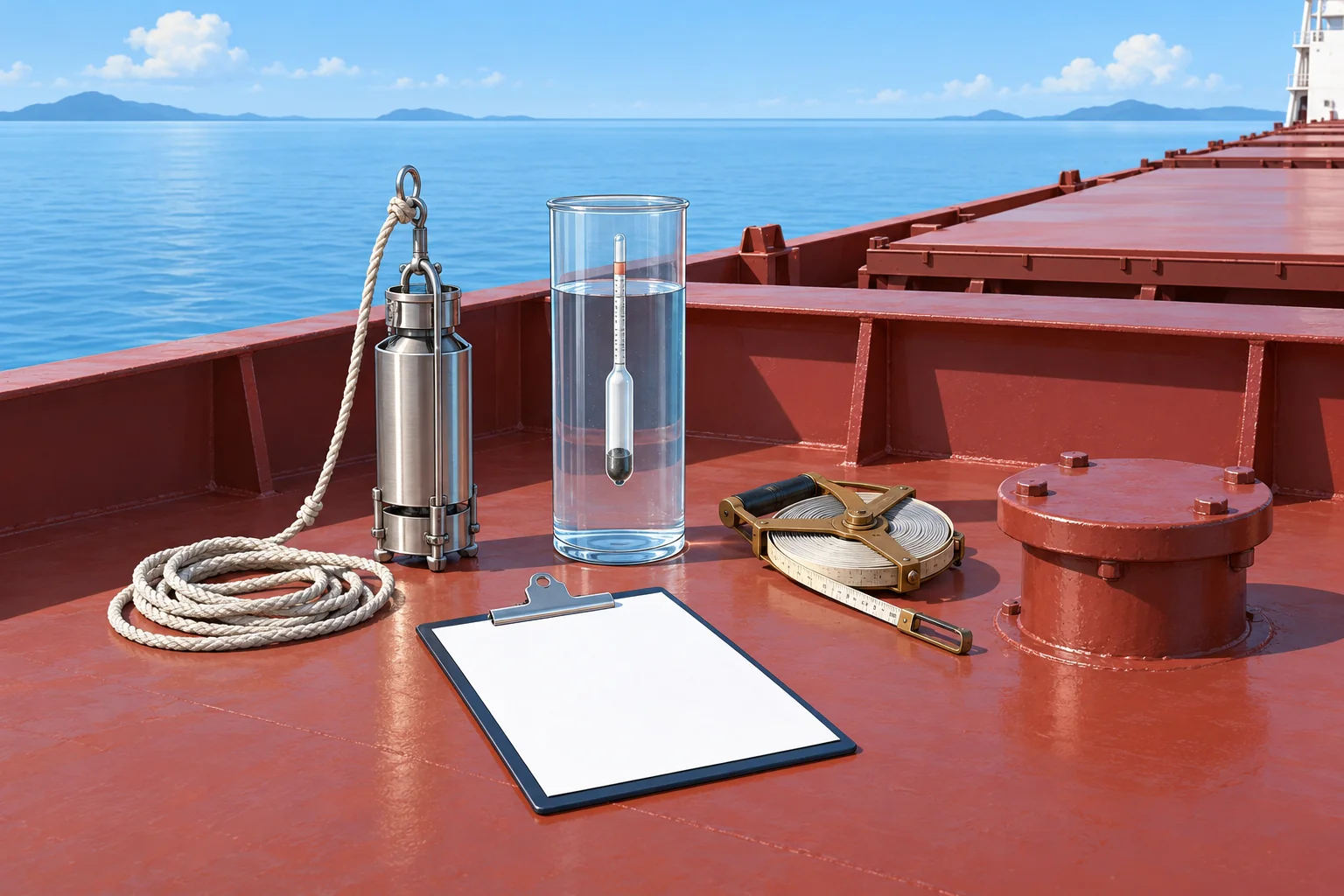
A full draught survey, worked step by step
1The lesson in plain words
Follow one final draught survey from six draught readings to the weight of cargo loaded, using real hydrostatic values.
The ship and the readings
A bulk carrier of 180 m between perpendiculars finishes loading coal in dock water of 1.018 t/m³. Her forward marks are 2.40 m aft of the forward perpendicular, her aft marks 6.20 m forward of the after perpendicular, and her midships marks at midships. Readings, port and starboard: forward 9.10 and 9.14 m, midships 9.62 and 9.66 m, aft 10.16 and 10.20 m.
Hydrostatic data
From the table for 1.025 t/m³: at 9.60 m, Δ 41,850 t, TPC 50.45 t/cm, LCF 3.10 m aft of midships; at 9.70 m, Δ 42,355 t, TPC 50.55 t/cm, LCF 3.30 m aft. MCTC is 702 t·m/cm at QM + 0.5 m and 661 t·m/cm at QM − 0.5 m. Intermediate values are rounded for display; carry unrounded values throughout. Display final weights to one decimal place.
Deductibles
Soundings and engine room figures give ballast 420 t, fresh water 185 t and bunkers, including lubricating oil, 1,240 t: 1,845 t in all. The initial survey before loading found a net displacement of 10,230 t: lightship 9,850 t plus a constant of 380 t.
Result and checks
Cargo loaded = 40,060.1 − 10,230 = 29,830.1 t. Investigate and document any unexplained difference from the shore figure. Check the constant too. If it differs widely from previous voyages, look for an error before you sign.
2Step by step
Worked example: the final survey
- 1
Means: F 9.12, M 9.64, A 10.18 m; observed trim 1.06 m by the stern. Length between marks = 180 − 2.40 − 6.20 = 171.40 m.
Averaging port and starboard removes list.
- 2
Perpendicular corrections: F = 9.12 − 1.06 × 2.40 ÷ 171.40 ≈ 9.10516 m; A = 10.18 + 1.06 × 6.20 ÷ 171.40 ≈ 10.21834 m. True trim ≈ 1.11319 m.
With stern trim the FP is shallower and the AP deeper than the marks.
- 3
Quarter mean = (F + A + 6 × 9.64) ÷ 8 ≈ 9.64544 m. Midships is 2.2 cm above the mean of the corrected ends: hogging.
The quarter mean corrects for the bent keel.
- 4
Interpolation fraction = (QM − 9.60) ÷ 0.10 ≈ 0.45438. Δ = 41,850 + fraction × 505 = 42,079.5 t; TPC ≈ 50.49544 t/cm; LCF ≈ 3.19088 m aft.
Interpolate linearly; retain unrounded values throughout, including draughts and trim.
- 5
Using unrounded trim, LCF and TPC: first = trim × LCF × TPC × 100 ÷ 180 = +99.6 t; second = 50 × trim² × 41 ÷ 180 = +14.1 t. Trimmed Δ = 42,193.2 t.
Stern trim and LCF aft point towards the same end, so add. Displayed rounded weights may not sum exactly.
- 6
Density: trimmed Δ × (1.018 − 1.025) ÷ 1.025 = −288.1 t; corrected displacement = 41,905.1 t. Less deductibles of 1,845 t: net 40,060.1 t.
Net displacement = lightship + constant + cargo.
3Key data
- Quarter mean
- ≈ 9.64544 m (hogging 2.2 cm)
- Table displacement
- 42,079.5 t at 1.025 t/m³
- Trim corrections
- +99.6 t (first) and +14.1 t (second)
- Density correction
- −288.1 t in dock water of 1.018 t/m³
- Net displacement
- 40,060.1 t after 1,845 t of deductibles
- Cargo loaded
- 40,060.1 − 10,230 = 29,830.1 t
4Key points
- 1
Correct end marks to the perpendiculars and offset midships marks to midships before calculating the quarter mean.
- 2
Interpolate the hydrostatic table at the quarter mean.
- 3
Here both trim corrections are added and the density correction subtracted.
- 4
Cargo = final net displacement − initial net displacement.
5Frequent mistakes
Wrong: Enter the table with the mean of forward and aft, 9.662 m.
Right: That ignores the 2.2 cm hog and overstates the cargo by about 80 t. Use the quarter mean.
Wrong: Leave out the dock water density.
Right: The table assumes 1.025 t/m³. Without the correction you would overstate the cargo by 288 t.
Wrong: Subtract the first trim correction out of habit.
Right: Check the direction: with stern trim and LCF aft it is added. Getting the sign wrong costs about 199 t here.
6Practice case & exam keys
At the initial survey the constant came out at 380 t, but the last three voyages gave 150–190 t. Shore scales show 29,600 t loaded; your survey gives 29,830.1 t. What do you do?
Show the answer
Investigate the changed constant and reconcile the roughly 230 t difference before accepting the cargo figure. Recheck both surveys’ draughts, densities and deductibles; ask for shore weighing records. Do not adjust the constant to match shore scales. Different methods alone do not explain the discrepancy. If unresolved, report it under company procedures and record both figures and the outstanding discrepancy before signing.
Exam keys
- Means → perpendicular corrections → QM → table → trim corrections → density → deductibles.
- Cargo = final net − initial net displacement.
- Watch the signs of the first trim correction and the density correction.
- Compare the constant with previous voyages.
Finish this unit
When you've read it, answer three questions. Get all three right to finish the unit; opening the page alone doesn't count.
My notes for this unit
No notes