

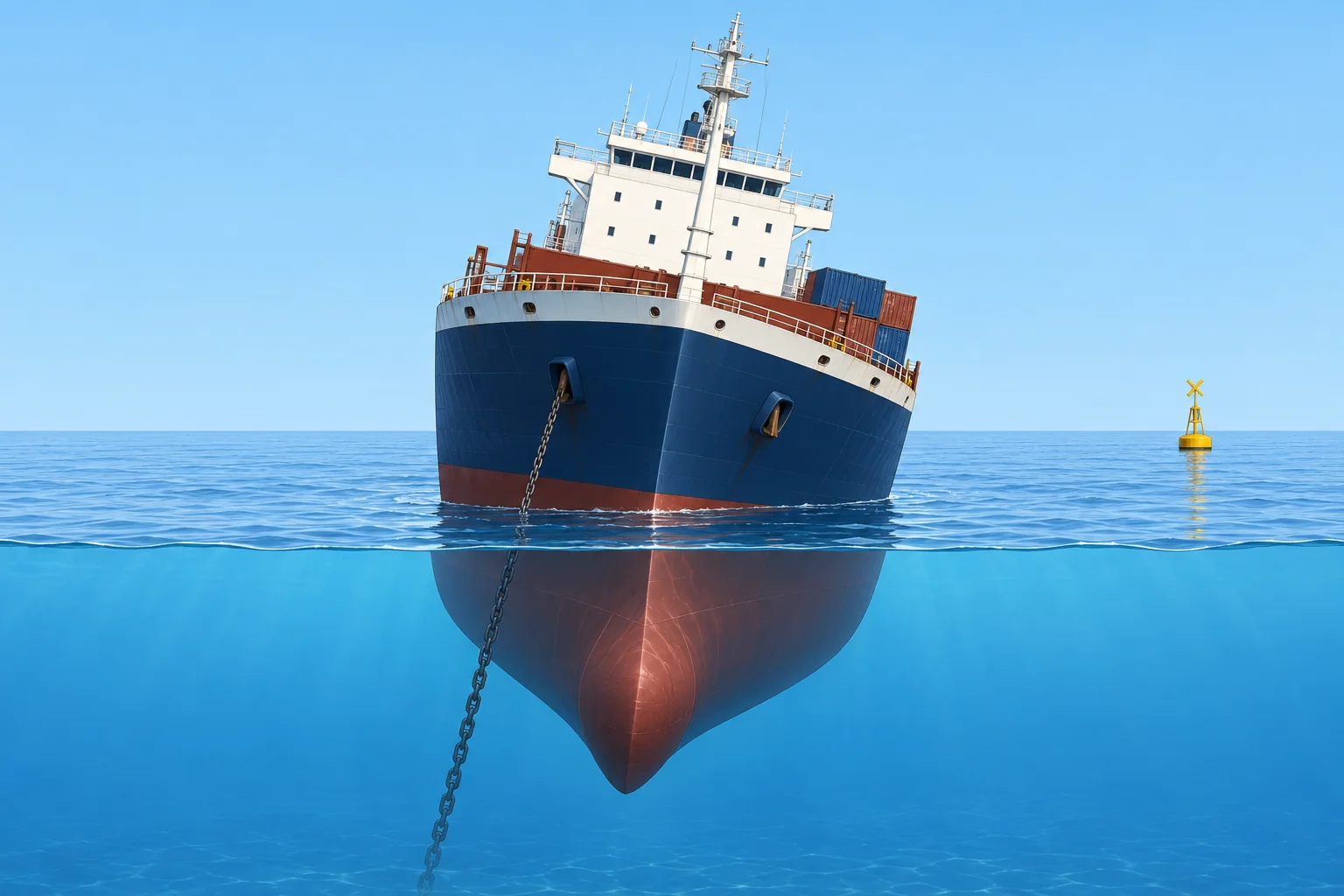
List: finding it, correcting it, and telling it from loll
1The lesson in plain words
A list comes from G off the centreline with positive GM. Loll comes from negative GM. They look alike and need different fixes.
Finding the list
With positive GM, G off the centreline by GGH gives a list: tan θ = GGH ÷ GM, using GM fluid. Get GGH from a table of transverse moments: GGH = Σ(w × y) ÷ Δ, with y each weight's distance off the centreline and sides given opposite signs. Use this formula only for small lists.
Correcting it
To bring her upright, create an equal and opposite moment, Δ × GGH. Transfer ballast or fuel across, or load the next cargo on the high side. Moving w across a distance y gives w × y. Plan with full and empty tanks in mind: a slack wing tank adds free surface while you work.
Loll
With negative GM fluid, the ship is unstable upright. She may capsize or settle at an angle of loll, a heeled equilibrium where GZ returns to zero. Signs: she lies over with no off-centre weight to explain it, rolls slowly about the leaning angle, and may flop to the other side. Slack tanks, fuel used from low tanks, water on deck or ice can cause it at sea.
Correcting loll safely
Confirm the loading condition and negative GM fluid. Follow the approved recovery plan to lower G. A usual sequence is to fill a low, divided double-bottom tank on the low side first, then its partner, one at a time. Lower or remove high weights where practicable. Do not transfer ballast across to the high side to counter the heel: she can flop farther the other way. Monitor intermediate GM fluid and heel; the first tank can initially increase the heel.
List or loll?
Both can involve rolling about a heeled equilibrium. Slow rolling or changing sides suggests loll but does not prove it. Check weight positions, tank levels and calculated GM fluid. Positive GM with G off the centreline indicates list; negative GM indicates loll. If uncertain, stop sideways transfers and check the loading condition before pumping. Correct a list by transverse transfer only after confirming positive GM fluid.
2Step by step
Worked example: correcting a list with ballast
- 1
Data: Δ 15,000 t, GM fluid 0.55 m. After loading, G lies 0.08 m to port.
GM is positive, so this is a list, not loll.
- 2
List: tan θ = 0.08 ÷ 0.55 = 0.145, θ ≈ 8.3° to port.
Small enough for the small-angle formula.
- 3
Moment to remove = 15,000 × 0.08 = 1,200 t·m.
An equal moment to starboard brings G back to the centreline.
- 4
Wing tanks lie 8 m each side of the centreline: transfer distance 16 m.
Weight moved across from port to starboard counts the full 16 m.
- 5
Ballast to transfer = 1,200 ÷ 16 = 75 t, port to starboard.
Check the tanks left slack and their free surface.
3Key data
- List angle
- tan θ = GGH ÷ GM fluid (small angles)
- Shift of G across
- GGH = Σ(w × y) ÷ Δ
- Correcting moment
- Δ × GGH, applied to the high side
- Loll
- Negative GM: lower G, low-side divided tank first
- Never with loll
- Do not transfer weight to the high side
4Key points
- 1
List: G off the centreline with positive GM; tan θ = GGH ÷ GM.
- 2
Correct a list with an opposite moment of Δ × GGH.
- 3
Loll: negative GM; she leans to either side and rolls about the leaning angle.
- 4
Correct loll by lowering G, filling a low divided tank on the low side first.
- 5
Never shift weight to the high side of a lolling ship.
5Frequent mistakes
Wrong: A ship lying over to port always needs weight moved to starboard.
Right: Only if it is a list. If she has negative GM, moving weight across can make her flop to a larger angle.
Wrong: Fill both double-bottom tanks of a pair together to correct loll.
Right: Follow the approved loll-recovery plan. Press the low-side tank full before starting its partner, and include all existing slack tanks when checking intermediate GM fluid.
Wrong: Use GM solid in tan θ = GGH ÷ GM.
Right: Use GM fluid; with slack tanks the real list is larger.
6Practice case & exam keys
After bunkering, your ship lies 6° to starboard. No cargo has shifted and the bunkers went into centreline tanks. She rolls slowly, and once heels to port before settling to starboard again. The mate wants to pump ballast to port. What do you do?
Show the answer
Stop the transfer. Suspect loll, but confirm the loading condition and GM fluid before pumping. If GM is negative, follow the ship's approved sequence to lower G: fill a low divided tank on the low side first, then its partner, one at a time. Include existing slack tanks and recheck GM fluid during the operation.
Exam keys
- List: tan θ = GGH ÷ GM; correcting moment = Δ × GGH.
- Loll: negative GM; heel to either side, slow roll about the leaning angle.
- Loll correction: lower G; low-side divided double-bottom tank first, one tank at a time.
- Never transfer weight to the high side with loll.
Finish this unit
When you've read it, answer three questions. Get all three right to finish the unit; opening the page alone doesn't count.
My notes for this unit
No notes