

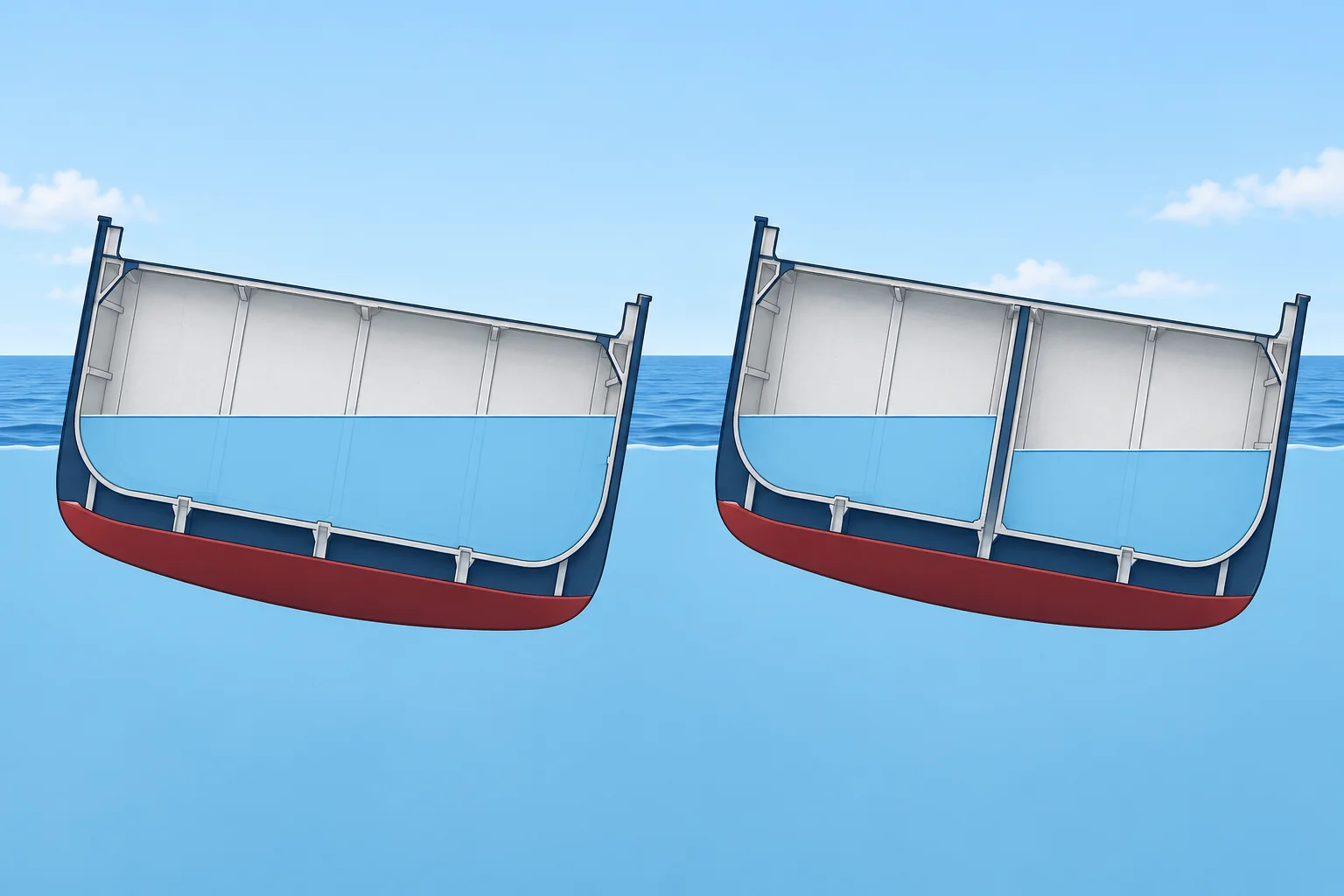
Free surface moments and GM fluid
1The lesson in plain words
Every slack tank costs GM. Add the tanks' free surface moments, divide by Δ, and use GM fluid in initial-stability checks.
On a ship
You know the idea from yacht stability: slack liquid moves to the low side and acts like a rise of G. On a ship you work it in numbers. Each tank's free surface moment, FSM, comes from the tank tables. The free surface correction is FSC = ΣFSM ÷ Δ, in metres, and GM fluid = GM solid − FSC.
The FSM
FSM = i × ρ, in t·m, where i is the transverse moment of inertia of the liquid surface in m⁴ and ρ the liquid's density in t/m³. For a rectangular surface, i = l × b³ ÷ 12, l along the ship and b across. Tank tables list i, or FSM at a stated density: scale by the density ratio for another liquid.
Subdivision
A liquid-tight lengthwise division into n equal parts divides the combined i by n²: both halves slack give a quarter; one gives an eighth. That is why double bottoms are split port and starboard. In a rectangular, vertical-sided tank, while the surface spans its full length and breadth, FSM is independent of liquid quantity. Its height in the ship does not affect FSM.
What to count
Under the Intact Stability (IS) Code, Part B 3.1, correct tanks below 98% full. Nominally full cargo tanks still need correction: follow the approved stability booklet. For each type of consumable liquid, such as fuel or fresh water, include at least the transverse pair or centre tank with the greatest free-surface effect. Omit small tanks only where the booklet permits it under 3.1.12; do not judge from upright FSM alone.
Good practice
Keep slack tanks to a minimum and work them one at a time. For fixed levels, use actual filling. For variable levels, use the greatest correction within the planned range unless the approved booklet permits stage-by-stage values. Ballast operations must cover the worst intermediate stage.
2Step by step
Worked example: GM fluid from the tank tables
- 1
Data: Δ 15,000 t, KM 8.40 m, solid KG 7.70 m; two slack tanks.
GM solid = 8.40 − 7.70 = 0.70 m.
- 2
Ballast tank table: i = 1,250 m⁴. FSM = 1,250 × 1.025 = 1,281 t·m.
Use the supplied table inertia and the ballast density, 1.025 t/m³.
- 3
Fuel tank table: FSM = 900 t·m at density 0.90 t/m³. At 0.95 t/m³, use 900 × 0.95 ÷ 0.90 = 950 t·m.
This supplied table entry needs scaling by the density ratio.
- 4
FSC = (1,281 + 950) ÷ 15,000 = 0.149 m.
Total FSM divided by the displacement.
- 5
GM fluid = 0.70 − 0.149 = 0.55 m.
Use 0.55 m for initial stability and small-angle list calculations.
- 6
If the rectangular ballast tank is divided liquid-tight lengthwise into equal halves, both slack total 1,281 ÷ 4 = 320 t·m.
n² rule: with the fuel tank still slack, FSC falls to 0.085 m.
3Key data
- Free surface moment
- FSM (t·m) = i × ρ
- Rectangular surface
- i = l × b³ ÷ 12 (m⁴)
- Free surface correction
- FSC (m) = ΣFSM ÷ Δ
- Effective GM
- GM fluid = GM solid − FSC
- n equal divisions
- Combined i ÷ n²; both halves slack: ¼, one half: ⅛
- When to count it
- Non-cargo, no exemption: below 98%; cargo: follow booklet
4Key points
- 1
FSM = i × ρ; for a rectangle, i = l × b³ ÷ 12.
- 2
FSC = ΣFSM ÷ Δ and GM fluid = GM solid − FSC.
- 3
Lengthwise division into n equal parts divides combined FSM by n², with all parts slack.
- 4
Non-cargo, no exemption: count below 98%. Cargo: follow the booklet. Include the worst consumable tanks.
- 5
Keep slack tanks few and work them one at a time.
5Frequent mistakes
Wrong: A tank nearly empty has a small free surface effect.
Right: In a rectangular, vertical-sided tank, while the surface spans its full length and breadth, FSM stays the same at a fixed density.
Wrong: Use the sea-water density for every tank.
Right: Use the density of the liquid in the tank, such as fuel at about 0.95 t/m³.
Wrong: Divide ΣFSM by the lightship weight.
Right: Divide by the displacement of the condition you are checking.
6Practice case & exam keys
In port the ship's GM solid is 0.40 m at Δ 12,000 t. You plan to run a rectangular 20 m × 12 m sea-water ballast tank slack during cargo work. What does it cost in GM, and what would you suggest?
Show the answer
FSM = 20 × 12³ ÷ 12 × 1.025 = 2,952 t·m; FSC = 2,952 ÷ 12,000 = 0.246 m. GM fluid is 0.154 m. Keep the tank full or empty under the approved plan. If it already has a liquid-tight lengthwise division, one slack half contributes 369 t·m (one eighth); both slack halves total 738 t·m (one quarter). Include every other slack tank and recheck the whole condition before cargo work.
Exam keys
- FSM = l b³ ρ ÷ 12 for a rectangular tank, in t·m.
- FSC = ΣFSM ÷ Δ; GM fluid = GM solid − FSC.
- Lengthwise division into n equal parts: combined FSM ÷ n² when all parts are slack.
- Non-cargo, no exemption: count below 98%. Nominally full cargo tanks still need correction; follow the booklet. Include worst consumables.
Finish this unit
When you've read it, answer three questions. Get all three right to finish the unit; opening the page alone doesn't count.
My notes for this unit
No notes