

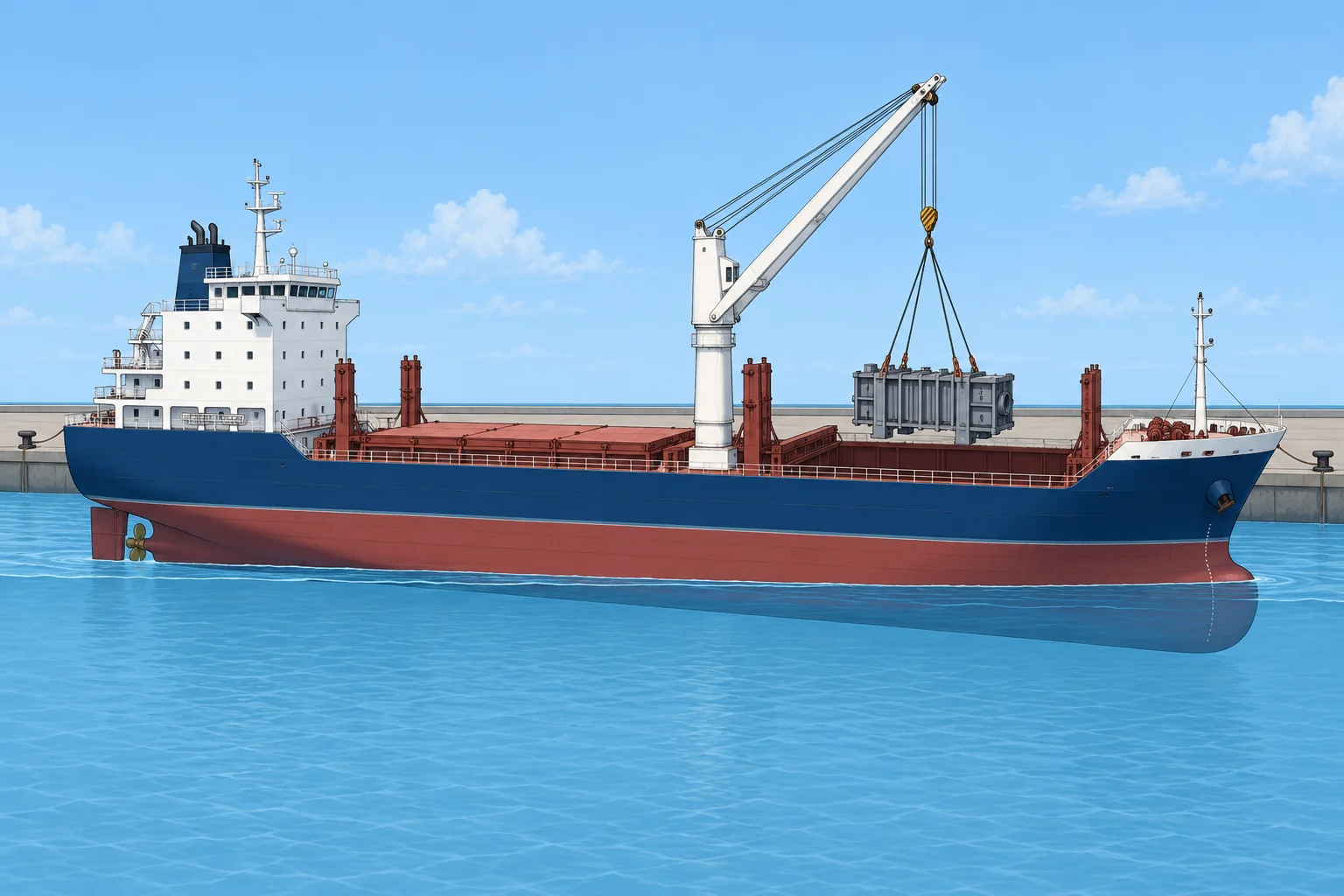
Loading and discharging: sinkage, trim and final draughts
1The lesson in plain words
Loading a weight sinks the ship and trims her about the LCF. Work the two effects separately, then add them at each end.
Two effects
Imagine loading first at the LCF. Both ends sink by w ÷ TPC cm. TPC means tonnes per centimetre immersion. Then move it to its real position: the trimming moment is w × d, with d measured from the LCF. Discharging works the same way with w taken off: she rises, and trims away from the end where the weight came off.
When it is accurate
This method suits weights that are small compared with Δ. TPC, MCTC and LCF all change with draught. For a larger change, take them at the mean of the old and new draughts, or use the LCG method below.
The LCG method
Sum weights and longitudinal moments for Δ and LCG. Read LCB, LCF, MCTC and draught at LCF (dLCF) from even-keel hydrostatics at Δ. With positions forward from AP, H (cm) = Δ × (LCG − LCB) ÷ MCTC is head-positive; H < 0 means stern trim. Draughts in metres: dA = dLCF − (H/100) × AP–LCF/LBP; dF = dLCF + (H/100) × LCF–FP/LBP, where FP is the forward perpendicular. This small-trim estimate needs approved trim-dependent data for larger trim.
Several weights
Use a table: weight, distance from the LCF (forward +, aft −) and moment. Sum the weights for sinkage and the moments for trim. The loading computer does this, but you must be able to check it and spot an input error, such as cargo entered in the wrong hold.
The limits
Final draughts must respect the load line, the berth and channel depth with under-keel clearance, air draught, and any trim the master requires. Check the arrival condition too: fuel and water used on passage change both draught and trim.
2Step by step
Worked example: loading forward of the LCF
- 1
Data: Δ 15,000 t, TPC 25 t/cm, MCTC 180 t·m/cm, LBP 140 m, LCF 66 m forward of AP; F 7.577 m, A 8.377 m.
Initial draughts are rounded from dLCF 8.000 m. Keep unrounded values.
- 2
Load 400 t, 30 m forward of the LCF. Sinkage = 400 ÷ 25 = 16 cm.
Bodily sinkage, the same at both ends.
- 3
Change of trim = 400 × 30 ÷ 180 = 66.7 cm by the head.
d is measured from the LCF.
- 4
Forward: +16 + (200/3) × 74 ÷ 140 ≈ +51.24 cm. Aft: +16 − (200/3) × 66 ÷ 140 ≈ −15.43 cm.
Add sinkage and trim share at each end, keeping change of trim = 200/3 cm unrounded.
- 5
Final (using unrounded values): F ≈ 8.090 m; A ≈ 8.223 m.
Trim is now about 0.133 m by the stern: 0.800 − 0.667. Carry unrounded draughts and changes through the calculation.
3Key data
- Sinkage
- Sinkage (cm) = w ÷ TPC
- Change of trim
- COT (cm) = w × d from LCF ÷ MCTC
- Head-positive trim
- H (cm) = Δ × (LCG − LCB) ÷ MCTC; even-keel LCB
- Draught aft
- dA (m) = dLCF − (H ÷ 100) × (AP to LCF) ÷ LBP
- Draught forward
- dF (m) = dLCF + (H ÷ 100) × (LCF to FP) ÷ LBP
4Key points
- 1
Loading = sinkage (w ÷ TPC) plus trim (w × d from the LCF ÷ MCTC).
- 2
Measure d from the LCF, not from midships.
- 3
H (cm) = Δ × (LCG − even-keel LCB) ÷ MCTC: head-positive; divide H by 100 for draughts in metres.
- 4
Check final draughts against the load line, depth, air draught and arrival condition.
5Frequent mistakes
Wrong: Measure the loading distance from midships.
Right: The ship trims about the LCF, so measure d from the LCF.
Wrong: Use the old TPC and MCTC for a very large load.
Right: Use values at the mean draught, or work the final condition with the LCG method.
Wrong: Discharging forward trims her by the head.
Right: Removing weight forward lifts the bow: she trims by the stern.
6Practice case & exam keys
At Δ 15,000 t, LCG is 69.54 m and even-keel table LCB is 70.50 m forward of AP. MCTC is 180 t·m/cm; draught at LCF is 8.000 m. LCF is 66 m forward of AP; LBP is 140 m. The berth allows 8.30 m aft after required under-keel clearance. Can you accept?
Show the answer
H = 15,000 × (69.54 − 70.50) ÷ 180 = −80 cm: stern trim. H/100 = −0.80 m. Aft: 8.000 − (−0.80) × 66 ÷ 140 ≈ 8.377 m. Forward: 8.000 + (−0.80) × 74 ÷ 140 ≈ 7.577 m. Reject: aft draught exceeds 8.30 m by about 0.077 m. Revise the loading or trim and recalculate both draughts.
Exam keys
- Sinkage = w ÷ TPC; COT = w × d (from LCF) ÷ MCTC.
- Add sinkage and trim share at each end.
- H (cm) = Δ (LCG − even-keel LCB) ÷ MCTC; positive head, negative stern.
- Draughts in metres: dA = dLCF − (H/100) × AP–LCF/LBP; dF = dLCF + (H/100) × LCF–FP/LBP.
Finish this unit
When you've read it, answer three questions. Get all three right to finish the unit; opening the page alone doesn't count.
My notes for this unit
No notes