

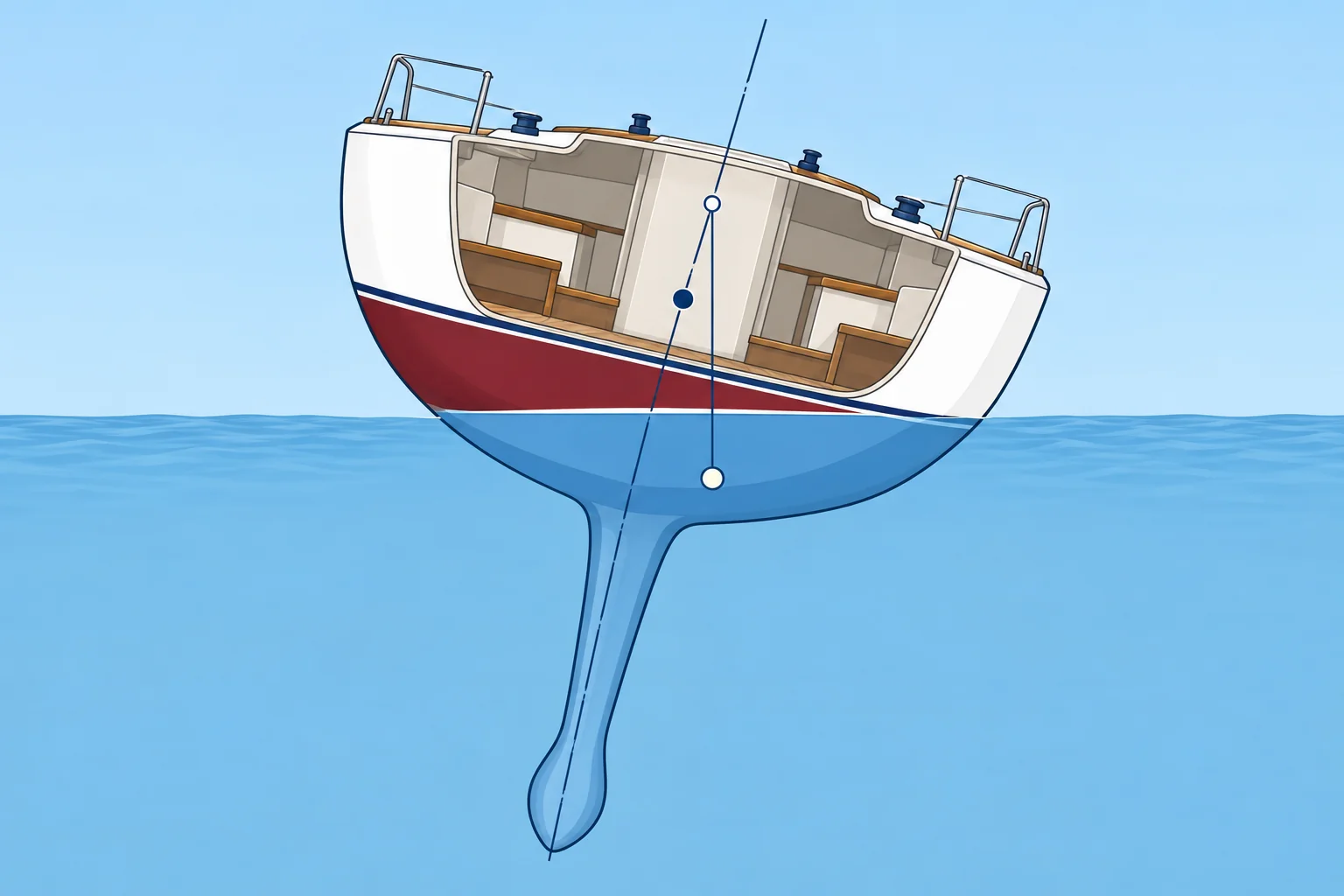
The metacentre M, GM and the three kinds of equilibrium
1The lesson in plain words
At small angles of heel, buoyancy acts through a point called the metacentre. Its height above G, GM, measures initial stability.
The metacentre
When your boat heels a few degrees, B, the centre of buoyancy, moves out along an arc. The vertical line of buoyancy through the new B crosses the centreline at the metacentre, M. For small angles, up to about 10°, M stays almost fixed.
Heights from the keel
Measure heights from the keel reference K. KB is the height of B, KG the height of G, your yacht’s centre of gravity, and KM the height of M. The metacentric height is GM = KM − KG. Hull shape and draught determine KM; weight position determines KG.
Three kinds of equilibrium
With M above G, GM is positive: stable, with an initial righting tendency. If M and G coincide, GM is zero: neutral initially, with no initial restoring tendency. At finite heel, check the GZ curve. With G above M, GM is negative: upright equilibrium is unstable. She may settle at an angle of loll, a heel caused by negative initial GM, or capsize. A list from off-centre weight can occur with positive GM.
GM and the lever
The righting lever, GZ, is the horizontal separation between the weight and buoyancy forces. At small angles GZ ≈ GM × sin θ, where θ is heel angle. GM tells you how quickly the lever grows near upright. Beyond about 10°, use the full GZ curve.
Stiff and tender
A large GM makes a stiff boat: hard to heel, with a short, quick roll that can be uncomfortable. A small GM makes a tender boat: she heels easily and rolls slowly. A very slow, lazy roll in harbour can warn you that GM is small.
2Key data
- Metacentric height
- GM = KM − KG
- Small-angle lever
- GZ ≈ GM × sin θ (up to about 10°)
- Stable
- M above G: GM positive
- Neutral
- M at G: GM zero
- Unstable
- GM negative: upright unstable; possible angle of loll
3Key points
- 1
M is where the buoyancy line crosses the centreline at small heel.
- 2
GM = KM − KG: positive, zero or negative describes initial stability.
- 3
At small angles GZ ≈ GM × sin θ.
- 4
Large GM: stiff, quick roll. Small GM: tender, slow roll.
- 5
Weight position controls KG; hull shape and draught determine KM.
4Frequent mistakes
Wrong: M is a fixed point at every angle of heel.
Right: M is nearly fixed only at small angles. At large angles use the GZ curve.
Wrong: A bigger GM is always better.
Right: Too much GM gives a violent roll that strains gear and crew. Enough GM with a good GZ curve is the aim.
5Practice case & exam keys
You move heavy stores from low lockers to an arch above the original G. Displacement and draught stay unchanged. Your yacht now rolls more slowly and heels further in gusts. What changed, and what should you check before sailing?
Show the answer
Moving stores upward raises KG. At unchanged draught, KM stays the same, so GM falls and she becomes more tender. Move suitable stores back to secured low stowage. Check the builder’s stability information for the new loading; GM alone does not describe the whole GZ curve.
Exam keys
- GM = KM − KG: positive stable, zero neutral, negative unstable near upright.
- GZ ≈ GM sin θ at small angles (to about 10°).
- Stiff (large GM): short quick roll. Tender (small GM): long slow roll.
- KM from hull form and draught; KG from loading.
Finish this unit
When you've read it, answer three questions. Get all three right to finish the unit; opening the page alone doesn't count.
My notes for this unit
No notes