

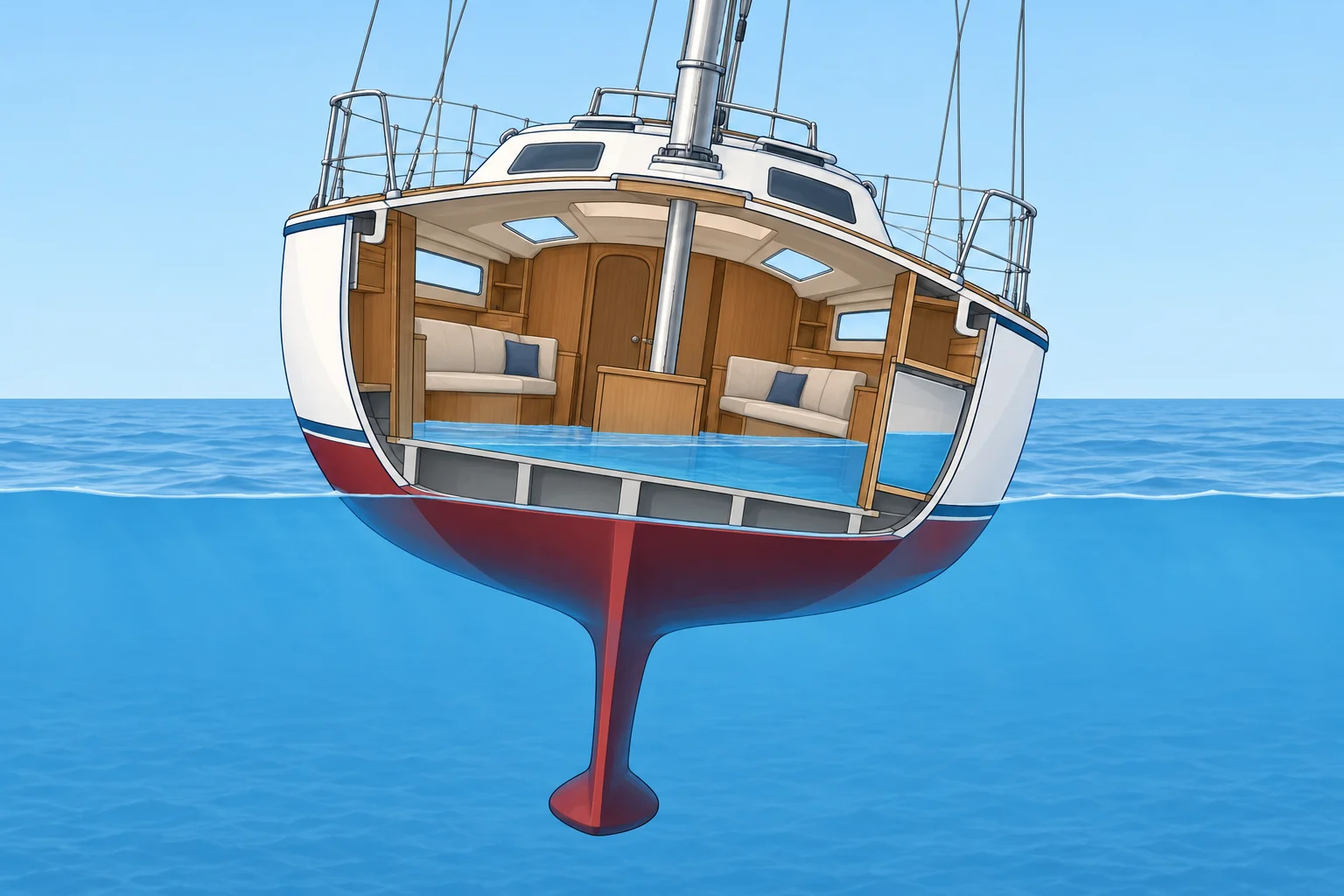
The free surface effect
1The lesson in plain words
Liquid that can slosh moves to the low side as you heel. It acts like a rise of G and can wipe out a small boat’s GM.
What happens
A tank partly full, bilge water or a flooded cabin has a free surface. When she heels, the liquid flows to the low side. Its weight moves sideways and adds to the heel. The effect is the same as if G had risen: a virtual rise of G, so the effective GM is smaller.
Width matters most
For a rectangular free surface at small heel, the correction depends on width cubed, length, liquid density and boat displacement. Depth does not enter this approximation while the surface spans the full width. Double the width alone and the correction increases eightfold. Very shallow water may uncover the floor as heel increases, changing that surface.
Dividing tanks
A liquid-tight longitudinal division, running lengthwise, creates separate narrow surfaces. Two equal isolated compartments reduce the small-angle correction to one quarter. Ordinary perforated baffles, plates with holes, reduce liquid surge but do not provide this static reduction if liquid can flow between compartments.
Keeping it small
Keep tanks full (pressed up) or empty where the maker’s instructions and tank layout allow, while maintaining transverse balance. Minimise slack tanks, meaning partly filled tanks. Keep the bilge pumped dry and cockpit drains clear. Water over a wide saloon floor after flooding or a knockdown can make your yacht very tender. Pump it out early.
2Key data
- Effect
- Virtual rise of G: effective GM = GM − free surface loss
- Width³ rule
- Rectangular surface; small heel; other factors unchanged
- Width doubled
- 8 times the small-angle correction, other factors unchanged
- Two isolated compartments
- Equal liquid-tight lengthwise halves: one quarter at small heel
3Key points
- 1
Sloshing liquid acts as a virtual rise of G.
- 2
For a rectangular surface at small heel, loss grows with width cubed; unchanged geometry makes depth irrelevant.
- 3
Two equal liquid-tight lengthwise compartments cut the small-angle correction to one quarter.
- 4
Minimise slack tanks within the maker’s balanced-use plan; keep the bilge dry.
4Frequent mistakes
Wrong: A few centimetres of water across the saloon floor are harmless because they weigh little.
Right: A little water can still form a dangerous wide surface. For unchanged rectangular surface geometry at small heel, depth does not reduce the correction. Pump it out.
Wrong: Always use one tank at a time, whatever the layout.
Right: Limit partly filled tanks where the maker’s instructions and tank layout allow, while keeping the yacht balanced. Paired side tanks may need balanced use.
5Practice case & exam keys
After a knockdown, water covers the saloon floor of your yacht from side to side, and two half-full water tanks are slopping. The boat now feels sluggish and hangs at each roll. What is happening and what do you do first?
Show the answer
The wide free surface and slack tanks act as a virtual rise of G, reducing effective GM. First stop more water coming in, then pump and bail the saloon water. Keep crew low and central. Follow the maker’s tank-use plan: minimise slack surfaces while maintaining transverse balance.
Exam keys
- Free surface effect = virtual rise of G; effective GM falls.
- Rectangular surface, small heel: width³ rule; depth irrelevant only while surface geometry stays unchanged.
- n equal isolated liquid-tight lengthwise compartments: small-angle correction ÷ n².
- Keep tanks full or empty within the maker’s balanced-use plan; bilges dry.
Finish this unit
When you've read it, answer three questions. Get all three right to finish the unit; opening the page alone doesn't count.
My notes for this unit
No notes