

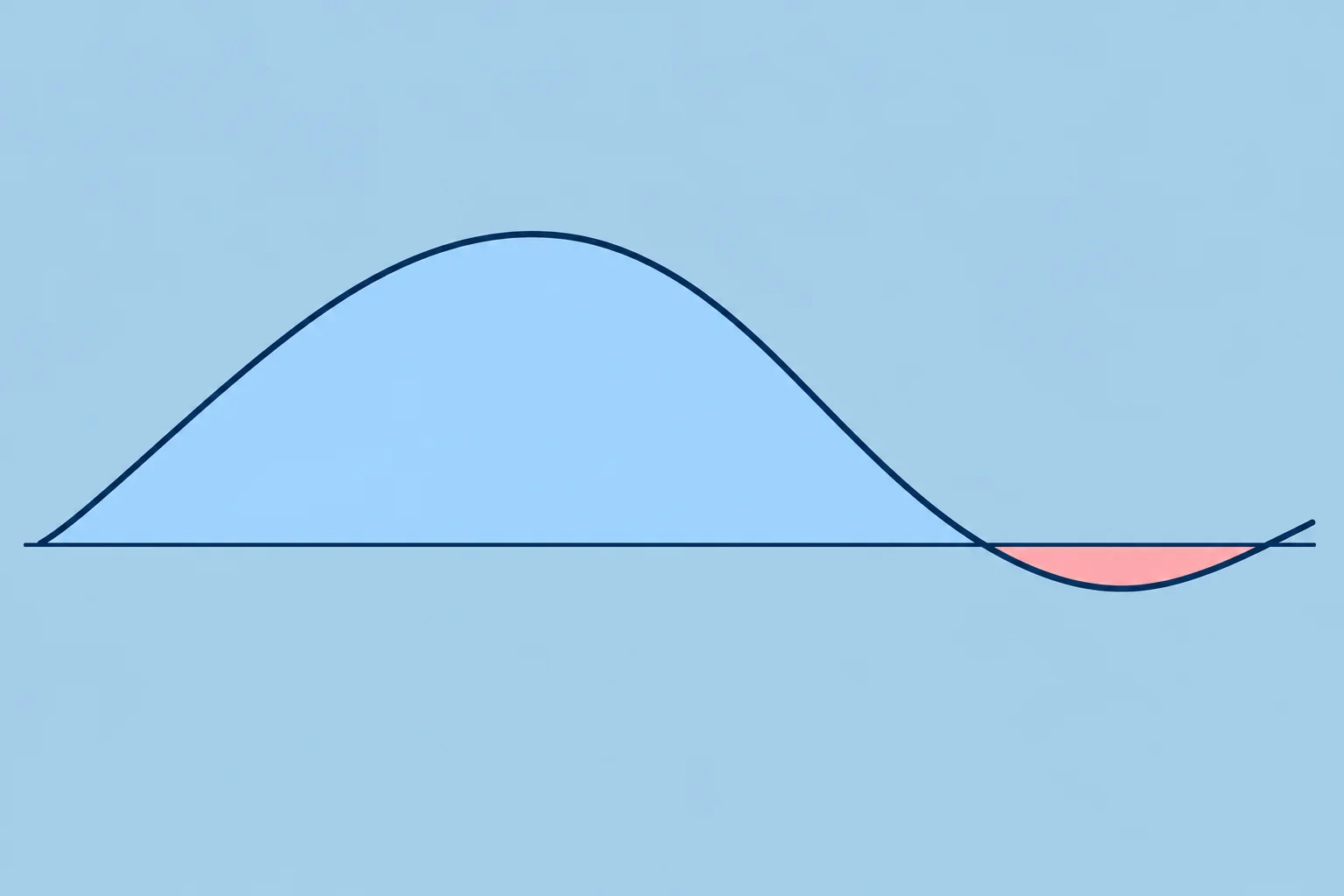
The GZ curve: maximum lever, AVS and area
1The lesson in plain words
The GZ curve shows the righting lever at every heel angle. Read four things: the start slope, the peak, the AVS and the area.
Reading the curve
The GZ curve, or curve of statical stability, plots GZ against heel angle for one loading. Near upright its slope matches GM: a line from the origin to GM at 57.3° touches the start of the curve. Then GZ grows, reaches a maximum and falls again.
Maximum GZ
The peak is the biggest righting lever your boat has, and you read its angle there. A ballasted monohull usually peaks beyond normal sailing heel. A catamaran usually peaks at small heel, near windward hull lift. The angle depends on the design: read that yacht’s curve.
AVS
Where GZ returns to zero after the positive range is the angle of vanishing stability, AVS. Beyond it, the intact yacht’s static lever acts towards inversion. That tendency does not guarantee capsize. Many cruising monohulls have an AVS around 110–130°, but use your yacht’s actual curve.
Area and energy
Positive GZ area measures an idealised restoring-energy barrier. Multiply area, with heel in radians, by your boat’s weight force to obtain restoring work. Starting heel and wind loading affect the remaining barrier; this does not predict a safe wave size. The downflooding angle is the heel at which an opening that is not effectively watertight admits water. Flooding can invalidate the intact curve before AVS.
Inverted stability
Past AVS, negative GZ acts towards inversion. The negative area measures the idealised barrier to recovery from inversion per unit weight. For a given boat, a smaller negative area means less work is needed to leave the inverted position. It guarantees neither recovery nor a recovery time; waves, loading, flooding and the yacht’s condition matter.
2Key data
- Initial slope
- Tangent at 0° reaches GM at 57.3° (1 radian)
- AVS
- Angle where GZ returns to zero (limit of positive stability)
- Positive area
- GZ area × boat weight force = restoring work (heel in radians)
- Negative area
- Inverted energy barrier per unit weight; no recovery guarantee
- Maximum GZ
- Read the largest lever and its angle at that yacht’s curve peak
3Key points
- 1
The start slope of the GZ curve equals GM.
- 2
Maximum GZ is the biggest lever; note its angle.
- 3
AVS ends the positive-stability range; check downflooding too.
- 4
GZ area × boat weight force = restoring work, with heel in radians; negative area measures inverted stability.
- 5
A low downflooding angle can cut the useful curve short.
4Frequent mistakes
Wrong: A high GM means a high AVS.
Right: GM only sets the start of the curve. A wide, shallow boat can have a big GM and a low AVS.
Wrong: The AVS is reached only in hurricanes, so it does not matter.
Right: A steep breaking wave can roll a yacht in a gale. Compare the complete curve, loading and downflooding limits; AVS alone does not establish safety.
5Practice case & exam keys
Two yachts have equal GM. A has AVS 125°, a small negative area and an unprotected opening that floods at 60°. B has AVS 105°, a large negative area and downflooding at 100°. Can you choose A for offshore work from AVS alone?
Show the answer
No. A has a wider intact positive-stability range and a smaller inverted barrier per unit weight, but flooding at 60° can invalidate its curve well before AVS. Equal GM and higher AVS do not prove greater positive area or capsize energy. Compare the full curves, displacement, actual loading and downflooding limits. Neither yacht is guaranteed to self-right.
Exam keys
- GZ curve: initial slope = GM (tangent meets GM at 57.3°).
- Max GZ and its angle; AVS where GZ returns to zero.
- GZ area × boat weight force = restoring work (heel in radians). Negative area measures inverted stability.
- Downflooding angle can limit the useful curve.
Finish this unit
When you've read it, answer three questions. Get all three right to finish the unit; opening the page alone doesn't count.
My notes for this unit
No notes