
Maldives motor vessel driving licence
In the Maldives, you need a motor vessel driving licence to drive a local powered boat at sea. You must be 18, finish training at a ministry-approved centre and pass a practical test in a boat of the category you want. Most leisure boaters start with outboard category A (up to 20 hp) or A1 (20 to 100 hp).
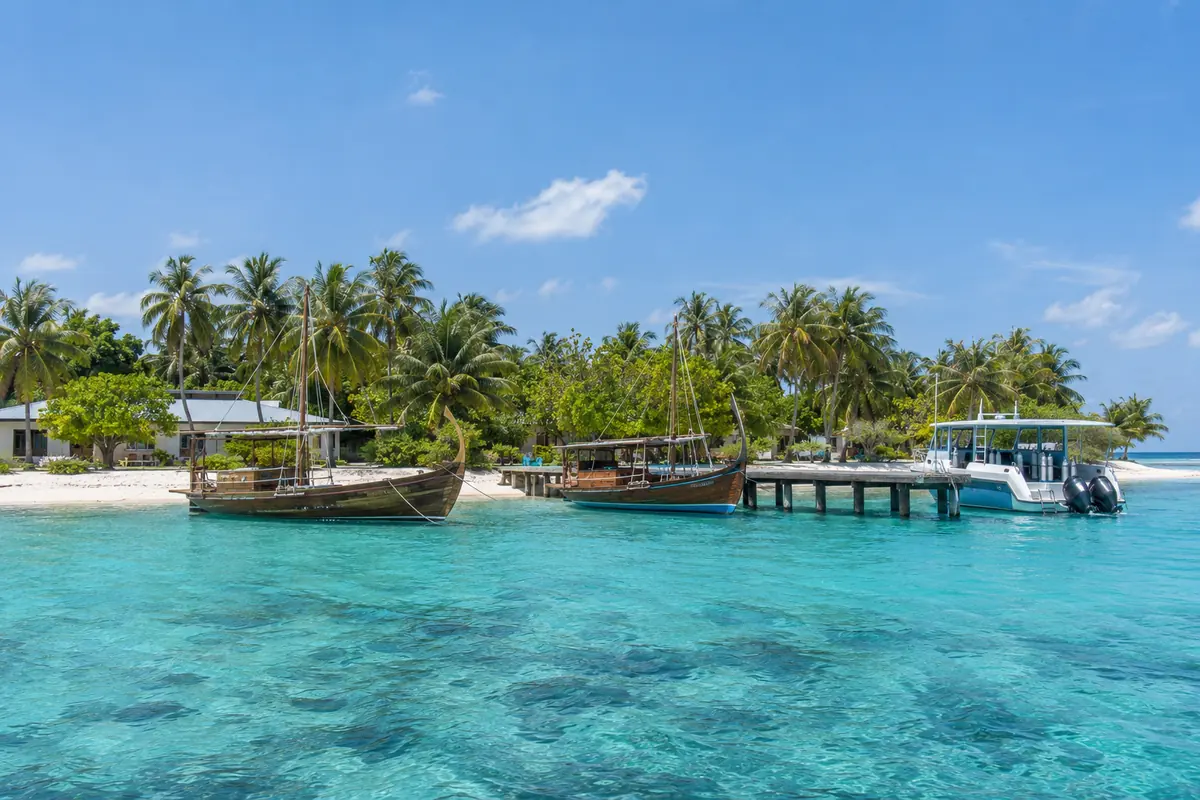
Maldives · Ministry of Economic Development, Transport & Trade (Maldives)
The licence comes in categories A to H by engine type and power, and each one is earned with a practical driving test. These free exercises help you revise COLREG rules, IALA buoyage, lights and shapes, and sound signals alongside the compulsory approved training.
Regulation 2023/R-50 on local vessel driving licences ·
Who needs this licence
Anyone who drives a powered vessel at sea in Maldivian waters, pleasure boats and watersports craft included, and you must be 18 to apply. A Maldivian without a licence may steer more than 1 mile outside an atoll's rim only under a licensed driver's supervision. Foreign residents need a qualifying water-sports work permit, work visa or residence visa, and a captain arriving on a boat from abroad can ask for a 1-year temporary licence based on an accepted foreign licence.
Topics to revise
Extra navigation practice
Practice questions (with answers)
A head-on situation exists at night when you see:
Show answer
Correct answer: B. Both sidelights and masthead lights nearly in line
Rule 14(b): head-on exists when a vessel sees both sidelights and/or masthead lights in a line or nearly in a line.
In a Rule 15 crossing encounter, the give-way vessel shall, if circumstances admit:
Show answer
Correct answer: C. Keep well clear and avoid crossing ahead of the other vessel
Rule 15 requires the give-way vessel to keep out of the way and, if circumstances admit, avoid crossing ahead. Rules 8 and 16 require early, substantial and effective action; the safe choice of course or speed depends on the whole situation.
The stand-on vessel MUST take action to help avoid collision when:
Show answer
Correct answer: B. Collision cannot be avoided by the give-way vessel acting alone
Rule 17(b): once so close that the give-way vessel alone cannot avoid collision, the stand-on vessel shall take action that best helps avoid it. Rule 17(a)(ii) separately permits earlier action when the give-way vessel is not taking appropriate action.
Except where Rules 9, 10 or 13 otherwise require, a power-driven vessel underway shall keep out of the way of all these EXCEPT:
Show answer
Correct answer: C. Another power-driven vessel of larger size
Rule 18(a): power-driven vessels give way to NUC, RAM, fishing, and sailing vessels — but size alone does not determine priority.
Emergency wreck marking buoys are used for:
Show answer
Correct answer: B. Marking new dangers, including newly discovered wrecks
The emergency wreck marking buoy marks new dangers, including newly discovered wrecks. The competent authority determines further marking once the danger is removed or its information has been sufficiently promulgated.
The topmark of a West Cardinal mark is:
Show answer
Correct answer: C. Two cones point to point
Two separate black cones with their points facing each other. The cones must remain clearly separated.
You are entering a river where the chart shows the conventional direction of buoyage is upstream from the sea entrance. What should determine whether a lateral mark is port-hand or starboard-hand?
Show answer
Correct answer: C. The charted conventional direction of buoyage
Lateral marks are interpreted in the conventional direction of buoyage. The chart, not guesswork, determines which side is port-hand and which is starboard-hand.
You sight a cardinal mark with both cones pointing down and a light showing six quick flashes followed by one long flash. What is the safe action?
Show answer
Correct answer: C. Pass south of the mark
Two cones down and the 6+1 light rhythm identify a South Cardinal mark, meaning the safe water lies to the south of the mark.
How to get the Maldives boat licence
Complete the required training at a ministry-approved centre. Then apply for the driving test through the ministry's ePortal and pass the practical test in a boat of your category (MVR 100 per attempt). Send the form with 2 recent photos, your training and medical certificates, the test pass letter and the licence fee (MVR 250 for Maldivian citizens). If everything is complete, the licence can be issued within 5 days.
Maldives boat licence questions
- Which category do I need for a small speedboat?
- Category A covers outboard boats up to 20 hp and A1 covers outboards from 20 to 100 hp. A1 also lets you drive category A boats, and B (outboards above 100 hp) gives you both.
- How long is the Maldives boat licence valid?
- 10 years from issue. You can renew it when 6 months or less are left, with a new medical certificate and your old licence.
- Can a visitor drive a boat in the Maldives?
- The temporary licence is for visitors who come as captain of a boat arriving from abroad. It is based on a foreign licence the ministry accepts, lasts 1 year, costs MVR 2,500 and covers that visiting boat, plus locally registered pleasure and watersports craft. The regulation does not describe a separate licence for holidaymakers who only want to hire a local boat, so check with the ministry before you travel.
- Is the training compulsory?
- Yes. The regulation says the training for the licence must be done at a ministry-approved training centre, and you hand in the certificate with your application. Holders of an STCW deck Certificate of Competency are exempt from that training but still take the driving test.