
- From 16years old, you can take the exam§§ 6 and 8 SpFV
- 39 tasksin the full theory paper
- 60 minutesallowed for theory
- 11.03 kWcombustion engines up to this power remain licence-free§ 5 SpFV
- No upper limiton length or engine power on sea waterways
The official sea licenceWhat SBF-See opens up
Sportbootführerschein See (SBF-See) is Germany’s official licence for powered recreational craft on sea waterways. Whether you need it depends on the waters and propulsion power. On these waterways, a licence is generally required for a powered recreational boat [§ 4 Sportbootführerscheinverordnung, SpFV, the recreational boat licensing regulation].
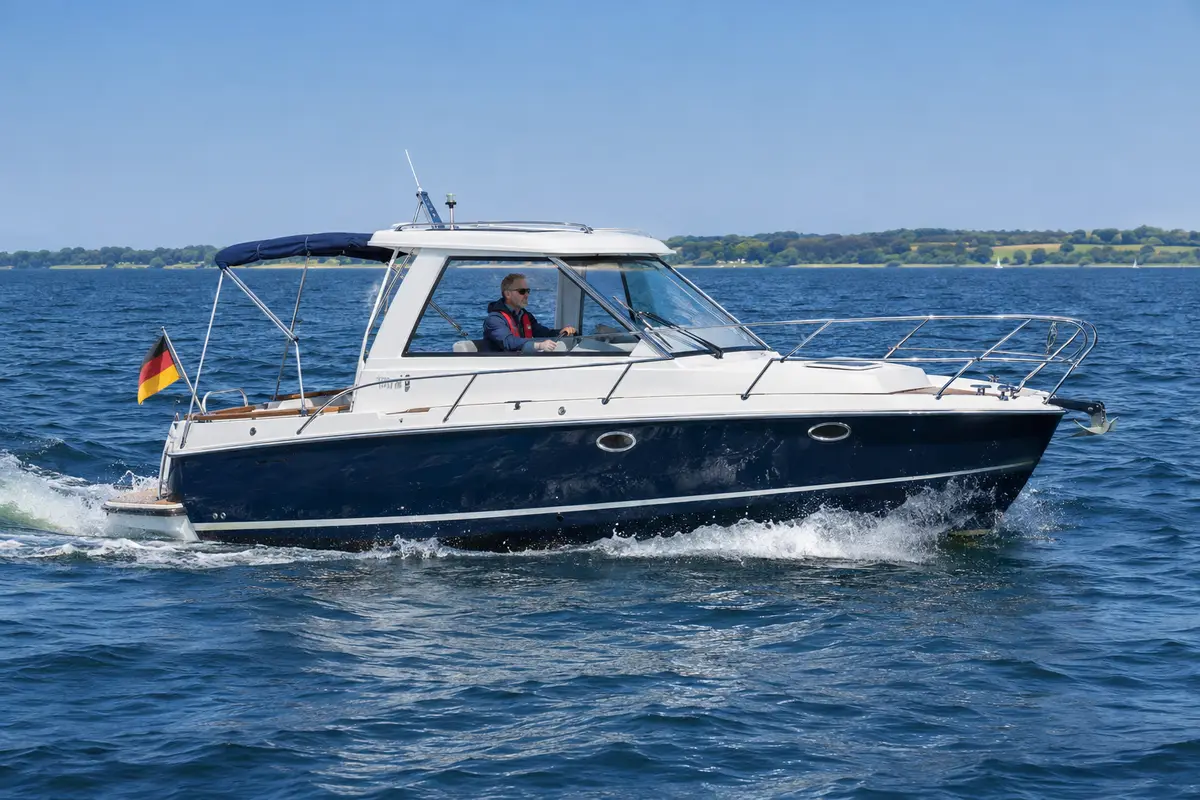
Waters, rather than a coastal radiusWhere you can go with SBF-See
SBF-See is a licence for German sea waterways, rather than one defined by a fixed distance from the coast. There are no upper limits on motorboat length or engine power there. The essential questions remain the same: which waters will you use, and how powerful is your propulsion?
With SBF-See, you can
- Operate powered recreational craft on German sea waterways
- Operate a motorboat with no upper length limit
- Operate a motorboat with no upper engine-power limit
What this licence does not cover
- Operating recreational craft under 20 metres on federal inland waterways: SBF Binnen (Germany’s inland recreational boat licence) is intended for that
- Ignoring sea-waterway licensing requirements when your engine does not qualify for the exemption [§ 4 SpFV and § 5 SpFV]
- Assuming that a small engine always needs a licence: combustion engines up to 11.03 kW or electric motors up to 7.5 kW remain licence-free [§ 5 SpFV]
Before your first stepWhat you need
- Be at least 16 years old
- Be medically fit
- Pass theory and practice within one year (§§ 6 and 8 SpFV)
Prepare with a planYour route to the exam
- Check the waters and engine power
First establish whether you will be on a sea waterway and whether your engine exceeds the licence-free threshold.
- Work through the official questions
Study the official ELWIS question bank. It contains 72 basic questions, 213 sea-specific questions and 15 navigation exercises.
- Focus on navigation
Practise the 15 navigation exercises and deepen your understanding of KVR (COLREG collision regulations) rules 5–37 and IALA Region A buoyage.
- Register for the exam
Ask the relevant Prüfungsausschuss (examination committee) about dates and registration.
- Bring theory and practice together
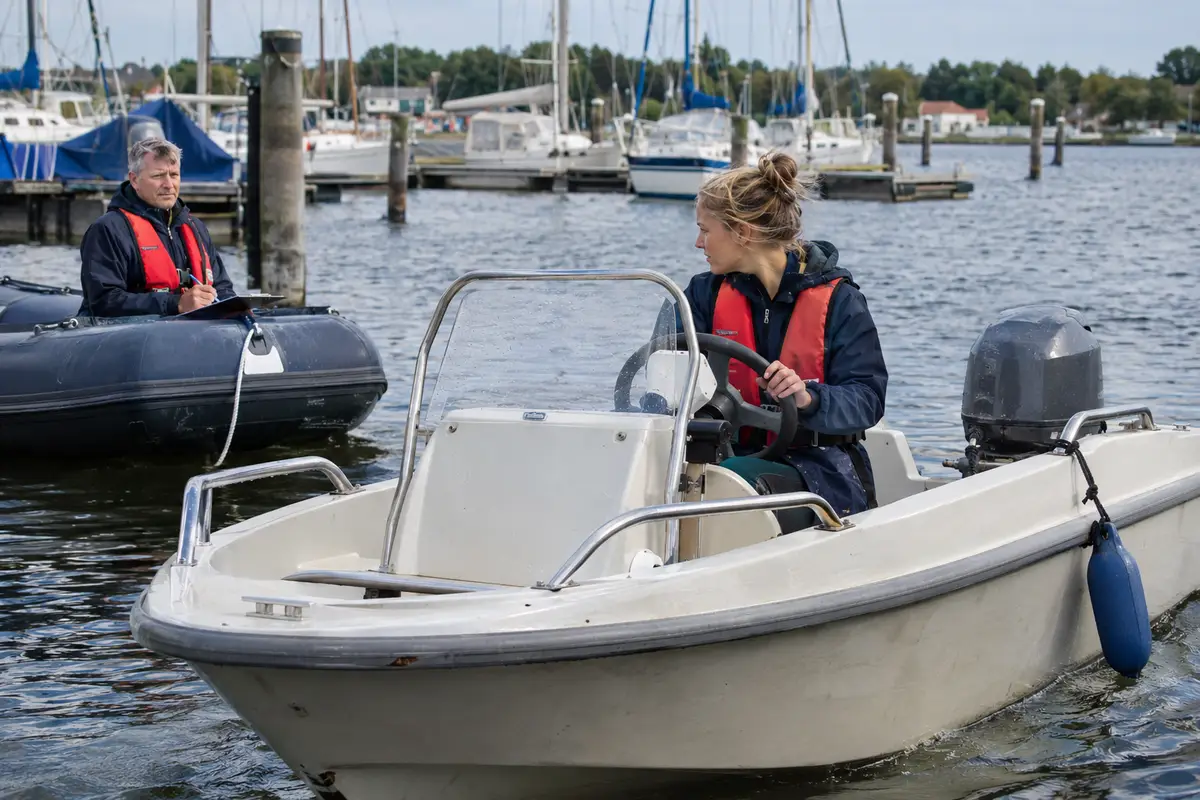
Pass the theory and practical sections within one year; the practical exam includes boat handling and knots.
Theory at a glanceHow the question paper is structured
| Section | Tasks | To pass |
|---|---|---|
| Basic questions | 7 | At least 5 correct |
| Sea-specific questions | 23 | At least 18 correct |
| Navigation exercise | 9 questions requiring written answers | At least 7 correct |
| Total | 39 tasks in 60 minutes | Pass all three sections |
The multiple-choice questions each offer four answers, exactly one of which is correct. Topics include KVR, IALA Region A buoyage, lights and shapes, sound signals, basic seamanship, weather and German navigation authority regulations.
Germany’s licencesWhich licence suits which boat?
- Charterbescheinigung (charter certificate)hired cabin boats, quiet inland routes
- Ferienpatent für den Bodensee (temporary Lake Constance permit)temporary recognition of an existing licence
- Sportbootführerschein mit dem Geltungsbereich Binnenschifffahrtsstraßen – unter Segel (inland recreational boat licence under sail)sailing recreational craft under 20 metres on federal inland waterways
- Sportbootführerschein mit dem Geltungsbereich Binnenschifffahrtsstraßen – mit Antriebsmaschine (inland recreational boat licence under power)motorboats under 20 metres on federal inland waterways
- Sportbootführerschein mit dem Geltungsbereich Seeschifffahrtsstraßen (sea recreational boat licence)motorboats on German sea waterways
- Bodenseeschifferpatent – Kategorie D (Lake Constance sailing licence)sailing on Lake Constance
- Bodenseeschifferpatent – Kategorie A (Lake Constance motorboat licence)motorboats on Lake Constance
- Hochrheinpatent (High Rhine endorsement)additional endorsement for the specified High Rhine section
- Sportschifferzeugnis (inland recreational vessel certificate)recreational craft up to 25 metres in inland zones 3 and 4
- Sportpatent (Rhine recreational vessel certificate)from 20 to under 25 metres on the Rhine and in inland zones 3 and 4
- Sportküstenschifferschein (coastal yacht certificate)private yachts within 12 nautical miles of the mainland coast
- Sportseeschifferschein (near-coastal yacht certificate)private yachts within 30 nautical miles of mainland coasts
- Sporthochseeschifferschein (ocean yacht certificate)private yachts on all the world’s seas
- Zusatzeintrag zum Sportsee- oder Sporthochseeschifferschein zum Führen von Traditionsschiffen (traditional-vessel endorsement on the near-coastal or ocean yacht certificate)traditional vessels from 25 to 55 metres
The magazine verdict on SBF-See
Why it stands out
- The official licence for powered recreational craft on German sea waterways
- No upper length or engine-power limit within its area of validity
- A clearly structured theory paper with navigation
Keep in mind
- The waters and propulsion power still determine whether you need it
- Theory and practice must be passed within one year
- SBF Binnen is intended for federal inland waterways
If your plans involve a motorboat on German sea waterways, SBF-See is the right starting point. Work carefully through the official question bank and take navigation seriously: that is where memorising answers turns into good seamanship.
Topics tested
Practice tests
IALACOLREG Exam Pass
SBF-See: get ready for your exam with the Exam Pass
Unlimited timed mock exams, every mistake back until it's right, and a readiness score that shows when you're ready for the exam.
512 exam-style questions with explanations · 7 timed subject exams · every simulator scenario
One payment for 12 months, so it covers a resit too. No subscription.
Practice questions (with answers)
A North Cardinal mark indicates safe water lies to the:
Show answer
Correct answer: C. North of the mark
Cardinal marks indicate safe water lies on the named side: North cardinal = pass to the north.
An isolated danger mark indicates:
Show answer
Correct answer: B. A danger with navigable water all around
An isolated danger mark is on or near a danger with navigable water around it. Consult charts and nautical publications for the extent of the danger and safe passing distance.
Safe water marks have:
Show answer
Correct answer: A. Red and white vertical stripes
Safe water marks are red and white vertical stripes, indicating navigable water all around.
Special marks are coloured:
Show answer
Correct answer: C. Yellow
Special marks are yellow, indicating special areas like military zones, cables, or pipelines.
If in doubt whether a head-on situation exists:
Show answer
Correct answer: C. Assume it IS a head-on situation and alter to starboard
Rule 14(c): when in doubt, assume it IS a head-on situation and act accordingly.
Your power-driven vessel and another identified power-driven vessel are in sight in open water, crossing with risk of collision. She is on your starboard bow; neither is overtaking. Which duty applies to your vessel?
Show answer
Correct answer: B. Take early and substantial action to keep clear and, if circumstances admit, avoid crossing ahead
Rules 15 and 16 require your power-driven vessel to give way because the other power-driven vessel is crossing on your starboard side with risk of collision. A red sidelight alone would not establish vessel type or this duty.
A power-driven stand-on vessel acts under Rule 17(a)(ii) in a crossing with another power-driven vessel. If circumstances admit, she shall NOT:
Show answer
Correct answer: B. Alter course to port for a vessel on her port side
Rule 17(c) says a power-driven vessel taking action under Rule 17(a)(ii) in a crossing with another power-driven vessel shall, if circumstances admit, not alter to port for a vessel on her own port side.
Which encounter makes Rule 13 govern the keep-clear duty regardless of the vessel types listed in Rule 18?
Show answer
Correct answer: B. One vessel is overtaking another
Rule 18 expressly applies except where Rules 9, 10 and 13 otherwise require. In an in-sight overtaking encounter, Rule 13 requires the overtaking vessel to keep clear until finally past and clear.
The full guide
The SBF-See is the German recreational boating licence required for motor-powered pleasure craft on German sea waterways; the licence trigger is tied to the applicable engine-power and waterway rules.
Core: KVR (COLREG 1972), IALA buoyage, lights and shapes, sound signals, basic seamanship and weather, German waterway authority rules.
Who should take the SBF-See
Recreational skippers operating motor-powered pleasure craft on German sea waterways that fall within the SBF-See licence trigger; check the applicable waterway and engine-power rule before operating.
How to prepare
Master KVR rules 5–37, IALA Region A marks, basic chartwork. Practise the current syllabus and approved examination material, checking the latest BMV/authorised examination information.
Other exams
Reviewed by Ramon Curto, Nautical teacher at IECNPC · Last reviewed: