
- 20 mrecreational boat length to which the regulation applies on federal inland waterways§ 1 SpFV
- 11.03 kWcombustion-engine power limit without a licence§ 5 SpFV
- 7.5 kWelectric-motor power limit without a licence§ 5 SpFV
- From 16for power; from age 14 for sail§ 6 SpFV
- 30 questionsin the first power theory exam, with 45 minutes allowed
- 300 questionsin the official bank: basic, inland and sailing
Getting startedWhat SBF-Binnen is
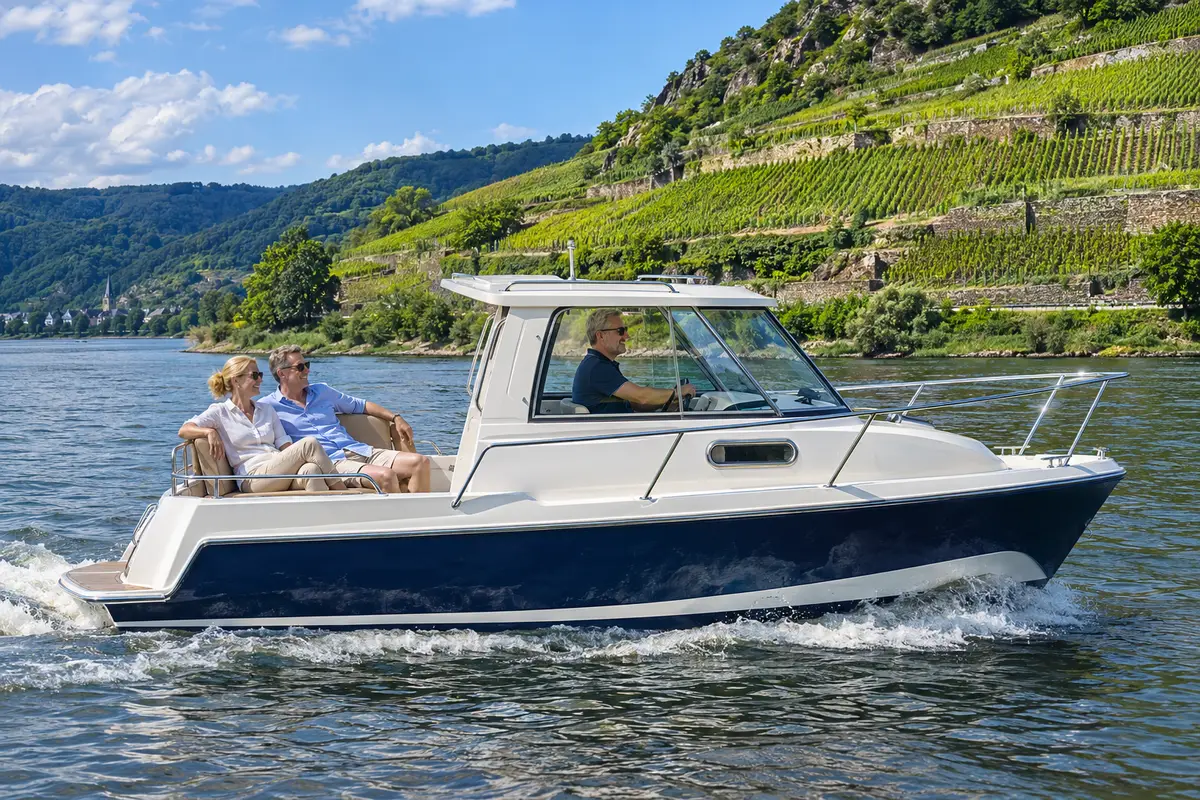
Sportbootführerschein Binnen (SBF-Binnen) is the licence for recreational craft under 20 metres on Germany’s federal inland waterways. You can obtain it for power and sail, separately or together. Your propulsion category matters: the licence is required for the particular category you operate (§ 3 Sportbootführerscheinverordnung, SpFV, the recreational boat licensing regulation).
Power or sailWhat SBF-Binnen covers
For a motorboat on federal inland waterways, SBF-Binnen becomes relevant when a combustion engine exceeds 11.03 kW or an electric motor exceeds 7.5 kW (§ 5 SpFV). For sailing, it is compulsory only on the inland waterways listed in annex 8 of SpFV. That makes it especially important to check both propulsion type and cruising area before setting off.
With the appropriate category, you can
- Operate powered recreational craft under 20 metres on federal inland waterways
- Operate sailing recreational craft under 20 metres on federal inland waterways
- Obtain power and sail categories together
What you should not assume
- That a licence for one propulsion type automatically covers the other
- That you can operate on federal inland waterways without a licence with a combustion engine above 11.03 kW (§ 5 SpFV)
- That international KVR (COLREG collision regulations) and IALA buoyage knowledge alone covers inland regulations
Before you registerWhat you need
- Be at least 16 for power (§ 6 SpFV)
- Be at least 14 for sail (§ 6 SpFV)
- Provide a medical fitness certificate (§ 6 SpFV)
- Pass the exam for your chosen propulsion category (§ 6 SpFV)
Step by stepHow to prepare for SBF-Binnen
- Choose your propulsion category
Decide whether you want the licence for power, sail or both. Your choice determines the question paper and examination sections.
- Study the official question bank
Work through the basic and inland questions in the official ELWIS bank; add the sailing questions for the sail licence. Also read the navigation regulations for your cruising area.
- Arrange an exam date
Ask the relevant Prüfungsausschuss (examination committee) about dates and registration.
- Pass theory and practice
A practical exam is generally required on a suitable recreational boat, which you must provide with a skipper. Theory and practice may take place on different dates and with different examination committees.
- Keep the one-year window in mind
All examination sections must be passed within one year (§ 8 SpFV).
The question paperWhat the theory exam looks like
Each multiple-choice question offers four answers, exactly one of which is correct. Your version depends on your chosen propulsion category and whether you already hold SBF-See (Germany’s sea recreational boat licence).
| Variant | Questions and time | Pass requirement |
|---|---|---|
| Power | 30 questions in 45 minutes: 7 basic and 23 inland questions | At least 5 of 7 basic questions and 18 of 23 inland questions correct |
| Power and sail | 37 questions in 60 minutes: an additional 7 sailing questions | At least 5 sailing questions correct |
| Sail only | 25 questions in 35 minutes: 4 basic, 14 inland and 7 sailing questions | At least 20 points overall |
| Power with SBF-See | 23 inland questions in 35 minutes | At least 18 correct |
Germany at a glanceWhere SBF-Binnen fits among the licences
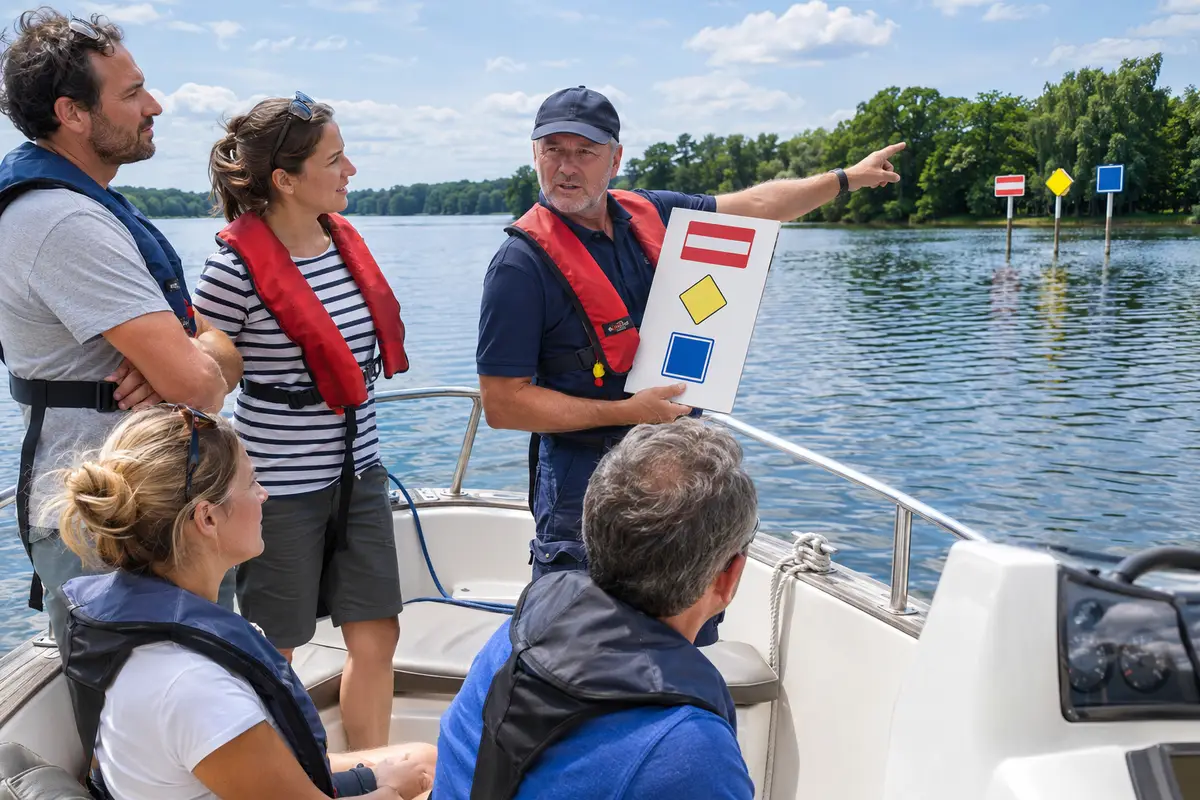
Germany has different qualifications for inland waters, the Bodensee (Lake Constance), the Rhine and sea waterways. The order here follows the overview of German recreational boating qualifications; length and distance appear only where specified for the qualification concerned.
- Charterbescheinigung (charter certificate)hired cabin boats on listed inland routes
- Ferienpatent für den Bodensee (temporary Lake Constance permit)temporary recognition of a suitable existing licence
- Sportbootführerschein mit dem Geltungsbereich Binnenschifffahrtsstraßen – unter Segel (inland recreational boat licence under sail)for sailing recreational craft on federal inland waterways
- Sportbootführerschein mit dem Geltungsbereich Binnenschifffahrtsstraßen – mit Antriebsmaschine (inland recreational boat licence under power)for powered recreational craft on federal inland waterways, including the Rhine
- Sportbootführerschein mit dem Geltungsbereich Seeschifffahrtsstraßen (sea recreational boat licence)for powered recreational craft on German sea waterways
- Bodenseeschifferpatent – Kategorie D (Lake Constance sailing licence)sailing on Lake Constance
- Bodenseeschifferpatent – Kategorie A (Lake Constance motorboat licence)motorboats on Lake Constance
- Hochrheinpatent (High Rhine endorsement)additional endorsement for the specified High Rhine section
- Sportschifferzeugnis (inland recreational vessel certificate)for recreational craft in inland zones 3 and 4
- Sportpatent (Rhine recreational vessel certificate)for recreational craft from 20 metres to under 25 metres
- Sportküstenschifferschein (coastal yacht certificate)private yachts within 12 nautical miles of the mainland coast
- Sportseeschifferschein (near-coastal yacht certificate)private yachts within 30 nautical miles of mainland coasts
- Sporthochseeschifferschein (ocean yacht certificate)private yachts on all the world’s seas
- Zusatzeintrag zum Sportsee- oder Sporthochseeschifferschein zum Führen von Traditionsschiffen (traditional-vessel endorsement on the near-coastal or ocean yacht certificate)for traditional vessels from 25 metres to 55 metres
The magazine verdict
Why it stands out
- You can choose power, sail or both to suit your plans
- The official ELWIS question bank makes theory preparation approachable
- Theory and practice can be taken on different dates and with different examination committees
Keep in mind
- You need to study inland rules specifically, alongside international fundamentals
- For sailing, the licence is compulsory only on the waterways listed in annex 8 of SpFV
- All examination sections must be passed within one year (§ 8 SpFV)
SBF-Binnen is a clear, useful starting point for anyone planning to use power or sail on federal inland waterways. Choose your propulsion category carefully, study the official bank and check the rules for your cruising area before each trip. The licence then becomes more than a document: it is a sound foundation for calm, attentive days afloat.
Related basics (international rules)
Practice tests on the international rules
IALACOLREG Exam Pass
SBF-Binnen: get ready for your exam with the Exam Pass
Unlimited timed mock exams, every mistake back until it's right, and a readiness score that shows when you're ready for the exam.
512 exam-style questions with explanations · 7 timed subject exams · every simulator scenario
One payment for 12 months, so it covers a resit too. No subscription.
Practice questions (with answers)
An isolated danger mark indicates:
Show answer
Correct answer: B. A danger with navigable water all around
An isolated danger mark is on or near a danger with navigable water around it. Consult charts and nautical publications for the extent of the danger and safe passing distance.
Safe water marks have:
Show answer
Correct answer: A. Red and white vertical stripes
Safe water marks are red and white vertical stripes, indicating navigable water all around.
Special marks are coloured:
Show answer
Correct answer: C. Yellow
Special marks are yellow, indicating special areas like military zones, cables, or pipelines.
Two sailing vessels in sight approach with risk of collision, neither overtaking, and have wind on different sides. Which gives way?
Show answer
Correct answer: B. The vessel with wind on port side gives way
Rule 12(a)(i): when each has wind on a different side, the vessel with wind on port side keeps out of the way.
Two sailing vessels in sight have wind on the same side and approach with risk of collision; neither is overtaking. Which gives way?
Show answer
Correct answer: B. The windward vessel gives way
Rule 12(a)(ii): when both have wind on the same side, the windward vessel keeps out of the way.
A vessel is considered overtaking when approaching from:
Show answer
Correct answer: C. More than 22.5 degrees abaft the beam of the other vessel
Rule 13(b): a vessel is overtaking when coming up from more than 22.5 degrees abaft the beam.
A head-on situation exists at night when you see:
Show answer
Correct answer: B. Both sidelights and masthead lights nearly in line
Rule 14(b): head-on exists when a vessel sees both sidelights and/or masthead lights in a line or nearly in a line.
How does IALA Region B differ from Region A?
Show answer
Correct answer: B. The colours are reversed — red to starboard
Region A: port-hand red, starboard-hand green. Region B: port-hand green, starboard-hand red. Interpret both in the charted conventional direction of buoyage.
The full guide
The SBF-Binnen is the German licence for pleasure craft under 20 m on federal inland waterways, issued for engine, sail or both.
The theory test draws on the official ELWIS catalogue (72 basic, 181 inland and 47 sailing questions). Inland waterways follow their own traffic rules, such as the BinSchStrO; our quizzes cover the international rules only.
Who needs the SBF-Binnen
Skippers of pleasure craft with an engine above 11.03 kW (combustion) or 7.5 kW (electric) on German federal inland waterways, and sailors on the waterways listed in Annex 8 of the SpFV.
How to prepare
Study the official ELWIS catalogue for the inland waterways and the traffic rules that apply where you will sail. Use these lessons for background on buoyage, lights and sound signals.
Other exams
Reviewed by Ramon Curto, Nautical teacher at IECNPC · Last reviewed: