Congo - Brazzaville
- Who issues it
- Direction générale de la marine marchande [Directorate General of the Merchant Marine]
- Minimum age
- 21 years
- Buoyage
- IALA region A
- Collision rules
- Règlement international de 1972 pour prévenir les abordages en mer
Do you need a licence?
At sea, anyone driving a motor pleasure boat must be 21 or older, and a permit is needed once the engine is over 10 CV (metric horsepower). Inland, boats under 5 tonnes or under 15 m are exempt; bigger ones need the CEMAC/DRC boatmaster permit, which asks for age 21 and 4 years of deck crew service.
Permis A · Class A permit
From 21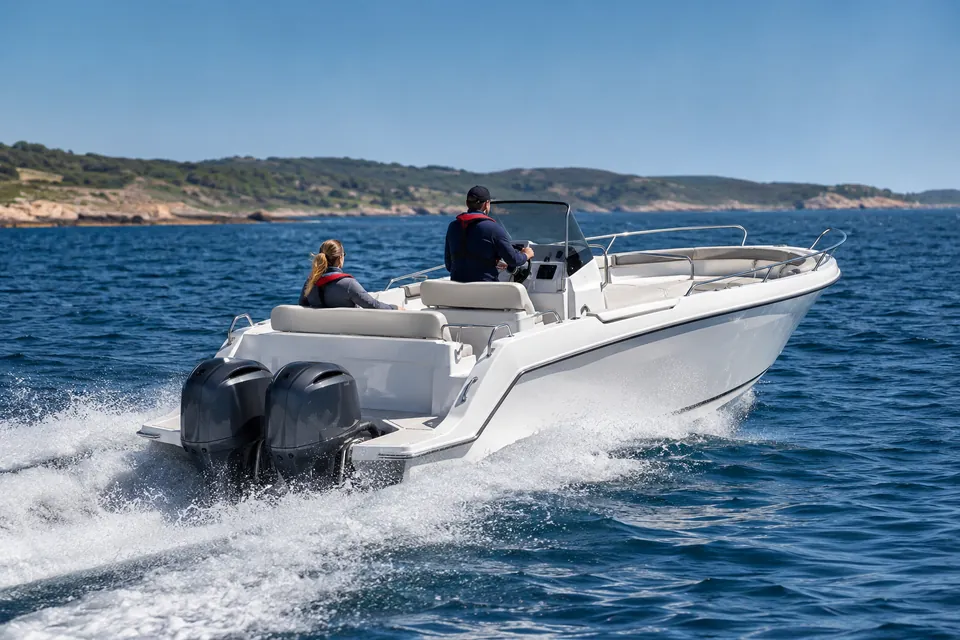
- What it lets you do
- At sea: motorboats under 800 kg (engine included) up to 5 nautical miles from a shelter, or bigger boats up to 5 nautical miles from the coast.
- How you get it
- Oral or written theory covers buoyage, collision rules and signals. The boat test includes docking and man overboard recovery. Pass each test with 10/20.
- Where to study
- Study it in Academy
Permis B · Class B permit
From 21- What it lets you do
- At sea: motor pleasure boats of 25 tons or less going more than 5 nautical miles from a shelter.
- How you get it
- Oral or written theory adds chartwork and tides. The boat test includes docking and man overboard recovery. Pass each test with 10/20.
- Where to study
- Study it in Academy
Permis C · Class C permit
From 21- What it lets you do
- At sea: pleasure boats of more than 25 gross tons.
- How you get it
- Oral or written theory adds chartwork and tides. The boat test includes docking and man overboard recovery. Pass each test with 10/20.
- Where to study
- Study it in Academy
Professional deck titles
Certificat de matelot qualifié « Pont »
STCW II/4- What it lets you do
- Serve as a deck rating on a bridge watch team.
- Where to study
- Study it in Academy
Chef de quart
STCW II/1- What it lets you do
- Lead a bridge watch on ships over 500 gross tonnage.
- Where to study
- Study it in Academy
Capitaine côtier
STCW II/3- What it lets you do
- Serve as master or chief mate on ships under 500 gross tonnage on near-coastal voyages.
- Where to study
- Study it in Academy
Capitaine de la navigation maritime
STCW II/2- What it lets you do
- Serve as master or chief mate on ships under 3,000 gross tonnage on offshore voyages.
- Where to study
- Study it in Academy
Capitaine au long cours
STCW II/2- What it lets you do
- Serve as master or chief mate on ships over 3,000 gross tonnage.
- Where to study
- Study it in Academy
Radio certificates
Certificat restreint de radiotéléphoniste
- What it lets you do
- Restricted radiotelephone operator certificate for a ship station.
- Where to study
- Study it in Academy
Certificat général de radiotéléphoniste
- What it lets you do
- General radiotelephone operator certificate for a ship station.
- Where to study
- Study it in Academy
Certificat restreint d’opérateur pour les besoins du SMDSM
ROC- What it lets you do
- Restricted GMDSS operator certificate, for distress and safety radio in sea area A1.
- Where to study
- Study it in Academy
Certificat général d’opérateur pour les besoins du SMDSM
GOC- What it lets you do
- General GMDSS operator certificate, for distress and safety radio in all sea areas.
- Where to study
- Study it in Academy
Certificat de radioélectronicien de 2e classe
- What it lets you do
- Second-class radio electronics certificate for ship radio stations.
- Where to study
- Study it in Academy
Certificat de radioélectronicien de 1re classe
- What it lets you do
- First-class radio electronics certificate for ship radio stations.
- Where to study
- Study it in Academy
Brevet d’officier radioélectricien
- What it lets you do
- Officer's certificate for running a ship's radio service.
- Where to study
- Study it in Academy
Ready to study for it?
Start the Academy free with an account: the first lessons of every topic and three timed mocks per exam, marked like the real exam, with your progress saved.
Official sources: Ministère des Transports et de l’Aviation civile — Arrêté n° 9254 du 12 décembre 1984 sur la conduite en mer des navires de plaisance à moteur · CICOS — Code de la navigation intérieure CEMAC/RDC, article 2 and annexe 9-1 (permis de conducteur de bâtiment) · CEMAC — Code communautaire de la marine marchande, articles 409–412 · ARPCE — Loi de finances pour l’année 2011, radio operator certificate exam fees (archived copy) · Journal officiel de la République du Congo — Arrêté n° 6967 du 3 mai 2011 sur le trafic maritime à Pointe-Noire · IALA — R1001 The IALA Maritime Buoyage System, edition 2.0