
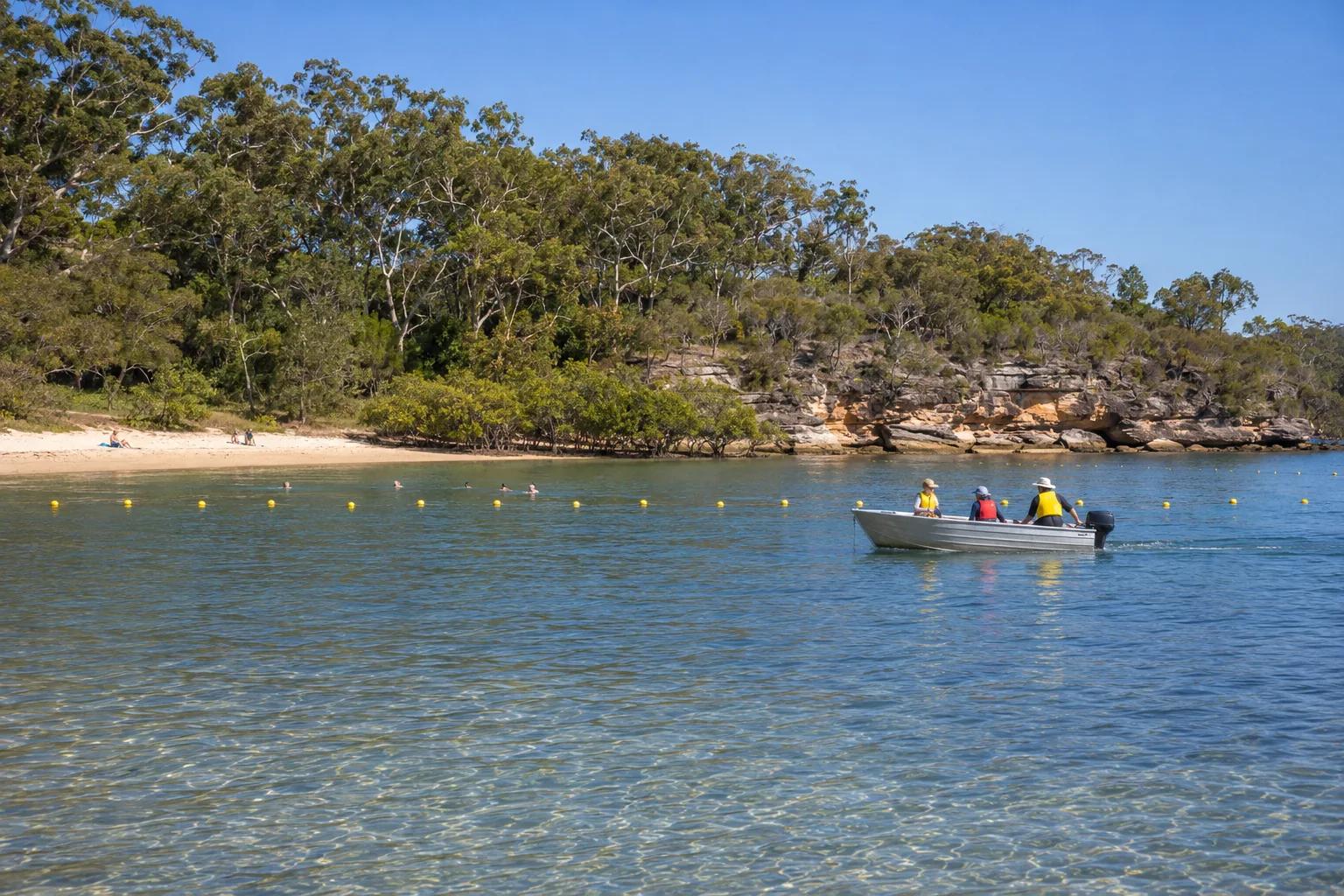
Decide
Four situations at sea. Decide first, then read why.
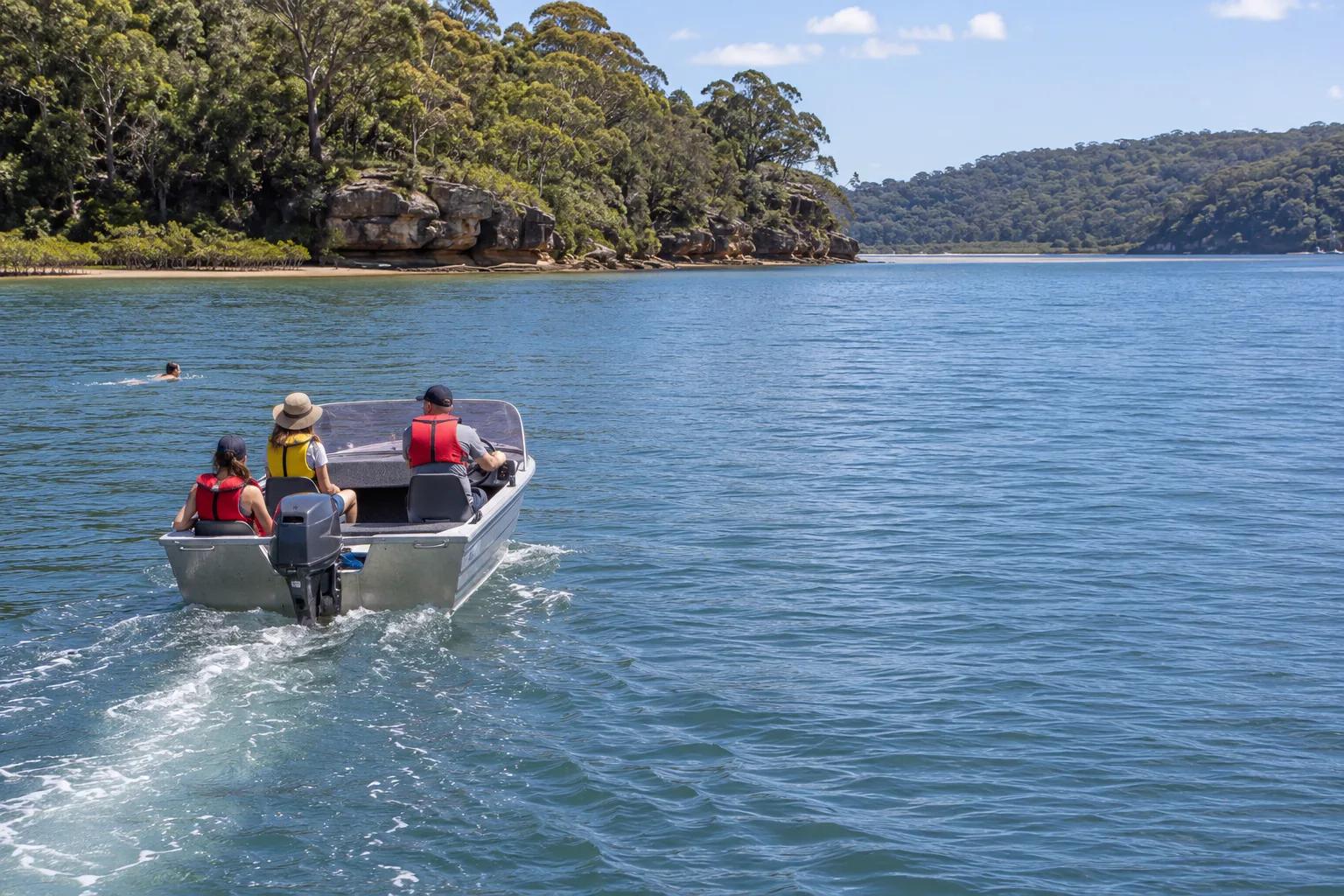
On Pittwater you plan to motor past a swimmer 40 metres away. There is open water to your right. What should you do?
Key points
- 60 for people, 30 at 6 knotsOn a powered boat, keep 60 metres from people in the water and 30 metres from boats, shore and structures at 6 knots or more.
- The 60-metre rule also covers dive floats and designated swimming and surf-zone boundaries.
- Moored boats, bridges, jetties and navigation markers count.
- Exceptions and confined situations still require a safe distance and safe speed. Naval vessels: 200 metres from the bow and 60 metres from the side underway; 60 metres at anchor.
- Watch your wakeThe safe speed may be well below the sign, especially near small boats and the shore.
- Allow time to stop or turn in the actual conditions.
- Slow well before reaching an anchorage or busy beach.
- Look astern: a speed limit does not excuse excessive wash.
- Choose a sober crewNSW: zero BAC under 18; below 0.05 for adults on recreational vessels.
- Drivers, towing observers and riders all have BAC limits.
- The adult commercial limit in the NSW handbook is below 0.02.
- You cannot reliably calculate your BAC from the number of drinks; plan no alcohol.
- People and loadCheck both capacity and weight, then keep passengers safely within the boat underway.
- Follow the Builders Plate if fitted; equipment adds to the load.
- Carry an approved lifejacket for everyone.
- No casual bow, platform or transom riding, or legs dangling outside a powered boat underway.
- One driver, one observer, a clear towWatch the rider throughout the tow and leave room for their wider path.
- An observer under 16 needs a boat or PWC licence; the observer faces backwards.
- Every rider wears a Level 50S or higher lifejacket. Ordinary tows keep the rider at least 7 metres behind; the shorter-distance exception has strict conditions.
- Maximum three people towed; no towing between sunset and sunrise. Under-16 driver wording conflicts: use the stricter no-towing approach and check the current TfNSW page.
- Wakesurfing without a rope still has a 7-metre separation rule and the same strict exception. Recover riders at a safe speed; stop and bring them aboard if safe. On the road, nobody rides in the trailer or boat being trailered.
- Check the state before you goVictoria uses an under-21 zero-BAC rule; Queensland recreational skippers must stay below 0.05.
- Victoria's under-21 zero rule includes being in charge at anchor.
- For Victoria's unresolved age-21 wording, plan no alcohol and check Safe Transport Victoria; for NSW, check the current TfNSW page.
- Conservatively stay below 0.05 if older in Victoria; check its current boundary wording.
- Check MSQ's separate commercial rules before commercial operation.
Check what you have read
You are motoring at 4 knots towards a swimmer on an open stretch of Pittwater. You have plenty of room to divert. What minimum clearance must you keep?
Worked case: A careful start to a Hawkesbury tow
You are a licensed 30-year-old skipper planning a daytime biscuit tow behind your outboard runabout on the Hawkesbury River. You have had no alcohol. Your 15-year-old cousin offers to observe but has no boat or PWC licence. The proposed run passes 45 metres from a swimmer and 25 metres from a moored boat at 12 knots. There is room farther out to choose another route.
Before you read the solution: what would you do?
True or false?
Decide each statement before you see the answer.
An adult recreational skipper is allowed a BAC of exactly 0.05.
Watch the rider throughout the tow and leave room for their wider path.
The speed sign lets me make this wake.
Check both capacity and weight, then keep passengers safely within the boat underway.
The safe speed may be well below the sign, especially near small boats and the shore.
If the boat clears the jetty by 30 metres, the tow is clear too.
An observer is only a passenger, so age and alcohol do not matter.
On a powered boat, keep 60 metres from people in the water and 30 metres from boats, shore and structures at 6 knots or more.
A passenger can stay in the boat on the trailer if we only drive around the corner.
NSW: zero BAC under 18; below 0.05 for adults on recreational vessels.
Victoria uses an under-21 zero-BAC rule; Queensland recreational skippers must stay below 0.05.
If I drop below 6 knots, I can choose to pass right beside a swimmer.
Exercise: Build a safe towing plan
You are an adult skipper in a powered runabout on Lake Macquarie, in daylight. There is ample room to choose a clear route. Use NSW rules.
Step by step
What is the minimum clearance from a swimmer on your ordinary towing route?
Show the solution
Keep the vessel, tow equipment and rider at least 60 metres from the swimmer. Boating Handbook, p. 104.
At 8 knots, what minimum clearance must the whole tow keep from a moored yacht?
Show the solution
At 6 knots or more, the minimum is 30 metres. It applies to the rider and equipment as well as the boat.
Your proposed observer is 14 and holds a boat licence. They are sober, fit to observe and know the signals. Does their age alone disqualify them?
Show the solution
The handbook requires a boat or PWC licence for observers under 16; it does not set a blanket minimum of 16 or 18. They must also meet the other observer requirements. Boating Handbook, p. 102.
Your wake rocks a nearby anchored dinghy even though you are below the local speed limit. What do you do?
Show the solution
The speed limit does not permit excessive wash. Look astern and slow down to reduce the impact. Boating Handbook, pp. 98–99.
Now on your own
Now plan an afternoon tow on Pittwater with an outboard runabout. The rider is 17, your adult observer is sober, and sunset is approaching.
For this ordinary tow behind an outboard, what minimum distance should the rope keep the rider behind the vessel?
What BAC must your 17-year-old rider have?
The sun has set but you still have good visibility. Can you make one final towing run?
At the ramp, a passenger wants to sit in the boat while you tow it home on its trailer. What do you say?
Check: 10 questions
Questions from this subject, explained after each answer.
Free: lesson + 10 questions · Exam Pass: all 30 questions, unlimited practice tests, your mistakes retrained
The full explanation and the lessons for each programme item
Topic 1 of 6
Give people and boats enough room
On a powered boat, keep at least 60 metres from people in the water, the boundaries of designated swimming areas and surf zones, and dive flags or floats.
The handbook includes sailing boats over 5.5 metres in this 60-metre rule, as well as PWC. The rule applies below 6 knots too. Divers and spearfishers can be up to 100 metres from their float or flag, so take extra care within 200 metres of them. A signed swimming area extends 60 metres from shore between the signs; a designated swimming area in a surf zone extends 500 metres from shore between patrol flags or signs. Measure your clearance from the boundary, not just from any swimmers you can see. Boating Handbook, pp. 89–90.
At 6 knots or more, a powered vessel must also keep at least 30 metres from other vessels, the shore and structures. That includes anchored and moored boats, jetties, bridges and navigation markers. Below 6 knots you still need a safe distance. A minimum is a starting point: traffic, visibility and your stopping distance may call for more room.
The handbook lists exceptions for supporting swimmers or divers, launching or retrieving, paddlecraft and rowing vessels, sailing vessels up to 5.5 metres without an engine, and Surf Life Saving NSW or lifeguard activities. If an exception applies, or the minimum distance is not possible, you must still keep a safe distance and travel at a safe speed. Do not choose a close shortcut when there is room to keep clear.
Naval vessels have larger exclusion zones for all vessels: stay at least 200 metres from the bow and 60 metres from the side of a naval vessel underway. At anchor, keep at least 60 metres from it. Marine mammals also have separate approach-distance rules. Boating Handbook, p. 91.
- People in the water and dive flags: 60 metres minimum for powered vessels.
- Vessels, shore and structures: 30 metres minimum at 6 knots or more.
- Judge the whole situation throughout the trip, including what is behind you.
Topic 2 of 6
A speed limit still leaves you a decision
Always travel at a speed that gives you time to stop or turn away from danger.
A posted limit is the maximum allowed there; you may need to go much slower. Many NSW waterways have no posted speed limit, but the safe-speed duty still applies. Think about visibility, traffic, wind and current, water depth, hazards, and how your boat stops and turns. At night, hazards may be unlit and background lights can hide other vessels, so reassess your speed. Boating Handbook, pp. 92–93.
Speed signs show knots and may have arrows showing where the limit applies. There is no universal 4-knot rule for every NSW shoreline. Read the local signs and keep the required distances.
Wash is the wake and waves your boat creates. You must not create excessive wash that damages or unreasonably affects other vessels, the shore, structures or works. You are responsible for damage your wash causes. Many powerboats make their biggest wash when half on the plane. Slow well before a busy beach or anchorage, then look astern to check the result. Boating Handbook, pp. 98–99.
No Wash, Reduce Wash and Minimise Wash signs mean you must travel at a speed that creates minimal wash. If your wake rocks nearby boats or breaks against the bank, slow down. Staying below the posted speed limit does not excuse excessive wash. You must also have lawful authority before securing a vessel to a bridge or navigation aid. Boating Handbook, p. 99.
- Reassess your speed when traffic, visibility or conditions change.
- Slow early so your earlier wake does not follow you into an anchorage.
- Check your wash behind you, as well as your speed ahead.
Topic 3 of 6
A sober skipper and safe passengers
In NSW, the BAC limit is 0.00 for anyone under 18.
For people aged 18 and over it is under 0.05 on a recreational vessel and under 0.02 on a commercial vessel. These limits apply to the driver, the towing observer and the person being towed. As skipper, do not let someone drive if you believe they are over the legal limit or under the influence of illegal drugs. Boating Handbook, pp. 94–95.
You cannot reliably work out your BAC by counting drinks. Wind, motion, noise and fatigue can make alcohol's effects worse on the water. Choosing no alcohol is the way to be sure you stay under the limit. Passengers are also advised to stay under the limit. Police can conduct random breath and drug tests while a vessel is underway, including while it is drifting. Staying under the limit at anchor is recommended in NSW in case you need to move.
Follow the Australian Builders Plate if your powerboat has one. Check both the people limit and maximum load, including equipment. If there is no plate, use the capacity guidance on the safety label. Do not simply fill every seat. Carry an approved lifejacket for everyone and reduce the load when conditions call for it. At times of heightened risk, passengers must put on their lifejackets when the skipper tells them to. Boating Handbook, p. 96.
While a powered vessel is underway, passengers must keep their bodies within its sides and bow. No legs dangling over the side, risky bow riding, or riding on the swim platform, ladder or transom. The skipper shares responsibility. The handbook allows exceptions for operating the vessel, fishing while anchored, moored or drifting, and securing the safety of people or property. Do not hold onto the stern while the vessel is underway (teak surfing). These exceptions are not permission for recreational platform riding. Never board or attach yourself or someone else to a vessel without authority or consent, except in an emergency or to avoid an immediate risk of injury or damage. Boating Handbook, p. 97.
- Under 18: zero BAC. Adults on recreational boats: below 0.05, not 0.05.
- The towing observer and rider have alcohol limits too.
- Check people, total load, lifejackets and safe seating before moving off.
Topic 4 of 6
Plan the tow, including the trip to the ramp
A boat towing a person needs a driver and a separate observer, registration if applicable, a safety label where required and the required safety equipment.
A towing PWC must be registered, display a PWC behaviour label and be designed for at least two people. Boating Handbook, p. 101.
A powerboat driver needs a boat licence at 10 knots or more; a PWC driver needs a PWC licence at any speed. The observer must hold a boat or PWC licence if under 16, be fit to observe, know the hand signals, keep a lookout and always face backwards towards the rider. Their job is to communicate with the rider and warn the driver about trouble and approaching vessels. The driver keeps a proper lookout ahead. Everyone being towed must wear a Level 50S or higher lifejacket; inflatable lifejackets are not recommended for towing. The driver must make sure the rope and equipment do not endanger or obstruct anyone. On a boat, the driver and observer must wear lifejackets when required by the lifejacket rules. On a PWC both must always wear one. Boating Handbook, pp. 13, 34, 101–103.
For an ordinary tow, use a rope long enough to keep the rider at least 7 metres behind the vessel. The handbook's shorter-distance exception requires both reduced carbon monoxide risk and a propeller forward of the back of the hull. Do not assume a short rope behind an outboard is safe. Avoid sudden loads on the rope: accelerating sharply while it is slack can seriously injure someone. Never pull someone through the water while they hold onto the back of the vessel. Never tow more than three people at once or tow between sunset and sunrise. Boating Handbook, pp. 101–105.
Page 103 limits towing drivers aged 16 or under to 10 knots, unless exempt in an organised event. For drivers under 16, the licensing webpage and handbook disagree about towing restrictions: use the stricter approach and do not drive while towing a person; check the current TfNSW page. Do not treat 10 knots as permission for an under-16 driver to tow. If the rider or anyone aboard is under 18, the maximum towing speed is 60 knots; conditions and local limits may require far less. Boating Handbook, pp. 20, 101–105.
The boat, tow equipment and rider must all keep the required distances: 60 metres from people in the water, swimming and surf-zone boundaries, and dive flags or floats; 30 metres from vessels, shore and structures at 6 knots or more. If those distances are not possible, safe distance and speed still apply. Allow extra room when turning: the rider swings wider than the boat, especially on an inflatable. Follow local no-towing signs. Aerial towing has a separate 200-metre clearance from other vessels, cables, wires, pipelines, bridges and structures. Tow-in surfing has its own special rules; do not use its observer exception for ordinary towing. Boating Handbook, pp. 104–105.
Wakeboarders and wakesurfers must stay at least 7 metres from the centreline of the stern, even without a rope, unless the same carbon-monoxide and forward-propeller conditions are met. They must wear lifejackets. Keep wash from affecting others unreasonably. When returning a rider to shore, keep clear of people and use a safe speed; a fast whip turn or fling finish can be fatal. If safe, stop and bring the rider aboard instead. Boating Handbook, pp. 103–106.
On the road, never carry a person in a trailer or the boat being trailered. Tow only one trailer and keep it under control. Learner drivers must not tow; P1 drivers may tow only a light trailer weighing less than 250 kg empty. If your vehicle and trailer combination is over 7.5 metres long, stay at least 60 metres behind other vehicles over 7.5 metres, except on a multi-lane road, in a built-up area or when overtaking. Check the road towing and dimension requirements for your combination. Boating Handbook, p. 107.
- Driver looks ahead; observer faces backwards and watches the rider.
- Every rider wears a lifejacket, including on an inflatable.
- Allow for the rider's wider path and stop towing before sunset.
- Recover a rider safely; stopping and bringing them aboard is recommended when safe.
Topic 5 of 6
In Victoria and Queensland
These are other states' rules, not NSW rules.
In Victoria, people under 21 operating or in charge of a vessel must have zero BAC, including at anchor. The reviewed Victorian page says people over 21 must not be over 0.05. Its exact-age-21 wording and the 0.05 boundary need checking. Use the stricter approach: no alcohol if you are 21 or younger, and stay below 0.05 if older. This is conservative study advice, not a claim that the unresolved wording is settled. Check Safe Transport Victoria's current page before boating there; check the current TfNSW page for NSW requirements.
In Queensland, a recreational skipper must have a BAC below 0.05. Do not apply NSW's commercial BAC table to Queensland; check MSQ's separate commercial rules. Check Maritime Safety Queensland before a trip there. Do not carry one state's age thresholds or commercial limits into another state.
- NSW under-18 and Victorian under-21 thresholds are different.
- Queensland recreational: below 0.05; check its separate commercial rules.
- Planning no alcohol avoids relying on an uncertain boundary.
Topic 6 of 6
Practise and go further
The best places to practise this subject. When you finish, one tap brings you back to the course.
- Keeping a proper lookout and judging riskLesson
- Planning a safe route near shoreLesson
- How forces affect boat handlingLesson
- Recreational boating responsibilitiesLesson
- Safety equipment and lifejacketsLesson
All lessons by programme item
- H5d Safe distance: 60 m from people in the water, 30 m from vessels, land and structures at 6 knots or more (Handbook pp. 89–91)
- H5e Safe speed, speed limits and wash (Handbook pp. 92–93, 98–99)
- H5f Alcohol limits and people on board (Handbook pp. 94–97)
- H6 Towing a person: observer, lifejackets and distances; towing a trailer (Handbook pp. 101–107)
- VQ3 Victoria and Queensland alcohol limits
Sources
- TfNSW Boating Handbook 2026: safe distance, speed, alcohol, passengers and wash, pp. 89–99 · checked
- TfNSW Boating Handbook 2026: towing a person and towing a trailer, pp. 101–107 · checked
- TfNSW boat and PWC licensing: under-16 towing wording conflicts with Handbook p. 20; also see p. 103 · checked
- Safe Transport Victoria: operating a boat safely, alcohol and drugs (other-state guidance) · checked
- Maritime Safety Queensland: alcohol and drug rules (other-state guidance) · checked
Checked against the official sources on .