
Ocean, tides and environment · Level R2 · 5 parts · about 16 min
Pollution at sea and MARPOL on board
5 short parts: Oil · Sewage · Garbage · Air & antifouling · Anchoring. Each part explains the idea, then gives the points to remember, the common mistakes, a worked case and a practice question; the Academy unit adds all 29 check questions.
1 · Oil
Oil: bilges, fuelling and spills
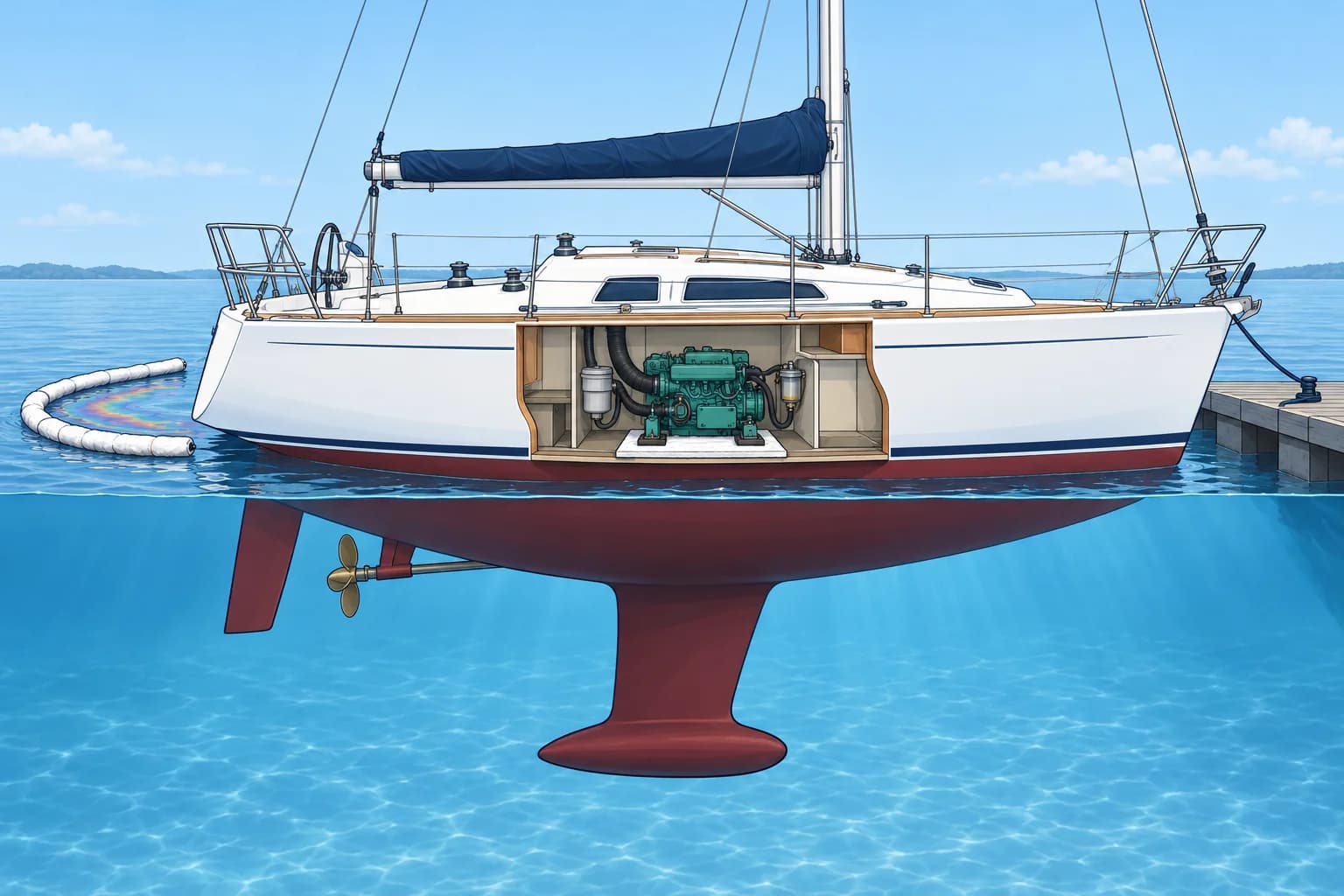
Even a small boat must keep oil out of the sea. Never pump oily bilge water overboard, fuel with care, and report any spill you cause or see.
MARPOL in one line
MARPOL is the IMO (International Maritime Organization) convention on pollution from ships. Its annexes (sections) cover oil (Annex I), sewage (Annex IV), garbage (Annex V) and air (Annex VI). Oil and garbage rules reach yachts; small-boat sewage rules usually come from national law. Coastal states may set stricter rules. See Law for the convention.
Oily bilge water
Fuel and lubricating oil end up in the bilge, the lowest part of the hull. Under Annex I a small ship may discharge oily water only while en route (making progress on your voyage), through approved equipment keeping oil at or below 15 ppm (parts per million). Yachts rarely carry such a separator. Keep the bilge clean, put absorbent pads under the engine, and land oily water and used pads at a port reception facility.
The automatic bilge pump
An automatic bilge pump can discharge leaked oil. If the water level is safe, stop automatic discharge using your pump’s controls. Manual/on may run it continuously. Monitor the bilge while you stop the leak and absorb the oil with pads; maintain essential pumping if safety requires it. Restore automatic operation once contamination is removed. Land oily water and pads ashore. Never add detergent: it disperses oil rather than removing it.
Fuelling
Most small spills happen at the fuel berth. A tank overflows through its vent, a small fitting on the hull side or deck, so know where yours is. Fill slowly near the end and stop short of full, because fuel expands as it warms. Keep a pad round the nozzle and one at the vent. The Ship module’s refuelling lesson gives the full safety routine.
Report it
A sheen, a thin rainbow film on the water, is enough to show oil. If you cause a spill, stop the source, contain it with pads and report it at once: to the harbour office in port, or to the coastguard on VHF channel 16 at sea. In the United States the National Response Center (1-800-424-8802) takes reports. Report spills you see too, with position, time and size.
Key figures
- Annex I limit for small ships
- 15 ppm oil, en route, through approved equipment only
- Practical yacht rule
- No oily bilge water overboard; land it ashore
- Detergent on a sheen
- Never: it hides the oil and can itself be an offence
- US spill reports
- National Response Center, 1-800-424-8802
Remember
- MARPOL oil and garbage rules reach yachts; small-boat sewage rules usually come from national law.
- Discharge needs approved 15 ppm equipment while en route; yachts rarely have it.
- If safe, stop automatic discharge and monitor the bilge; absorb oil with pads. Maintain essential pumping.
- Never use detergent on a sheen; contain the oil and report it.
- Report any spill you cause or see to the harbour office or the coastguard.
Common mistakes
Wrong: A little diesel in the bilge can go overboard; it evaporates.
Right: Oily bilge water stays on board. Soak it up with pads and land it at a reception facility.
Wrong: A squirt of washing-up liquid clears a sheen.
Right: Detergent only spreads the oil through the water. Contain it with pads and report the spill.
Wrong: Only the person who caused a spill needs to report it.
Right: Report any spill you see. Position, time and size help the authority respond quickly.
Worked case
Motoring into harbour, your crew sees a rainbow film spreading behind the boat. In the engine space the automatic bilge pump is running and the bilge water smells of diesel.
Show the answer
If the water level is safe, stop automatic discharge using the pump’s controls. Manual/on may keep it running. Monitor the bilge and maintain essential pumping if needed. Stop the leak and absorb the oil with pads; never add detergent. Report the spill to the harbour office or coastguard with position, time and size. Land oily water and pads ashore. Restore automatic operation once contamination is removed.
Practice question
Which MARPOL annex deals with pollution by oil?
- Annex I
- Annex IV
- Annex V
- Annex VI
Show the answer
Answer: A. Annex I covers oil, Annex IV sewage, Annex V garbage and Annex VI air pollution.
2 · Sewage
Sewage: MARPOL Annex IV and the rules for small boats
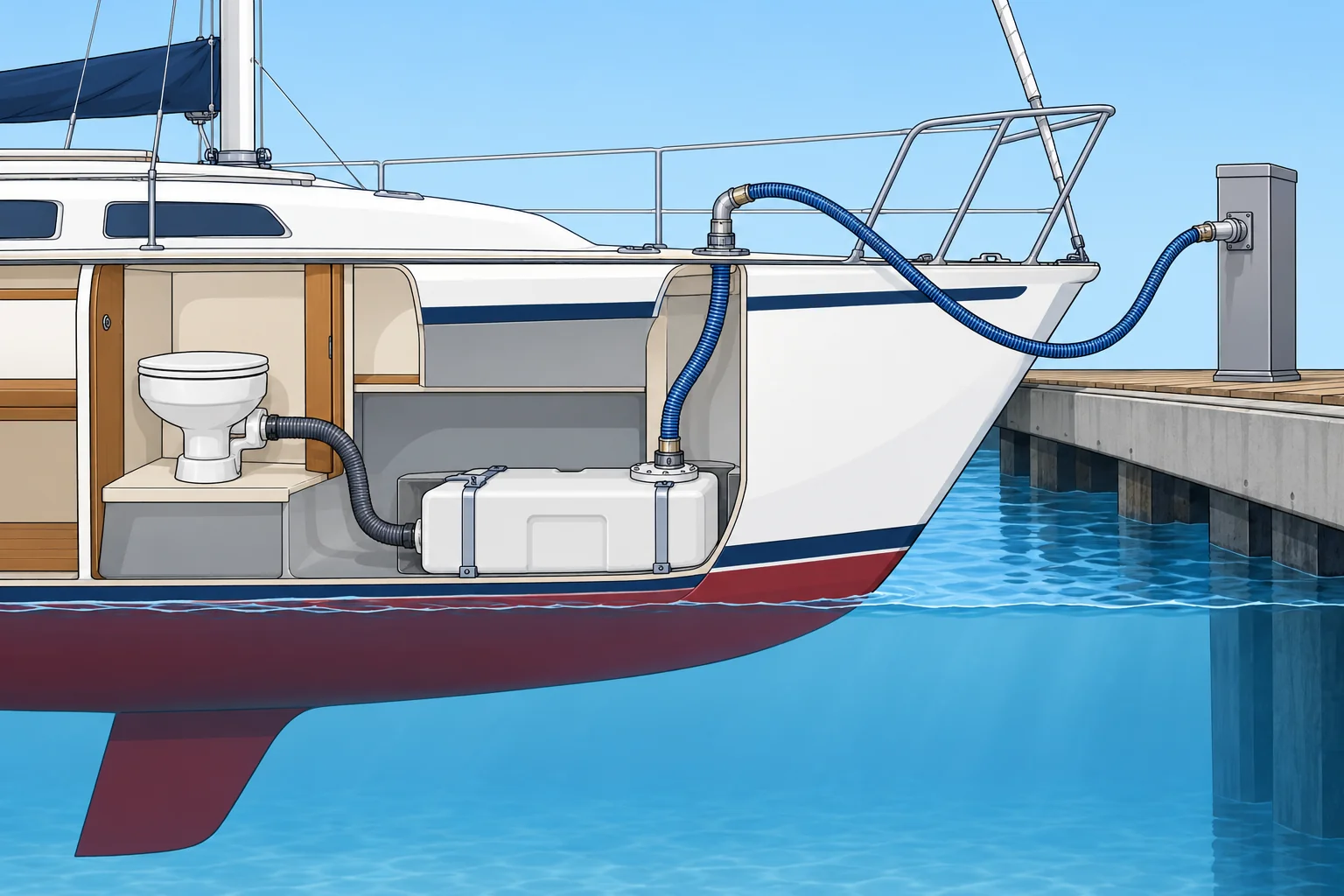
MARPOL Annex IV mostly covers bigger ships. Small boats fall under national and regional rules, which often ban toilet discharge near the coast.
Who Annex IV covers
MARPOL Annex IV covers international voyages by ships of 400 GT or more, or certified for more than 15 people. GT means gross tonnage: enclosed volume, not weight. Approved grinding and disinfection equipment permits discharge beyond 3 nautical miles (nm) from the nearest land. Untreated sewage needs more than 12 nm. Under these permissions, stored sewage must be released at an approved moderate rate while en route at 4 knots or more. Local bans still apply. Small yachts usually follow national rules instead.
National and regional rules
Small boats are covered instead by the coastal state, and the rules differ widely. Many ban toilet discharge in ports, marinas, bays and protected areas, and some ban it everywhere in their waters. Before a cruise, look up the rules for each country and area: pilot books, the harbour office and national boating websites carry them.
Examples
Sweden has banned toilet discharge from all recreational boats, foreign ones included, in its waters out to 12 nautical miles since 1 April 2015. In the United States, a boat with an installed toilet needs a certified marine sanitation device, and in a No Discharge Zone even treated sewage may not go overboard. In the Baltic special area, passenger ships must retain sewage or use an approved treatment plant meeting its additional nutrient-removal standards.
Holding tanks
A holding tank keeps toilet waste on board until you reach a pump-out station. Boats built under the current EU Recreational Craft Directive with a toilet must have a holding tank or a treatment system. Where discharge is banned, secure the Y-valve, the selector for tank or sea, to the tank. See Ship for the plumbing.
Grey water
Grey water comes from sinks and showers. Kept separate from sewage, it normally falls outside Annex IV. Mixed with sewage, it follows sewage rules. Local restrictions may also apply. Keep oil and food scraps out: mixing them in does not bypass pollution rules. Use little soap and scrape food into the bin; biodegradable soap can still harm marine life.
Key figures
- Annex IV scope
- International voyages, 400 GT or more, or certified for over 15 people
- Annex IV distances
- Ground + disinfected: >3 nm; untreated: >12 nm; conditions apply
- Sweden
- No toilet discharge from leisure boats since 1 April 2015
- US No Discharge Zone
- No sewage overboard, treated or untreated
Remember
- Annex IV covers ships of 400 GT or more, or certified for over 15 people, on international voyages.
- Small boats follow national and regional sewage rules, which vary from country to country.
- Many areas ban toilet discharge in ports, bays and protected areas; some ban it completely.
- A holding tank keeps waste aboard until a pump-out station.
Common mistakes
Wrong: My yacht is under 400 GT, so I may discharge sewage anywhere.
Right: Annex IV may not apply, but national rules do. Many ban discharge near the coast or completely.
Wrong: Treated sewage can always go overboard.
Right: In a US No Discharge Zone, no sewage may go overboard, whether treated or untreated. Other areas may impose the same ban.
Worked case
You plan a summer cruise from Denmark to the Stockholm archipelago in a 10 m yacht with a toilet, a holding tank and a Y-valve to an overboard outlet.
Show the answer
Sweden bans toilet discharge from all recreational boats in its waters out to 12 nautical miles, foreign boats included. Before you enter Swedish waters, set the Y-valve to the holding tank and secure it there. Confirm working pump-out facilities at your planned stops before departure, and plan your route around tank capacity.
Practice question
On international voyages, which ships does MARPOL Annex IV cover?
- Every boat with a toilet, whatever her size
- Ships of 400 GT or more, or certified for over 15 people
- Ships over 24 m long that carry paying passengers
- Only cruise ships sailing inside special areas
Show the answer
Answer: B. Annex IV applies to ships on international voyages of 400 GT or more, or certified to carry more than 15 persons.
3 · Garbage
Garbage: MARPOL Annex V and special areas
Under MARPOL Annex V almost nothing may go overboard. Plastics never, food waste only far from land, and the Mediterranean is a special area.
The basic rule
MARPOL Annex V starts from a ban: discharging garbage into the sea is prohibited unless the annex expressly allows it. It applies to every ship, a dinghy as much as a tanker. Plastics are never allowed overboard anywhere: bags, bottles, ropes, fishing line and cigarette ends. Paper, rags, glass, metal, cans and crockery are banned too. Bring it all back ashore.
Food waste outside special areas
Food waste is the main exception. Outside special areas, food ground small enough to pass a 25 mm screen may go overboard more than 3 nautical miles from the nearest land, while en route (making progress on your voyage). Food that is not ground needs more than 12 nautical miles, also en route. Most yachts have no grinder, so the 12-mile figure applies to you. Discharge as far from land as practicable, not simply just beyond the minimum.
Special areas
In a special area the rules are stricter: only ground food waste, more than 12 nautical miles from the nearest land, en route and as far from land as practicable. Unground food waste may not go overboard at all. These stricter rules are in force in the Mediterranean, Baltic and North Sea areas, among others.
Paperwork thresholds
Every ship of 12 m length overall or more must display placards showing the discharge rules. Ships of 100 GT or more, or certified for 15 or more people, need a written garbage management plan. Since 1 May 2024, ships of 100 GT or more also keep a garbage record book, as do ships certified for 15 or more people sailing to ports or offshore terminals of another country bound by MARPOL.
Good habits
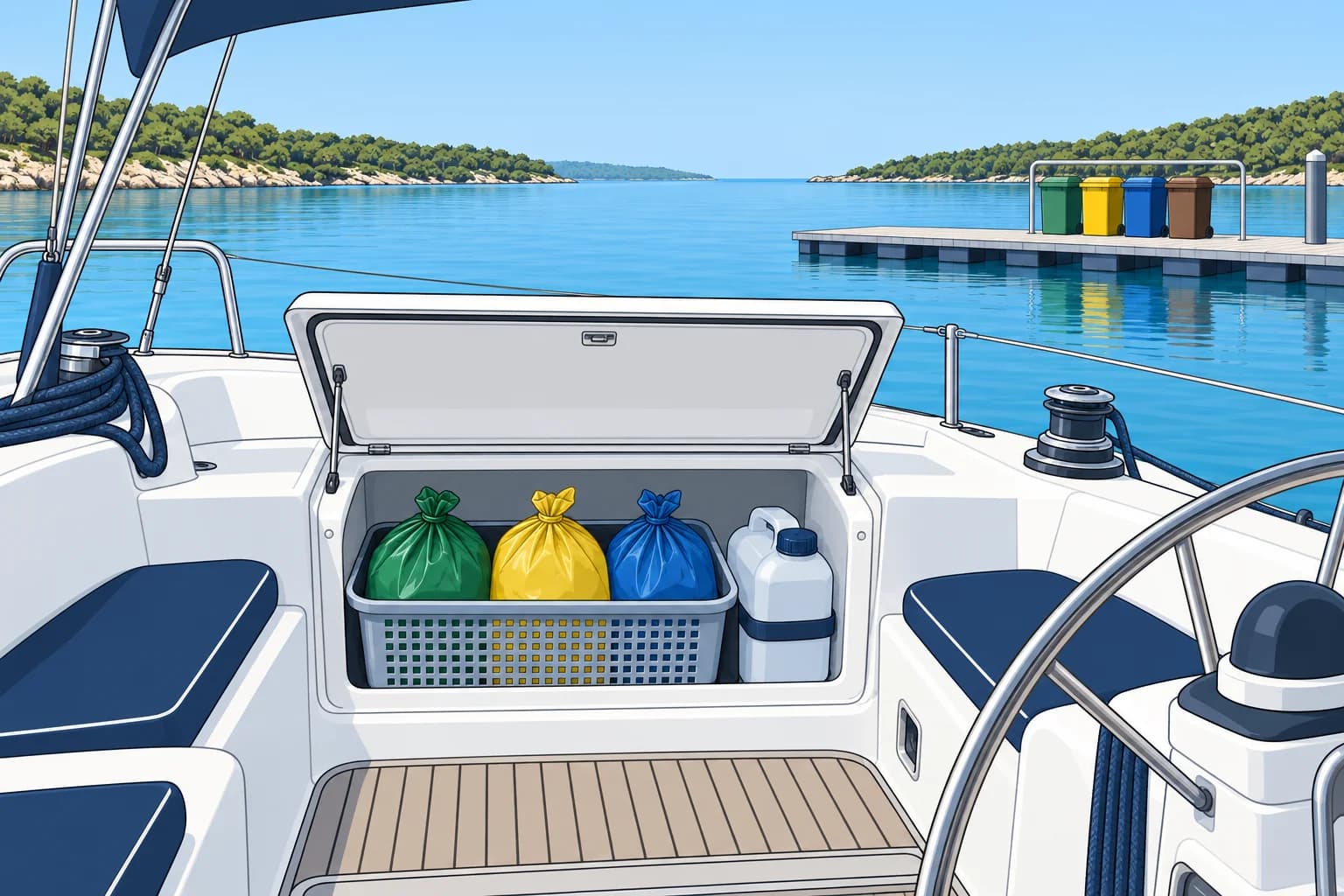
Plan your garbage before you sail. Leave packaging ashore, carry reusable containers, and keep separate bags for plastics, cans and glass, and food. Stow the bags so nothing blows overboard. Land everything at the marina’s reception facilities. If something goes overboard by accident, try to recover it.
Key figures
- Plastics
- Never overboard, anywhere
- Food waste, outside special areas
- Ground (25 mm): over 3 nm; not ground: over 12 nm; en route
- Food waste, in special areas
- Ground only, over 12 nm, en route; unground: never
- Placards
- Ships of 12 m length overall or more
- Garbage management plan
- 100 GT or more, or certified for 15 or more people
Remember
- Annex V bans garbage overboard except where it expressly allows it.
- Plastics never go overboard, in any sea, from any boat.
- Without a grinder, food waste needs over 12 nm from land outside special areas, en route.
- In the Mediterranean special area, only ground food waste, over 12 nm, en route.
- Boats of 12 m or more display garbage placards.
Common mistakes
Wrong: Biodegradable bags can go overboard.
Right: Bags count as plastic. No plastic of any kind goes overboard.
Wrong: In the Mediterranean, unground food scraps can go over the side 12 miles out.
Right: The Mediterranean is a special area: only ground food waste, over 12 nm, en route. Unground food stays aboard.
Wrong: Glass and cans sink, so they can go overboard far offshore.
Right: Annex V bans glass, metal and other garbage overboard everywhere. Land them ashore.
Worked case
You are crossing from Mallorca to Sardinia in an 11 m yacht with no food grinder, about 40 nautical miles from the nearest land. Your crew wants to throw vegetable peel and cooked leftovers overboard, and the bin is full of plastic packaging.
Show the answer
The Mediterranean is an Annex V special area. Only ground food waste may go overboard there, more than 12 nm from land and en route. Your food waste is not ground, so it stays aboard, in a sealed bag. The plastic packaging never goes overboard anywhere. Compress it, stow it securely and land everything at the marina in Sardinia.
Practice question
Under MARPOL Annex V, where may plastic garbage be thrown overboard?
- More than 12 nm from the nearest land
- More than 25 nm from the nearest land
- Nowhere: plastics must stay aboard
- Only outside designated special areas
Show the answer
Answer: C. Plastics, including ropes, fishing line and bags, may never be discharged into the sea.
4 · Air & antifouling
Air emissions and antifouling paint
The Mediterranean sulphur ECA began on 1 May 2025. TBT antifouling is banned; new cybutryne coats have been banned since 1 January 2023.
Annex VI and emission control areas
MARPOL Annex VI limits air pollution from ships. Without an approved equivalent compliance system, such as exhaust cleaning, fuel sulphur limits are 0.50 % globally and 0.10 % in an emission control area (ECA). The Mediterranean Sea became a sulphur ECA on 1 May 2025, joining the Baltic, the North Sea, the North American and US Caribbean areas. These requirements apply to yachts too.
What it means on a yacht
Do not assume marina diesel has road-diesel sulphur content; check the supplier’s fuel specification against the applicable limit. Keep the engine serviced, do not run it at idle for hours, and keep generators off at anchor when you can. Black smoke means poor combustion and wasted fuel.
Why antifouling is regulated
Antifouling paint stops weed and barnacles growing on the hull. Many paints work by releasing a biocide, a substance that kills or repels them. Some biocides harm far more than the fouling. TBT (tributyltin) deformed oyster shells and caused female sea snails to develop male sexual organs, disrupting reproduction. That damage led to an IMO convention.
The AFS Convention
The AFS Convention (International Convention on the Control of Harmful Anti-fouling Systems on Ships) bans organotin paints such as TBT. It entered into force in 2008. Since 1 January 2023 it also bans new coats of paint containing cybutryne, a weedkiller that harmed seagrass and algae.
Painting and cleaning
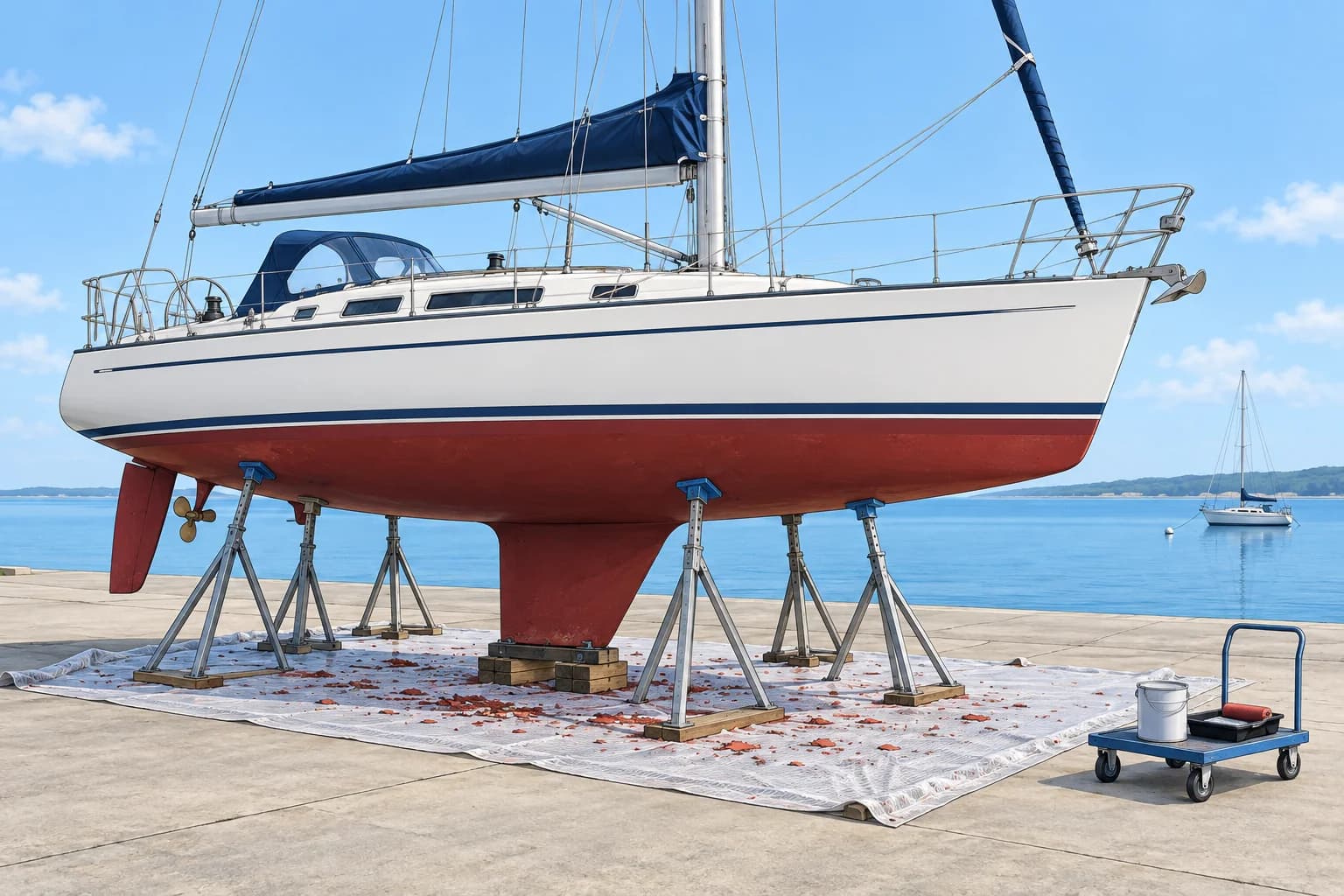
Do hull work ashore, on a hard standing that collects scrapings and wash water. Never scrape or pressure-wash antifouling into the sea. Many marinas ban in-water hull scrubbing.
Key figures
- Sulphur limit, global
- 0.50 % by mass, unless using an approved equivalent
- Sulphur limit inside an ECA
- 0.10 % by mass, unless using an approved equivalent
- Mediterranean sulphur ECA
- In effect since 1 May 2025
- TBT (organotin) paint
- Banned under the AFS Convention, in force since 2008
- Cybutryne paint
- New applications banned since 1 January 2023
Remember
- Without an approved equivalent, fuel sulphur limits are 0.50 % globally and 0.10 % in ECAs.
- The Mediterranean has been a sulphur ECA since 1 May 2025.
- TBT antifouling is banned; new cybutryne coats have been banned since 1 January 2023.
- Scrape and wash the hull ashore, where the waste is collected.
Common mistakes
Wrong: An old tin of cybutryne paint is still legal to apply.
Right: Do not apply it: new cybutryne coats have been banned since 1 January 2023.
Wrong: Scraping the hull in the water on a mooring is harmless.
Right: Paint flakes and biocide go straight into the sea. Do hull work on a hard standing that collects them.
Worked case
You buy a second-hand yacht in Greece. The old owner left a tin of antifouling dated 2016, labelled with cybutryne (Irgarol). Your friend suggests scrubbing the hull on the mooring and then applying it at the yard.
Show the answer
Do not apply it. Since 1 January 2023 the AFS Convention bans new coats of cybutryne paint. Dispose of the tin as hazardous waste at the yard. Clean the hull ashore on a hard standing that collects the scrapings, not on the mooring.
Practice question
Without an approved equivalent, what is the maximum fuel sulphur content inside an emission control area?
- 0.10 %
- 0.50 %
- 1.00 %
- 3.50 %
Show the answer
Answer: A. Without an approved equivalent compliance system, fuel sulphur is limited to 0.10 % by mass in an ECA and 0.50 % globally.
5 · Anchoring
Anchoring without harming seagrass
Anchors and chains tear up seagrass meadows that take centuries to grow. Anchor on sand, use buoy fields, and know the local bans.
The damage
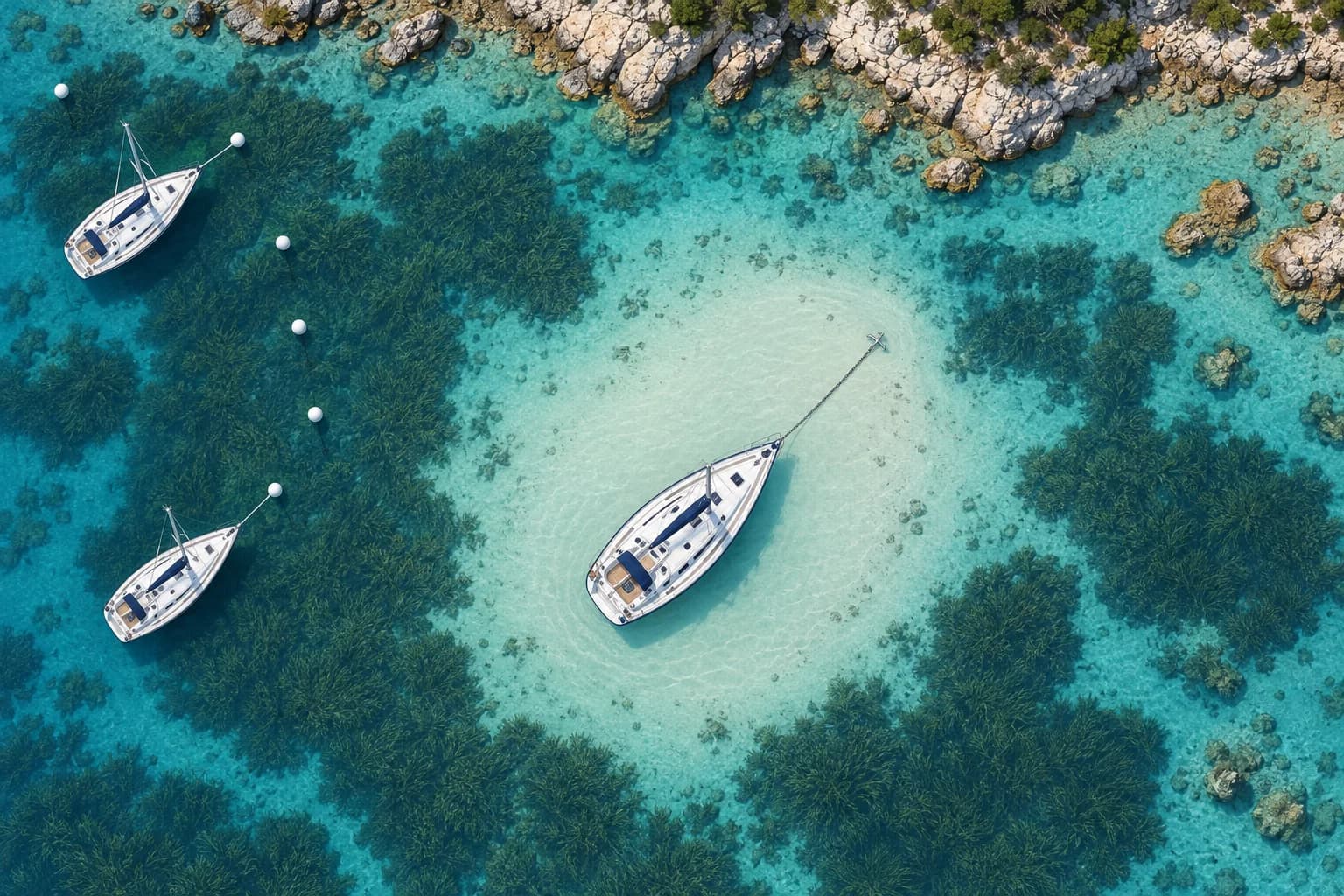
Posidonia oceanica is a seagrass found only in the Mediterranean. Its meadows grow a few centimetres a year, so a scar left by an anchor can take decades to close. The damage comes from the anchor dragging and from the chain sweeping the seabed as the boat swings. The Marine life lesson explains why these meadows matter.
Balearic Islands
Decree 25/2018 of the Balearic Islands bans anchoring on Posidonia meadows in general. Where the meadow is large, buoy fields replace anchoring: in those zones you must pick up a buoy and may not drop anchor. Since 2022 the regional port authority, Ports de les Illes Balears, manages and takes bookings for these fields in summer. Surveillance boats patrol and fine offenders.
France and other coasts
French Mediterranean prefectural orders set local anchoring restrictions on Posidonia, commonly for vessels 24 m and over, sometimes with lower limits. Smaller boats must also avoid damaging protected Posidonia. Check the current local order. Many marine parks, such as Cabrera National Park in Spain, require a permit to navigate and allow mooring only on their buoys.
Find the sand
In clear water, seagrass often looks dark and sand light, but colour alone does not identify the bottom. Look down from the bow, and choose a sand patch large enough for the boat and chain to swing over sand. Use official meadow maps, and follow the Seamanship lesson for setting and holding checks. Weigh anchor (raise it) with the boat directly above it, so it lifts straight up instead of dragging through the meadow.
Using buoy fields
Charts usually show buoy fields. Yellow special marks may indicate them (see the IALA Special marks lesson). Check the buoy’s permitted vessel size, book where required, and attach as the operator instructs, using the designated load-bearing fitting or mooring rope (strop). Leave when the time limit expires or conditions become unsafe.
Protecting seagrass when anchoring
- Check the chart, pilot book and local rules for meadows, bans and buoy fields. — Many anchorages have mapped meadows or a buoy field you must use.
- Approach slowly and confirm a sand patch from the bow. — Pale rock can resemble sand. Confirm the bottom using a clear view and official meadow maps; if unsure, use an authorised buoy or another anchorage.
- Drop the anchor in the middle of the sand, allowing for the swinging circle. — The chain sweeps the bottom as the boat swings, not just the anchor.
- Weigh anchor with the boat right above it. — The anchor then lifts straight up instead of tearing through the seabed.
Remember
- Posidonia meadows grow a few centimetres a year; anchor scars take decades to heal.
- Anchor in the middle of a sand patch large enough for the swinging circle.
- In a regulated buoy field, pick up a buoy; anchoring there is banned.
- The Balearics ban anchoring on Posidonia in general (Decree 25/2018).
- Weigh anchor from directly above it, so it does not drag.
Common mistakes
Wrong: Only the anchor touches the bottom, so a small anchor does no harm.
Right: The chain sweeps the seabed as the boat swings. Anchor where the whole swinging circle is sand.
Wrong: If the buoy field is full, anchor next to it on the seagrass.
Right: Anchoring on the meadow is still banned. Find sand elsewhere or another anchorage.
Worked case
You arrive at a Balearic cove at midday in an 11 m yacht. Most of the bottom is dark, with one small light patch near the rocks. A buoy field covers the centre of the cove and you have not booked a buoy.
Show the answer
Do not anchor on the dark seagrass. The light patch looks too small for your swinging circle near the rocks. Check whether a buoy is free to book through Ports de les Illes Balears. If not, go to another anchorage with a sand bottom. In the buoy field zone itself, anchoring is not allowed.
Practice question
In clear water, how does a Posidonia meadow usually look from the boat?
- As dark patches on the seabed
- As light, almost white patches
- As bright green floating weed
- As a band of rippled sand
Show the answer
Answer: A. Posidonia usually appears dark, while sand looks light. Rocks and shadows can also look dark, so confirm the bottom before anchoring.