
Ocean, tides and environment · Level R2 · 4 parts · about 13 min
Protected areas and marine life
4 short parts: Protected areas · Whales & dolphins · Strikes & reports · Turtles & seagrass. Each part explains the idea, then gives the points to remember, the common mistakes, a worked case and a practice question; the Academy unit adds all 24 check questions.
1 · Protected areas
Marine protected areas: what they mean for your boat
A marine protected area limits what people may do in part of the sea. Before you enter one, find out its limits and its rules for boats.
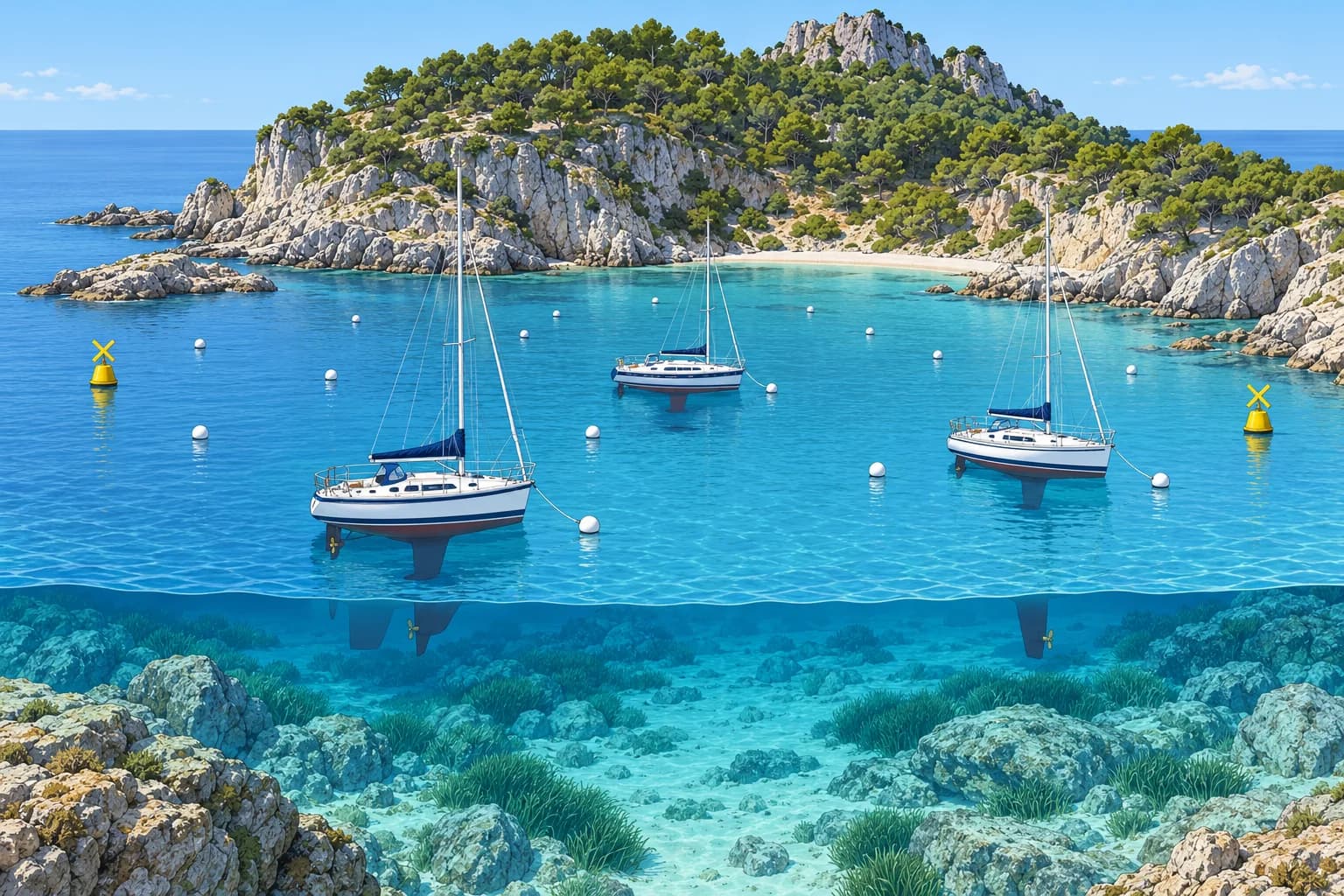
What an MPA is
A marine protected area (MPA) is a stretch of sea, and often its coast, managed to protect nature. The level of protection varies a lot. A no-take reserve bans all fishing and collecting. Other areas allow most uses but limit a few, such as anchoring, speed or night-time access. The name alone does not tell you the rules: read them.
Kinds you will meet
National parks at sea, such as Cabrera in the Balearics or Port-Cros in France, often need a permit to enter, anchor or dive. Marine reserves protect fish stocks and usually ban fishing in a core zone. In the EU, Natura 2000 sites protect habitats such as seagrass. Around the Mediterranean, the Barcelona Convention lists SPAMIs (Specially Protected Areas of Mediterranean Importance), and the Pelagos Sanctuary protects whales and dolphins between France, Monaco and Italy.
Areas for shipping
The International Maritime Organization (IMO) can designate a PSSA (Particularly Sensitive Sea Area). Its associated protective measures may include routing, reporting or voluntary precautions. In 2023 the North-Western Mediterranean became a PSSA to cut collisions with fin and sperm whales. It asks ships to keep a lookout for whales and consider slowing down. Check which measures apply to your vessel.
Typical rules for boats
Expect some of these: entry or navigation permits, a maximum number of boats, speed limits near the coast, no anchoring outside set zones, moorings to be booked, no fishing or spearfishing, no landing on certain islands, and no jet skis. Fines can be heavy, and rangers patrol by boat. For Cabrera, obtain navigation authorisation and check the park’s current daytime mooring conditions; overnight buoy stays require a reservation.
Finding the limits
The chart shows many MPA limits as a dashed line with a note, and the pilot book and the park’s website give the rules. Official map viewers show zones and buoy fields. Limits and mooring zones may be marked with yellow special marks; the chart says what each one means. The IALA lesson on special marks explains these marks. Published restrictions apply even without a continuous buoy boundary. Check before every season, because rules change.
Key figures
- No-take reserve
- No fishing or collecting of any kind
- Pelagos Sanctuary
- Whale and dolphin sanctuary: France, Monaco, Italy
- NW Mediterranean PSSA
- Designated by the IMO in 2023 against whale strikes
- Where to find the rules
- Chart note, pilot book, park website, map viewer
Remember
- An MPA’s name does not tell you its rules; look them up before you go.
- Marine national parks often need a permit to navigate, anchor or dive.
- A no-take reserve bans all fishing and collecting.
- A PSSA is an IMO designation with associated protective measures; these may include voluntary advice.
- Find limits on the chart, in the pilot book and on official map viewers.
Common mistakes
Wrong: If I am only passing through a park, its rules do not apply to me.
Right: Some parks need a permit just to navigate inside, and speed and anchoring limits apply to every boat.
Wrong: A protected area always means no boats allowed.
Right: Most MPAs allow boats with conditions. Read the rules to know what is allowed and where.
Worked case
You want to spend a summer day at Cabrera National Park, south of Mallorca, in your 10 m yacht, and swim from the boat. A friend says you can simply anchor in the main bay when you arrive.
Show the answer
Obtain Cabrera’s navigation authorisation online before you go. Check the park’s current daytime mooring conditions and use designated visitor buoys under those conditions. Do not anchor outside permitted zones. Overnight buoy stays require a reservation. Check prohibited navigation zones, speed limits and landing rules.
Practice question
What does a no-take marine reserve ban?
- All boats from entering the reserve
- All fishing and collecting
- Only anchoring on sand at night
- Only motor boats above 10 knots
Show the answer
Answer: B. No-take means nothing may be taken: no fishing, spearfishing or collecting.
2 · Whales & dolphins
Watching whales and dolphins without harm
Keep your distance and approach slowly. Local law sets requirements; viewing guidance recommends further precautions.
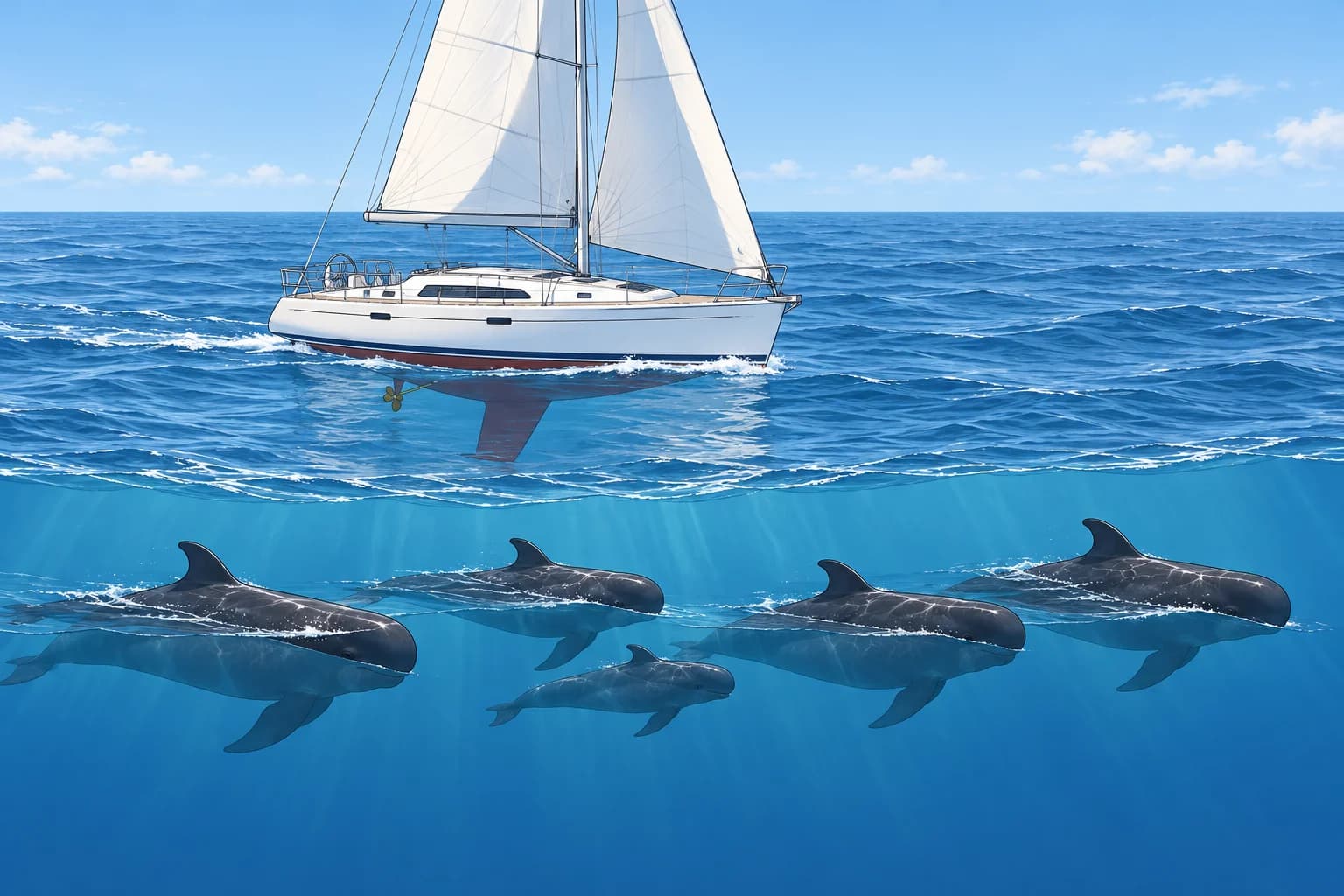
Why rules exist
Cetaceans are whales, dolphins and porpoises. A boat that comes too close or too fast can stop them feeding, resting or nursing, split a mother from her calf, or hit them. Most countries protect them by law. Check local law and guidance before approaching. Keep a safe distance and follow the applicable close-encounter rules.
Spain
Spain’s Royal Decree 1727/2007 sets a protection space of 500 m round cetaceans. Inside it, keep a steady speed of 4 knots or less, no faster than the slowest animal. The restricted zone, 60–300 m, allows two boats at most, and none for an isolated adult–calf pair. Never enter the exclusion zone inside 60 m. If animals come within 60 m, go to neutral. Keep the propeller stopped until they leave the exclusion zone.
ACCOBAMS
ACCOBAMS is the agreement that protects cetaceans in the Mediterranean, the Black Sea and the nearby Atlantic. Its viewing guidance is advice, distinct from national law: do not deliberately approach closer than 100 m, and within 300 m keep a steady course at 5 knots or less, never faster than the slowest animal. Only one boat at a time should watch a group. National law, such as Spain’s, can be stricter.
United States
The US National Oceanic and Atmospheric Administration (NOAA) advises at least 100 yards (about 90 m) from large whales and 50 yards from dolphins, porpoises and seals. Federal law sets 500 yards from North Atlantic right whales anywhere in US waters. In Washington State waters, all boats, kayaks included, must stay 1,000 yards from Southern Resident killer whales since 1 January 2025.
How to approach and leave
Come in slowly from the side and slightly behind, on a course converging at about 30° with theirs. Never approach head-on or from straight behind, never chase, circle or cut through a group, and do not swim with them. Possible signs of disturbance include sudden changes of direction or speed, long dives, or tail slaps. If you see them, leave slowly the way you came.
Meeting cetaceans at sea
- Before approaching, identify the applicable local rules and species-specific distances. — Requirements vary by location and species; check before closing.
- Slow down early. In Spain’s 500 m protection space, stay at 4 knots or less and no faster than the slowest animal. — Speed increases noise, stress and collision risk.
- Keep outside required exclusion distances and follow greater recommended distances. Where both apply, use Spain’s 4-knot limit and ACCOBAMS’ 100 m guidance. — Spain bans entry within 60 m; ACCOBAMS recommends at least 100 m. Guidance and law have different status.
- In Spain, if animals come within 60 m, go to neutral and keep the propeller stopped until they leave the exclusion zone. — A turning propeller can injure an animal near the stern. Follow local rules elsewhere; orca interactions have their own advice.
- Watch for a limited time, then leave slowly the way you came. — Long or crowded watching disturbs feeding and resting.
Remember
- Slow down and approach from the side and slightly behind; never head-on.
- Spain: within 500 m, at most 4 knots, no faster than the slowest animal; never enter the 60 m exclusion zone.
- ACCOBAMS guidance: no closer than 100 m; at most 5 knots within 300 m.
- NOAA advice: 100 yd large whales, 50 yd dolphins; US federal law: 500 yd North Atlantic right whales.
- Possible signs of disturbance are a warning to leave slowly and keep clear of the animals’ path.
Common mistakes
Wrong: Dolphins ride the bow wave, so speeding up to meet them is fine.
Right: Never speed up or steer towards bow-riding dolphins. Follow the close-encounter instructions for your location.
Wrong: Getting in the water to swim with dolphins is harmless.
Right: Spain bans swimming or diving in the 60 m exclusion zone, and swimming with them stresses the animals.
Wrong: Driving in front of a whale gives the best view.
Right: Never cross in front or block their path. Stay to the side and let them pass.
Worked case
Off the coast of Almería you spot one adult pilot whale with a calf and no other whales nearby, about 400 m ahead and to starboard. You are motoring at 7 knots, and your crew wants to get close for photos.
Show the answer
Slow to 4 knots or less, and no faster than the animals. This is an isolated adult–calf pair, so do not enter the 60–300 m restricted zone. Watch from beyond 300 m without closing for photos. Leave slowly if they show possible signs of disturbance.
Practice question
Under Spain’s RD 1727/2007, what is the maximum speed inside the 500 m protection space?
- 2 knots
- 4 knots
- 6 knots
- 8 knots
Show the answer
Answer: B. Keep a steady speed of no more than 4 knots, and no faster than the slowest animal.
3 · Strikes & reports
Collisions with whales, orca encounters and reporting
Whales are hard to see and can be hit by any boat. Keep a lookout, slow down where they gather, and report strikes, strandings and entanglements.
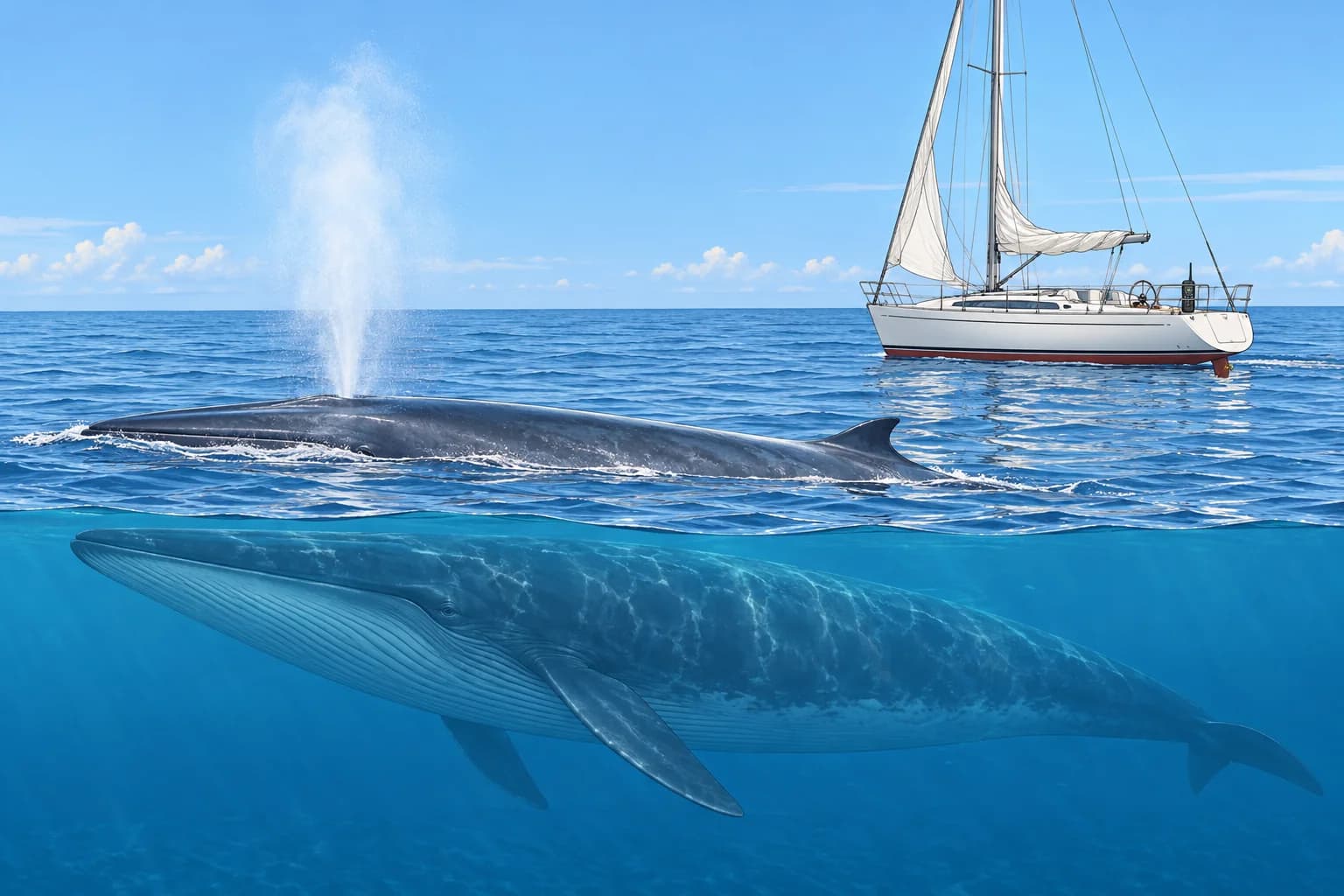
Ship strikes
Whales breathe and rest at the surface and may not move clear. Strikes can injure people and kill whales. Keep a lookout and slow down where whales gather, especially at night. In the NW Mediterranean Particularly Sensitive Sea Area (PSSA), voluntary advice under International Maritime Organization (IMO) resolution MEPC.380(80) includes reducing to 10–13 knots where whales are detected or reported, when safe. Check applicable published measures. Slow further around nearby animals and follow local rules.
Iberian orcas
Since 2020, a small group of orcas off Spain and Portugal has been pushing and biting rudders of sailing yachts, sometimes sinking them. The cause is uncertain; play and social learning are possible explanations. Spain’s official advice: do not stop the boat; head towards the coast and shallower water only where safe for your draught and the sea conditions; keep crew away from the sides; do not use anything that harms or frightens the animals; report to the nearest rescue centre on VHF 16.
When and where
The Spanish authorities ask sailors to take extra care from April to August in the Strait of Gibraltar and the Gulf of Cádiz, and publish risk maps for Galicia from July to October. Choose coastal routes only where depths, hazards and conditions allow. Check the latest notices from the rescue centres, which broadcast warnings in season.
Reporting
Report a whale you have hit, or a dead, injured, stranded or entangled animal, to the coastguard or rescue centre on VHF 16 or by phone, with position and time. In US waters use NOAA’s reporting channels or VHF 16 for right whales. Ship-strike reports also go to the IWC global ship strike database, which anyone can use. Photos help, if taking them is safe.
Entanglement
A whale or dolphin caught in rope or net may tow gear for miles. Never try to free it yourself: a large whale can kill a person with one movement of its tail. Keep your distance, note the gear and report the position. Follow the rescue centre’s instructions.
Key figures
- Orca interaction (Spain)
- Keep moving towards safe coastal depths; report on VHF 16
- Iberian orca high season
- April–August, Strait of Gibraltar and Gulf of Cádiz
- Entangled whale
- Never free it yourself; report and stand off
- Global strike reports
- IWC ship strike database
Remember
- Collision risk with whales rises sharply with speed; slow down where they gather.
- Iberian orcas: keep moving towards safe coastal depths; report on VHF 16.
- Report strikes, strandings and entanglements with position and time.
- Never try to cut an entangled whale free yourself.
Common mistakes
Wrong: If orcas start pushing the rudder, stop the boat and wait.
Right: Spain’s advice is to keep moving towards the coast and shallower water only where safe for your draught and sea conditions. Report on VHF 16.
Wrong: I can cut the rope off an entangled whale from the dinghy.
Right: Its tail can kill you. Keep your distance, note the gear and call the coastguard for a trained team.
Worked case
In June you are sailing south past Barbate, west of the Strait of Gibraltar, when three orcas start hitting your rudder. The wheel jerks hard in your hands.
Show the answer
Keep hands clear of the jerking wheel or tiller and the crew away from the sides. If steering remains effective, keep moving towards the coast and shallower water where safe for your draught and the conditions. Report to the nearest rescue centre on VHF 16 and follow its instructions. Check the rudder and steering for damage once the orcas leave.
Practice question
What most increases the risk of a fatal collision between a boat and a whale?
- The colour of the hull
- A high boat speed
- Sailing in daylight
- Using an echo sounder
Show the answer
Answer: B. The faster the boat, the less time to react and the more severe the injury to the whale.
4 · Turtles & seagrass
Sea turtles, seagrass and plastic
Turtles, seagrass meadows and the animals living in them suffer from boats, hooks and plastic. A few simple habits on board protect them.
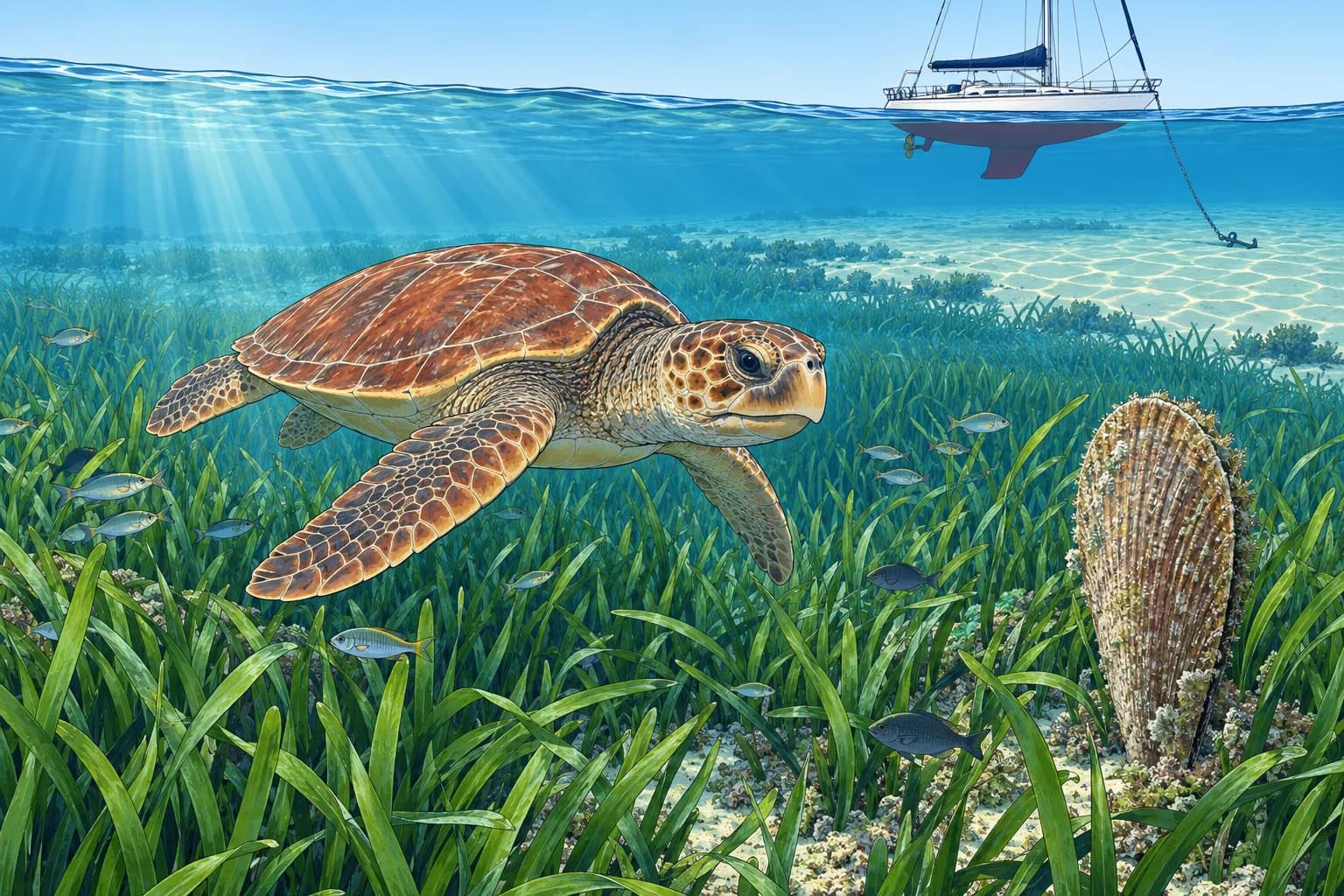
Sea turtles
The loggerhead turtle is the most common sea turtle in the Mediterranean and nests on its beaches in summer. Turtles breathe air and often rest at the surface, where propellers and hulls hit them. Keep a lookout, slow down if you see one and keep at least 50 yards (about 45 m) away, as NOAA advises. Put the engine in neutral and let it pass.
Plastic and ghost gear
Turtles mistake floating plastic bags for jellyfish, their food, and die with blocked guts. Lost nets and lines, called ghost gear, keep catching turtles, dolphins and seabirds for years. Never let plastic or fishing line go overboard. If you find floating plastic and can pick it up safely, take it aboard and land it.
A hooked turtle
Never lift a turtle by the line, pull on the line or try to remove the hook: this can worsen injuries. Keep the line slack and let the turtle surface to breathe. Call the coastguard or a turtle-rescue service before cutting. Follow their instructions on handling, cutting and release. If release is advised or unavoidable, cut the line as close to the hook as you safely can without pulling.
An entangled turtle
Keep clear of the gear and propeller. Call the coastguard or a turtle-rescue service with your position and what you can see. Do not enter the water, tow the turtle or lift or pull it by the line or net. Follow the rescuers’ instructions and keep it in sight from a safe distance if possible.
Seagrass as a nursery
Posidonia oceanica is a seagrass that forms underwater meadows in the Mediterranean. Fish, octopus, seahorses and the giant fan mussel (Pinna nobilis) live and breed in them. The leaves shelter young fish and other marine animals. The seagrass releases oxygen, helps keep the water clear, stores carbon and reduces wave energy. Dead leaves piled on beaches in winter protect the sand from storms. Anchoring rules live in the Pollution lesson.
Key figures
- Common Mediterranean turtle
- Loggerhead (Caretta caretta)
- Distance from turtles (NOAA)
- At least 50 yards; neutral and let it pass
- Hooked turtle
- Keep the line slack; call rescuers before cutting or release
- Posidonia meadows
- Nursery, oxygen, clear water, carbon store, beach protection
Remember
- Turtles rest at the surface; keep a lookout and slow down near them.
- Plastic bags look like jellyfish to turtles; nothing plastic goes overboard.
- Hooked turtle: keep the line slack; call rescuers before cutting. Entangled turtle: stand clear and call for help.
- Posidonia meadows are a nursery for fish, octopus and seahorses.
Common mistakes
Wrong: Pull firmly on the line to get the hook out of a turtle’s mouth.
Right: Pulling can worsen injuries. Keep the line slack and call the coastguard or turtle rescuers. Follow their advice on handling, cutting and release.
Wrong: Seagrass leaves piled on a beach are rubbish that should be cleared.
Right: These piles protect the beach from winter storms and are part of the meadow’s life cycle.
Worked case
Fishing from your yacht at anchor off Sicily, you hook a loggerhead turtle. It is tired and close to the stern. One crew member wants to haul it aboard by the line and pull the hook out.
Show the answer
Do not haul it aboard by the line or try to remove the hook. Keep the line slack and let it surface to breathe. Call the coastguard on VHF 16 or by phone before cutting; give your position and follow the turtle-rescue service’s handling and treatment advice. If release is advised or unavoidable, cut the line as close to the hook as you safely can without pulling.
Practice question
Why are floating plastic bags so dangerous to sea turtles?
- They block sunlight from the seabed
- Turtles mistake them for jellyfish
- They make the water too warm
- They scare turtles off the beaches
Show the answer
Answer: B. Turtles eat jellyfish. Swallowed plastic blocks the gut and can kill them.