
Sailing and sail trim · Level R4 · 5 parts · about 17 min
Downwind sails: spinnaker, gennaker and preventer
5 short parts: Downwind sails · Hoist and drop · Spinnaker gybe · Broaching · Downwind safety. Each part explains the idea, then gives the points to remember, the common mistakes, a worked case and a practice question; the Academy unit adds all 29 check questions.
1 · Downwind sails
Symmetric, asymmetric and code zero
Downwind sails are big, light and powerful. A symmetric spinnaker flies from a pole; an asymmetric or gennaker is tacked at the bow; a code zero is for close reaching.

Symmetric spinnaker
A symmetric spinnaker is a large, balloon-shaped sail with two matching side edges. It is flown from a spinnaker pole clipped to the mast. The windward corner sits at the pole end, controlled by the guy (US: afterguy). The leeward corner is trimmed by the sheet. A topping lift holds the pole up and a downhaul (foreguy) holds it down. It suits broad reaches and runs.
Asymmetric spinnaker
An asymmetric spinnaker has a longer luff (front edge) than leech (rear edge). Its tack (front lower corner) is held by a tack line at the bow or on a bowsprit, a spar projecting ahead of the bow. No pole is needed. Two sheets trim it, one each side. It suits reaches and broad reaches. When flown to leeward on a dead run, it is usually blanketed by the main. Broad reaches linked by gybes often keep it drawing better.
Gennaker and code zero
Gennaker is a common cruising name for an asymmetric, often a flatter, all-purpose cut. A code zero is a flat, light reaching sail with a tight luff, usually set on its own furler at the bow. It is for close reaching in light to moderate winds, at apparent wind angles from roughly 40° to about 100°. It is not a running sail.
Wind ranges
Use each sailmaker's wind-speed and angle chart, checking whether values are true or apparent. Symmetric and asymmetric spinnakers have different ratings for light, moderate or stronger winds; their shape alone does not tell you the limit. A cruising gennaker commonly suits light to moderate winds; a code zero mainly suits light-air reaching. Stay within your particular sail's chart and drop early in rising gusts.
Choosing
For a cruising crew, an asymmetric in a snuffer (a sleeve pulled over the sail) is often easiest to handle. A furling code zero suits light-wind reaching. A symmetric sails deeper but needs more crew coordination. Choose for your usual wind angles, your sail's limits and the crew available.
Key figures
- Symmetric spinnaker
- Pole, guy, sheet, topping lift, downhaul; best running
- Asymmetric / gennaker
- Tack line at bow or bowsprit, two sheets; best reaching
- Code zero
- Flat, on its own furler; close reaching, roughly 40–100° apparent
- Wind range
- Sailmaker's speed and angle chart; check true or apparent wind
Remember
- A symmetric spinnaker flies from a pole: guy to windward, sheet to leeward.
- An asymmetric has its tack fixed at the bow or bowsprit and needs no pole.
- Broad reaches linked by gybes usually keep an asymmetric drawing better than a dead run to leeward of the main.
- A code zero is a flat reaching sail on a furler, not a running sail.
- Know each sail's maximum wind speed and drop before it.
Common mistakes
Wrong: An asymmetric always draws well to leeward on a dead run.
Right: The main commonly blankets it there. Broad reaches and gybes often keep it drawing more reliably.
Wrong: A code zero is a light-wind run sail.
Right: It is a flat reaching sail for close reaching. Deeper angles need an asymmetric or symmetric spinnaker.
Worked case
A couple cruising a 12 m yacht want a light-wind sail for long trade-wind passages, mostly at 120–150° apparent wind angle. They have no spinnaker pole and do not want one.
Show the answer
A cruising asymmetric cut for deep reaching, in a snuffer, suits them. It needs no pole, uses two sheets and a tack line, and works well on broad reaches. They can gybe downwind when the wind is dead astern. A conventional code zero is intended for shallower apparent angles.
Practice question
On a symmetric spinnaker, which line controls the windward corner at the pole end?
- The trimming sheet
- The spinnaker guy
- The bow tack line
- The pole downhaul
Show the answer
Answer: B. The guy (afterguy) runs through the pole end and controls the windward corner. The sheet trims the leeward one.
2 · Hoist and drop
Hoisting and dropping, with and without a snuffer
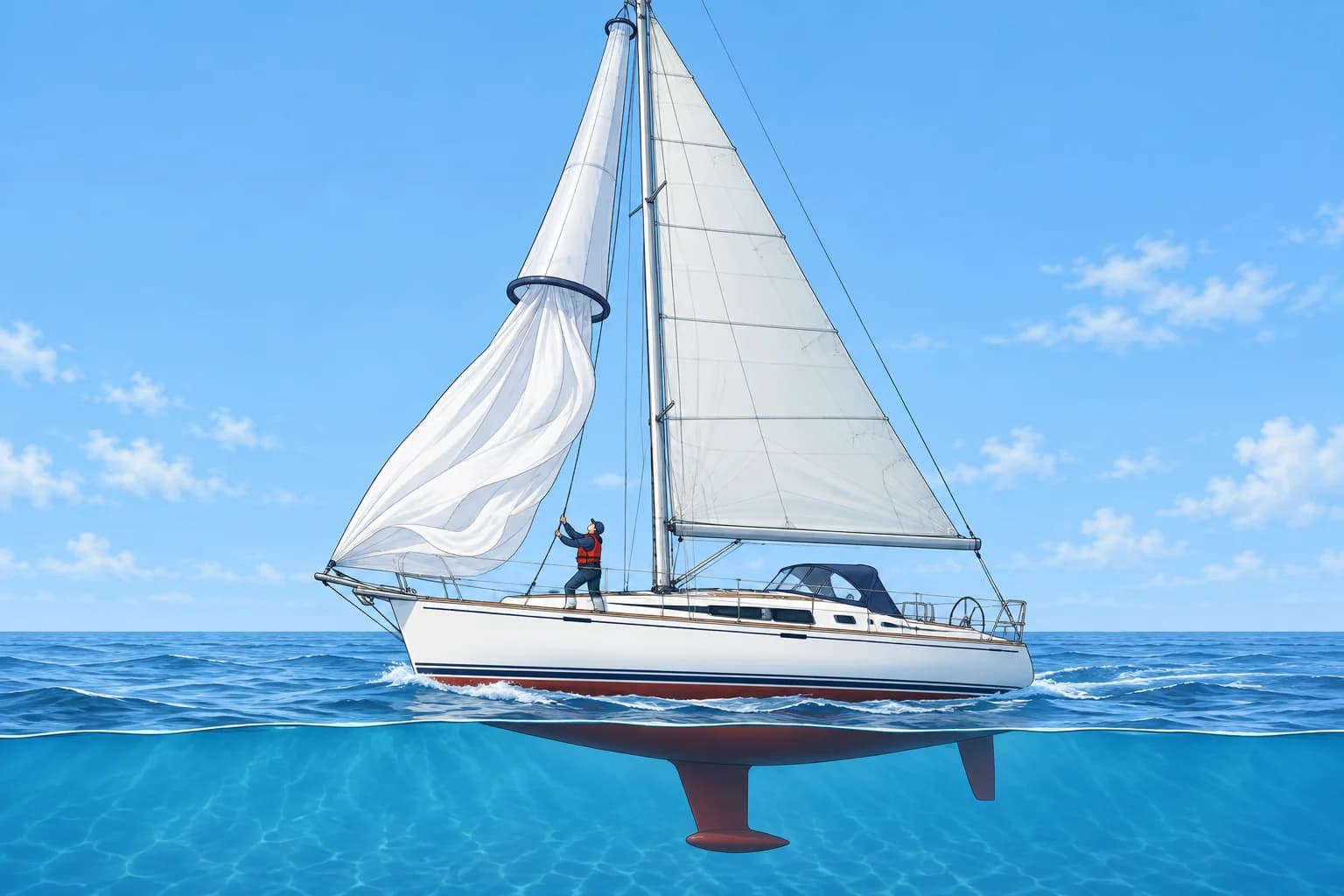
Hoist behind the headsail, fast, on a broad reach. Drop behind the main or headsail, depowered first. A snuffer makes both easier.
Prepare
Bring the sail on deck in its bag on the leeward side, secured. Lead the sheets, outside everything, back to the cockpit. Check the halyard is clear and not wrapped round the forestay. On a symmetric spinnaker, rig the pole on the windward side, at roughly right angles to the apparent wind. Brief each crew member on their job.
Hoist
Bear away to a broad reach so the main shelters the sail while it goes up. Hoist the halyard quickly, all the way to its mark, while the sheet stays slack so the sail does not fill too early. Then trim the sheet (and guy) and roll away or drop the headsail. A sail that fills half-hoisted can drag a crew member or wrap.
Trim
The basic trim rule for any spinnaker: ease the sheet until the luff just starts to curl, fold in, then trim a little. Play the sheet constantly. On a symmetric, keep the pole roughly at right angles to the apparent wind and the two corners at about the same height.
Drop
Bear away so the main shelters the sail; set the headsail. Have the gathering crew take control of the leeward sheet and clew (lower aft corner). Using the boat's briefed method, ease the guy forward on a symmetric, or ease the tack line on an asymmetric. Retain the leeward sheet and gather the foot (bottom edge) behind the main while lowering the halyard under control. Do not let the halyard run free: keep the sail out of the water.
Snuffer
A snuffer or sock is a long tube of cloth with a ring at its bottom, hoisted with the sail inside. Pull the snuffer's uphaul line to release the sail; pull its downhaul line to pull the sock down over it. Before snuffing, ease the sheet fully and bear away so the sail collapses behind the main. Then lower the sock and sail together.
Key figures
- Hoist
- Broad reach, behind the headsail, sheet slack until full height
- Trim rule
- Ease until the luff curls, then trim a little
- Symmetric pole
- About square to the apparent wind; corners level
- Drop
- Broad reach, behind main or headsail, halyard controlled
Dropping an asymmetric with a snuffer
- Bear away to a broad reach; unroll the headsail. — The main and headsail shelter the spinnaker and take its load.
- Ease the sheet fully so the spinnaker collapses behind the main. — A powered sail cannot be snuffed safely.
- Pull the snuffer down over the sail with its downhaul. — The sock smothers the sail from the top down.
- Lower the halyard under control and gather the snuffed sail in. — A running halyard can drop the sail into the sea.
- Release the tack line, bag the sail and coil the lines. — A tidy foredeck is ready for the next hoist or a manoeuvre.
Remember
- Hoist on a broad reach, sheltered behind the main and headsail, quickly to the top.
- Keep the sheet slack until the sail is fully hoisted.
- Trim rule: ease until the luff just curls, then trim in a little.
- Drop behind the main or headsail, with the halyard under control.
- Snuffer: depower the sail first, then pull the sock down.
Common mistakes
Wrong: Trim the sheet as you hoist, to fill the sail quickly.
Right: A sail that fills half-hoisted is uncontrollable. Hoist fully, then trim.
Wrong: To drop quickly, let the halyard run.
Right: The sail falls into the water and can be run over. Lower the halyard under control as the crew gathers.
Wrong: Pull the snuffer down while the sail is still full.
Right: A full sail will not snuff and can lift the crew. Bear away and ease the sheet first.
Worked case
Hoisting the asymmetric on a beam reach in 12 knots, the crew trims the sheet before the halyard is fully up. The sail fills halfway, the halyard is torn from the hoister's hands and the sail twists.
Show the answer
Ease the spinnaker sheet immediately to unload the half-hoisted sail. Bear away to a broad reach so the main shelters it, then lower under control and clear the twist. Before trying again, check the halyard and sheets are clear. Hoist behind the headsail with the sheet slack until the halyard reaches its mark; only then trim.
Practice question
Which point of sail is best for hoisting a spinnaker?
- Close-hauled
- Close reach
- Beam reach
- Broad reach
Show the answer
Answer: D. On a broad reach, the main and headsail shelter the sail as it goes up and the apparent wind is lighter.
3 · Spinnaker gybe
Gybing with a spinnaker
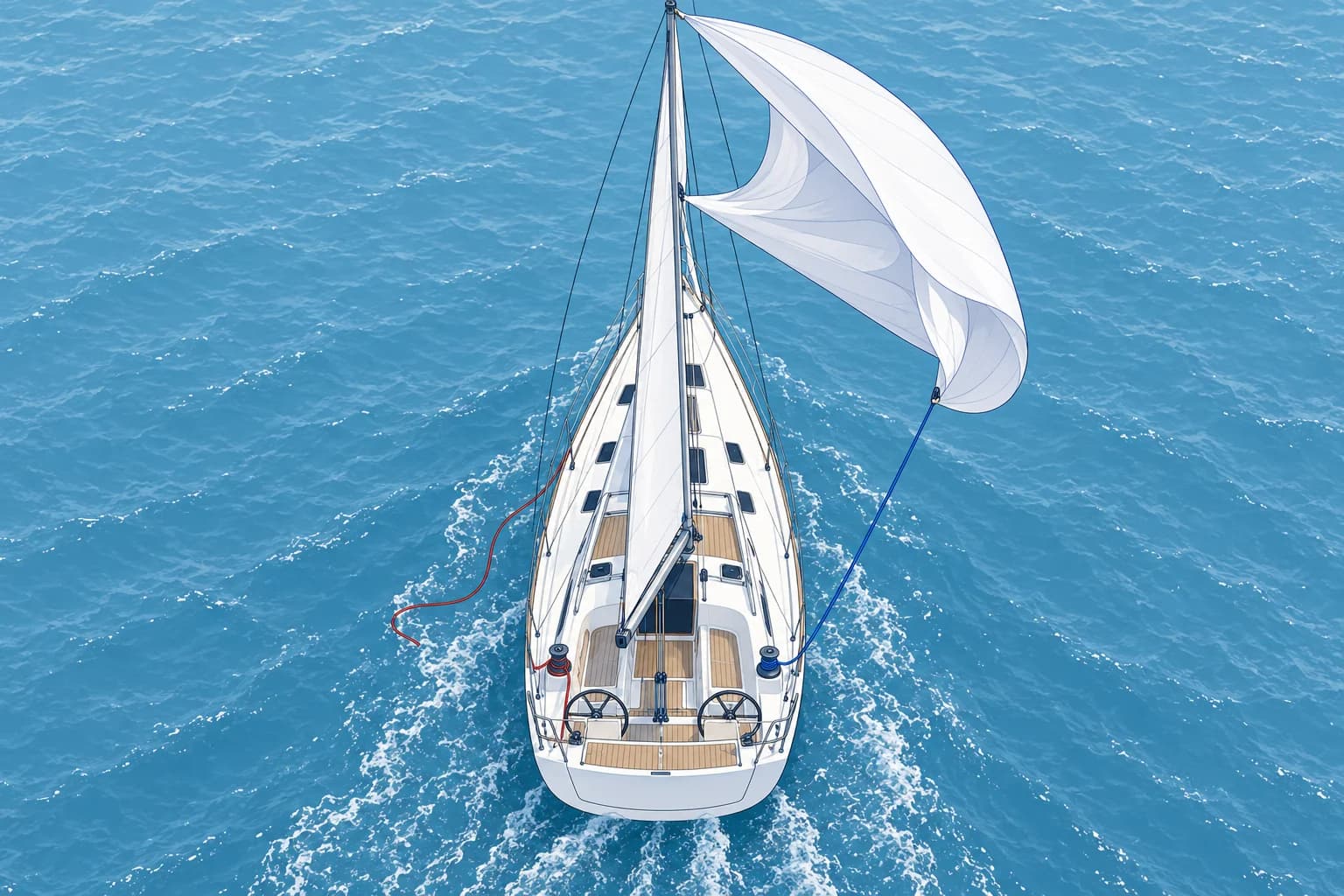
Gybing an asymmetric means passing the sail round the front; a symmetric needs the pole moved across. Keep the sail flying and the main controlled.
Asymmetric gybe
The tack stays at the bow. Only the clew crosses. As you bear away towards a run, let the old sheet run so the clew moves forward of the forestay before the main crosses. Trim the new sheet as you complete the turn.
Inside or outside
For an inside gybe, lead the lazy sheet (the unloaded sheet) between the forestay and tack line; the clew passes between forestay and luff. Check there is enough clearance for the clew and sail to pass freely. For an outside gybe, lead it ahead of the tack line; the clew passes outside the luff. Outside gybes need longer sheets. Choose a method that suits your tack position and bow clearance, then check the sheet leads and brief the crew before turning.
Symmetric: end-for-end
With a compatible double-ended pole, an end-for-end gybe swaps the pole ends. Stabilise near a run. The old leeward sheet becomes the new guy. Trimmers unload the pole; ease the downhaul so it can move. Keep the pole supported by its topping lift. Unclip the mast end and clip it to the new guy. Unclip the other end from the old guy and attach it to the mast. Reset the pole controls and trim.
Symmetric: dip-pole
In a dip-pole gybe, the mast end stays attached. Each corner has a sheet and guy; lazy means unloaded. Near a run, transfer the old guy’s load to its lazy sheet; both sheets now fly the sail. Ease the foreguy and adjust the topping lift; raise the mast end if needed for clearance. Remove the unloaded old guy from the pole jaw, dip the outer end inside the forestay and clip in the new guy. Raise the pole, reset its controls and load the new guy.
Main and preventer
Coordinate with the mainsail trimmer. Release the preventer before the gybe and re-rig it on the new side once settled. Use your practised controlled mainsail gybe. In strong wind, drop the spinnaker before gybing; re-hoist only if conditions and crew control allow.
Key figures
- Asymmetric gybe
- Tack stays; clew passes the forestay; release old, trim new
- Inside gybe
- Clew passes between luff and forestay
- Outside gybe
- Clew passes outside the luff; longer sheets
- End-for-end
- Requires a compatible double-ended pole; swap its ends
- Dip-pole
- Inboard end stays on mast; outer end dips inside forestay
Gybing an asymmetric
- Release the preventer; check the lazy sheet is clear and has turns on its winch. — A preventer stops the main crossing; a fouled sheet stops the sail.
- Call the gybe and bear away steadily towards a run. — A steady turn keeps the sail full and the crew in step.
- Let the old sheet run as you approach a run, before the main crosses. — The clew needs to move forward of the forestay before the main crosses.
- Coordinate with the mainsail trimmer; trim the new sheet as you complete the turn. — The sail fills on the new side without being pinned by the old sheet.
- Settle on the new broad reach, finish trimming and re-rig the preventer. — The boat settles on the new course with the sails controlled.
Remember
- Asymmetric: let the old sheet run so the clew moves forward before the main crosses; trim the new sheet as you turn.
- Check tack position, clearance and sheet leads for an inside or outside gybe before you start.
- Use the method your pole system supports: end-for-end or dip-pole.
- Coordinate the sails; preventer off before the gybe and re-rigged afterwards.
- In strong wind, drop before gybing; re-hoist only if conditions and crew control allow.
Common mistakes
Wrong: Hold the old sheet until the main has crossed.
Right: Let it run as you approach a run so the clew moves forward of the forestay before the main crosses; trim the new sheet as you complete the turn.
Wrong: Forget the preventer during a spinnaker gybe.
Right: A preventer left on pins the main aback. Release it before the gybe, re-rig it afterwards.
Worked case
Before an asymmetric gybe, you find the new sheet trapped under deck gear. Gusts are increasing and the crew are struggling. The helm suggests turning first and clearing it afterwards.
Show the answer
Do not start the gybe with a trapped sheet. Hold a safe course while you clear it. If the crew cannot manage the sail, drop it before changing gybe. Before any re-hoist, reassess the wind and crew. When gybing under spinnaker, let the old sheet run so the clew moves forward of the forestay before the main crosses; trim the new sheet as you complete the turn.
Practice question
During an asymmetric gybe, which part of the sail stays at the bow?
- The clew
- The head
- The tack
- The leech
Show the answer
Answer: C. The tack stays fixed. Only the clew and the body of the sail cross to the new side.
4 · Broaching
Broaching and the death roll
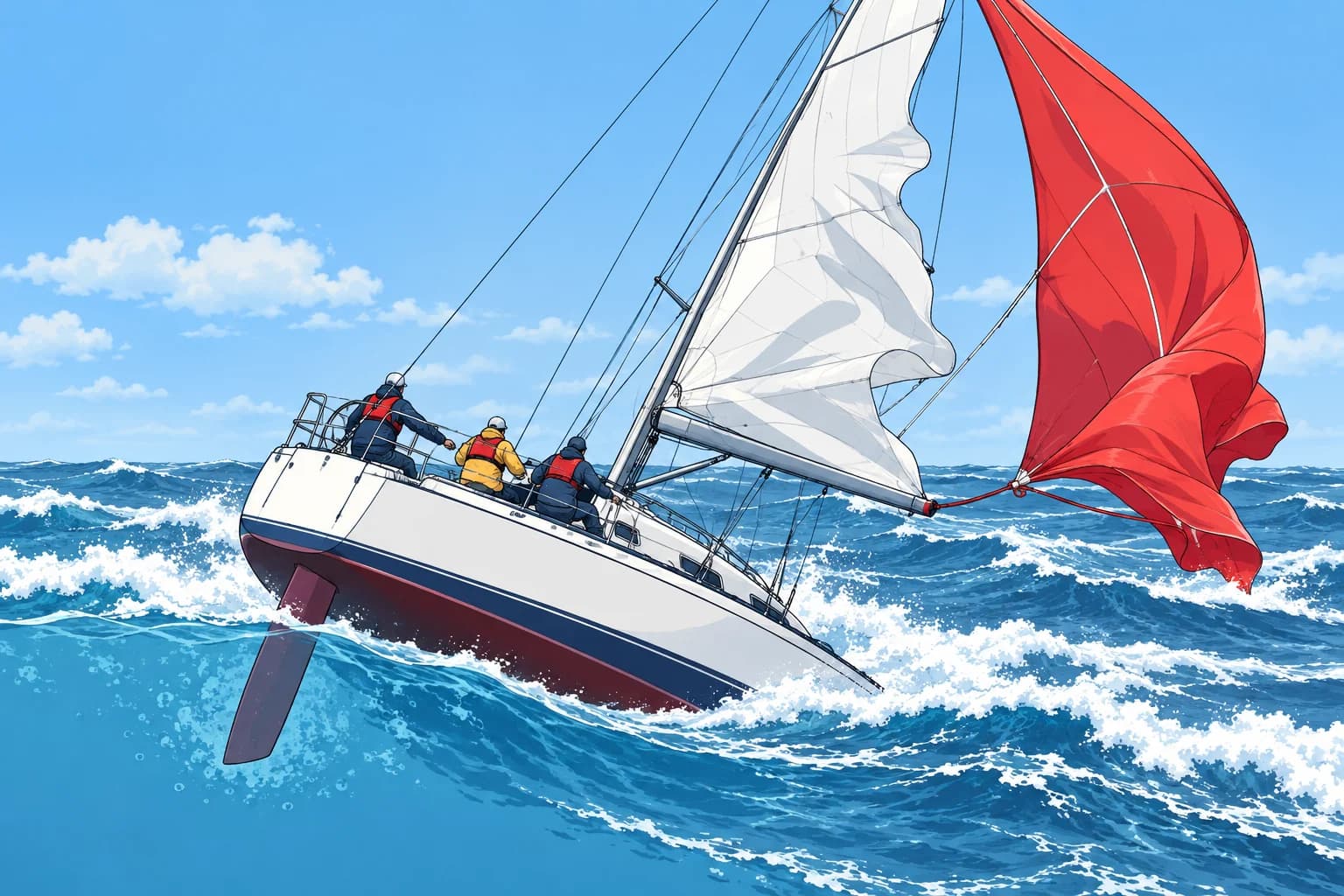
A broach is an uncontrolled round-up into the wind; a death roll is a violent roll to windward that can gybe the boat. Both have warning signs.
The broach
In a broach, the boat heels too far and turns sharply into the wind, out of control. The rudder stalls or comes out of the water and stops steering. The spinnaker pins the boat on her side until the load is released. Causes: too much sail, a gust, a wave pushing the stern sideways, a main sheeted too tight or a helm reacting too late.
Avoiding a broach
Steer down, bearing away, in gusts, before the heel builds. Ease the kicker (boom vang) first: it opens the main's leech and spills power from the top. Ease the mainsheet and spinnaker sheet as needed. Keep crew weight aft and to windward. Set a smaller or flatter sail in a rising wind; on a symmetric, lower the pole a little to stabilise the sail.
Recovering
If the boat broaches, release the kicker and mainsheet, and ease the spinnaker sheet until the sail flaps. As heel reduces, reduce excessive helm so the rudder can regain grip. Bear away gently as steering returns, then re-trim. Crew must hold on and stay clipped on: a broach can throw people across the boat or overboard.
Death roll
On a deep run, growing side-to-side rolls can develop into a violent roll to windward and an uncontrolled gybe or round-down (turn away from the wind). Warning signs include increasing rolling and an unstable spinnaker. Sailing by the lee, with wind coming over the same side as the boom, increases the danger. A pole too high and aft, or a sheet too loose, can let the sail swing.
Stopping rolling
Head up slightly, away from a dead run. On a symmetric, lower the pole and bring it forward a little, and trim the sheet in and down using a barber hauler, a control line that pulls the sheet down through a forward block. Keep the main not quite fully eased. Rolling is a warning: act before it builds.
Key figures
- Broach
- Round-up to windward: heel, stalled rudder
- Broach prevention
- Bear away early, ease kicker, smaller sail, crew aft
- Broach recovery
- Release kicker and main; ease spinnaker sheet
- Death roll
- Roll to windward and accidental gybe, running deep
- Stop rolling
- Head up, lower pole, sheet led forward and down
Remember
- A broach is a round-up to windward with a stalled rudder.
- Prevent: bear away in gusts, ease the kicker, carry less sail.
- Recover: release kicker and main, ease the spinnaker until it flaps.
- A death roll is a roll to windward and accidental gybe when running too deep.
- Rolling: head up, lower the pole, lead the sheet forward and down.
Common mistakes
Wrong: When the boat starts to round up, pull the tiller hard to windward and hold the sheets.
Right: Ease sail loads promptly and avoid excessive helm. If the rudder stalls, reduce its angle so flow can reattach; steer down as control returns.
Wrong: Sailing deeper always steadies the spinnaker.
Right: Too deep, especially by the lee, starts rolling and can cause a death roll. Head up a little.
Worked case
Under spinnaker on a broad reach in 20 knots, gusting 26, the boat heels hard in each gust and needs full rudder. The kicker is very tight and the crew are sitting forward.
Show the answer
Repeated heavy heel and full rudder are already warnings to reduce sail. Ease the kicker, mainsheet and spinnaker sheet to unload the boat, and bear away early while steering still responds. Move crew aft and to windward. Arrange a controlled drop now; do not wait for stronger gusts. If she broaches, release kicker and main and ease the spinnaker; reduce excessive helm so the rudder can regain grip.
Practice question
What happens in a broach?
- The boat rolls to windward and gybes by itself
- The boat rounds up into the wind out of control
- The spinnaker wraps round the forestay
- The boat stops head to wind in irons
Show the answer
Answer: B. A broach is a sudden, uncontrolled round-up into the wind with excessive heel.
5 · Downwind safety
Downwind safety: preventer, MOB and night
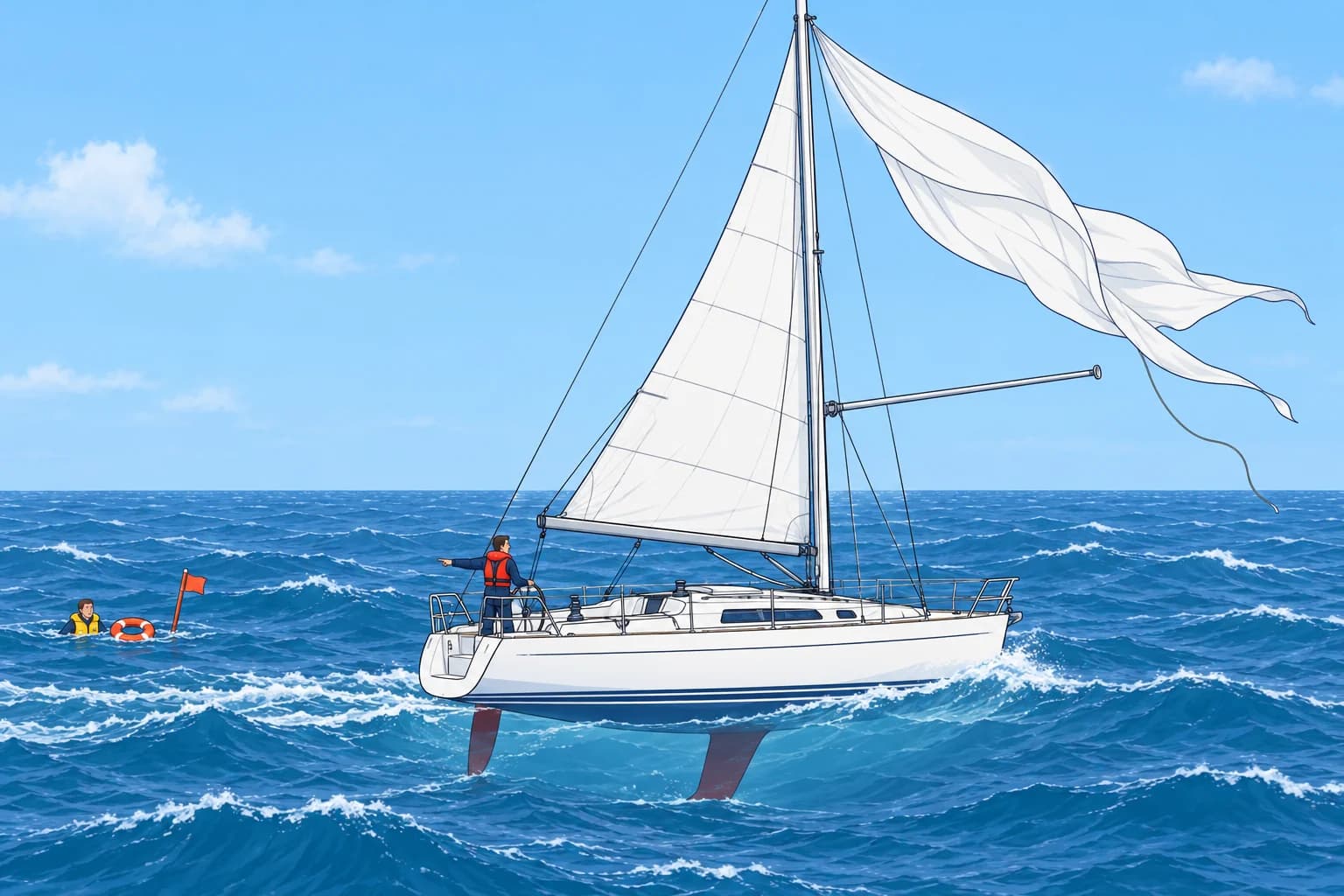
Downwind sailing hides the wind's strength. Rig a preventer, know how to depower the spinnaker fast for a man overboard, and be conservative at night.
The preventer downwind
On long downwind legs, rig a preventer using suitable boom and deck strongpoints: from the boom end, forward through a block and back to the cockpit. It restrains the boom; it cannot stop the wind crossing the stern and backing the main. Keep steering actively. The line must be releasable under load. Rig both sides if needed, but release the working preventer before gybing.
Hidden wind
Downwind, the apparent wind feels much lighter than the true wind. A spinnaker set in what feels like 12 knots may be in 20 true. Read the true wind on your instruments or estimate it from the sea, and remember you will feel the full force if you round up, broach or turn to recover a person.
Man overboard
Throw flotation, mark the position with the MOB button and keep someone pointing. Depower immediately. Where fitted, fire the guy: trip its windward-clew shackle using its pre-rigged release from a safe position, with any lazy sheet free to run. Do not open the pole jaw or reach for loaded fittings. Otherwise use the boat's briefed depowering method. Lower and gather the sail under control, then follow your practised man-overboard recovery plan.
At night and short-handed
At night, the spinnaker's trim and the sea are hard to see. Many cruising crews drop the spinnaker at dusk or keep a smaller sail. Use harnesses and tethers on deck, and keep the sheets on winches with a crew member ready. If you doubt you can control it, drop early.
Key figures
- Preventer
- Boom end → bow block → cockpit; releasable under load
- Apparent vs true downwind
- Apparent can be several knots lighter than true
- MOB under symmetric
- Use the briefed windward-corner quick-release, where fitted
- Night
- Many cruisers drop the spinnaker at dusk
Remember
- Rig a preventer on long downwind legs; release it before gybing.
- Downwind, the true wind is stronger than it feels: check instruments or the sea.
- MOB under spinnaker: lifebuoy, MOB button, pointer, then depower the spinnaker at once.
- Symmetric: use the briefed windward-corner quick-release, where fitted; any lazy sheet must be free to run.
- At night or short-handed, carry less sail; when in doubt, drop it.
Common mistakes
Wrong: With a preventer rigged, you can gybe without touching it.
Right: A preventer stops the boom crossing. Release it before every gybe.
Wrong: Recover a person overboard with the spinnaker still up.
Right: A powered spinnaker restricts safe manoeuvring. Depower and gather it promptly, then follow your practised recovery plan.
Worked case
At night under symmetric spinnaker, someone falls overboard. One crew member wants to turn back with the sail drawing; another reaches for the loaded pole jaw. Your rig has a remote guy-clew release. What do you do?
Show the answer
Shout 'Man overboard', throw flotation, mark the position and assign a pointer. Depower immediately using the boat's briefed method. If fitted, trip the guy's windward-clew shackle with its pre-rigged release from a safe position; any lazy sheet must be free to run. Do not open the pole jaw or reach for loaded fittings. Lower and gather the sail under control. Once the sail and lines are secured, continue your practised MOB recovery.
Practice question
On a long downwind leg, why rig a preventer?
- To restrain an unexpected boom crossing
- To hold the spinnaker pole forward
- To raise the boom above the crew
- To reduce the spinnaker's power
Show the answer
Answer: A. The preventer restrains an unexpected boom crossing. It does not stop the boat crossing the wind and backing the main; active steering remains essential.