
Sailing and sail trim · Level R3 · 5 parts · about 16 min
Sail trim and balance
5 short parts: Telltales · Headsail · Mainsail · Balance · Depowering. Each part explains the idea, then gives the points to remember, the common mistakes, a worked case and a practice question; the Academy unit adds all 30 check questions.
1 · Telltales
Reading telltales and twist
Telltales show the airflow on each side of a sail. Read them top to bottom to judge the sheet, the course and the sail's twist.
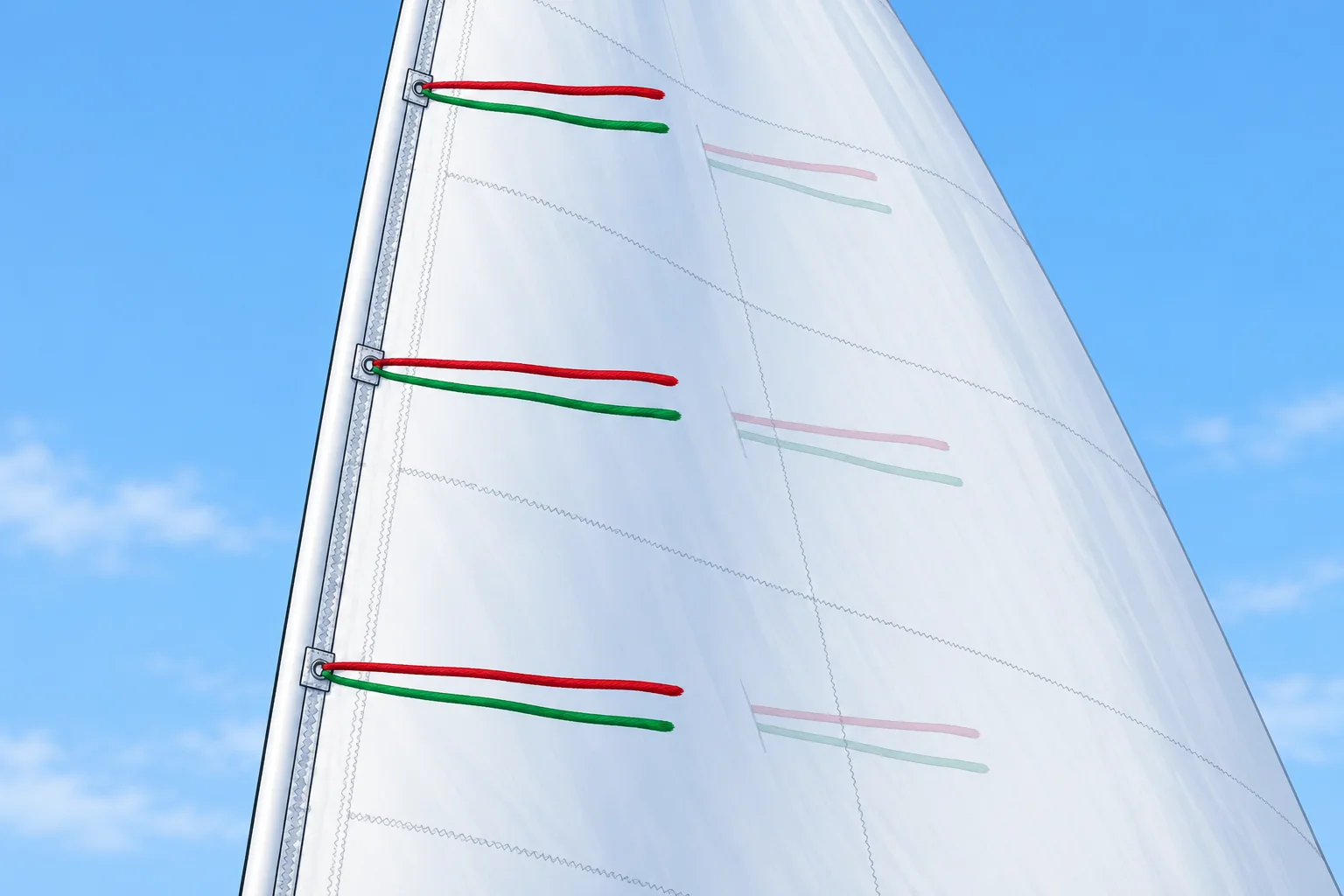
Luff telltales
Luff telltales are short strips just behind the headsail front edge (luff), usually at three heights. Both sides should stream aft. If the windward strip, on the side facing the wind, lifts, sheet in (pull in the sail control rope) or bear away (turn away from the wind). If the leeward strip, on the sheltered side, droops or spins, the sail is stalled: ease the sheet (let it out) or head up (turn towards the wind).
Steer or trim
Upwind, you usually keep the sheet set and steer to the telltales. On a reach, with the wind coming from the side, you usually hold your course and adjust the sheet.
Twist
Twist is how much the top of a sail opens compared with the bottom. Some twist lets the upper sail match the apparent wind, the wind you feel aboard, which usually comes from further aft aloft. To check it upwind, keep the sheet fixed and head up slowly. Watch the windward luff telltales: upper ones lifting first means too much twist; lower ones first means too little. Aim for them to lift together.
Leech telltales
On the mainsail, leech telltales fly from the back edge, often at batten ends; battens stiffen the sail. Streaming aft suggests clean flow. Hidden behind the sail may mean the leech is too tight. When sailing steadily upwind, about 50% streaming at the top is a common guide. In light air or while accelerating, aim for more continuous streaming. On a reach, the kicker holds the boom down and controls twist. On a deep run, these telltales may not stream reliably.
Shape words
Sailmakers describe shape with three terms. Draft or depth is how curved the sail is, its belly. Draft position is where along the sail the deepest point lies. Twist is the opening from bottom to top. A deep sail gives power for light wind and waves; a flat sail gives less drag and heel in strong wind.
Key figures
- Windward luff telltale lifts
- Sheet in, or bear away
- Leeward luff telltale stalls
- Ease the sheet, or head up
- Heading up slowly: upper windward luff telltales lift first
- Too much twist: reduce it
- Heading up slowly: lower windward luff telltales lift first
- Too little twist: add it
- Main top leech telltale upwind
- About 50%; more in light air or while accelerating
Remember
- Both luff telltales streaming aft: flow is right.
- Windward lifting: sheet in or bear away. Leeward stalling: ease or head up.
- Twist is the top of the sail opening relative to the bottom.
- Heading up slowly: upper windward luff telltales lift first = too much twist; lower first = too little.
- Main top telltale: about 50% streaming upwind; more in light air or while accelerating.
Common mistakes
Wrong: A quiet, full sail with no flapping is trimmed perfectly.
Right: It may be stalled. Check the leeward telltales; ease until the luff just lifts, then sheet in a little.
Wrong: Twist is a fault; the sail should be the same angle top to bottom.
Right: Wind is stronger and further aft aloft. The right amount of twist matches the sail to it.
Worked case
Close-hauled, sailing as close to the wind as the sails allow, all three windward jib telltales lift. You bear away until they stream. With the sheet fixed, you then head up slowly: the upper windward telltale lifts before the lower ones. What do you adjust?
Show the answer
Bearing away restored flow. In the slow heading-up test, the upper telltale lifting first shows too much twist. Move the jib car, the sheet's sliding lead block, slightly forward. Reset the sheet and repeat the test. Aim for all three heights to lift together.
Practice question
Close-hauled, the windward jib telltale is lifting. What should the helm do?
- Head up towards the wind
- Bear away from the wind
- Ease the jib sheet a lot
- Tack onto the other side
Show the answer
Answer: B. Bear away slightly until both telltales stream aft.
2 · Headsail
Headsail controls: sheet, car and halyard
Three controls set the headsail: the sheet sets angle and twist, the car sets how the sheet pulls, and the halyard sets luff tension and draft position.
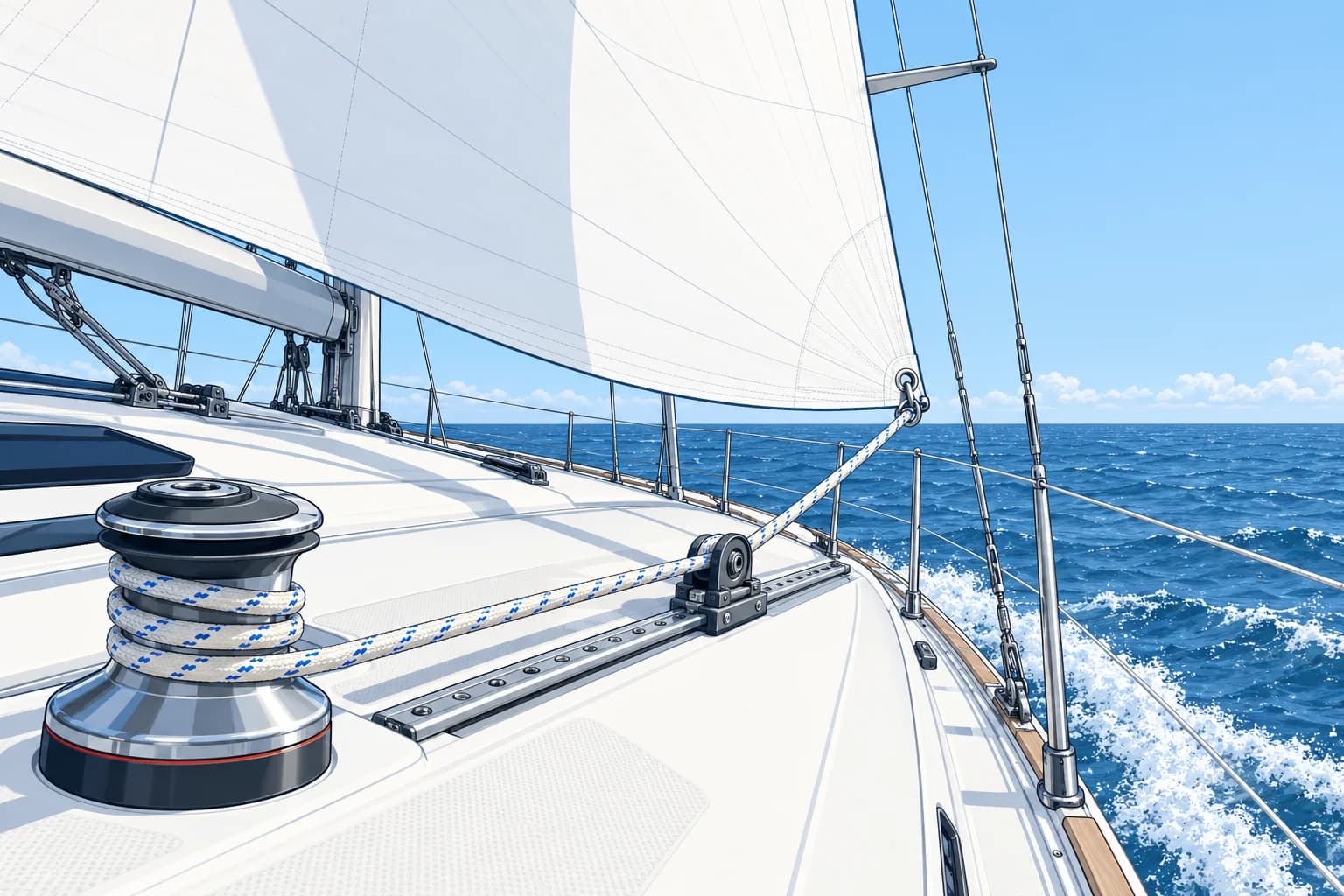
Sheet
The sheet, a control rope, sets angle and twist by pulling the clew (lower aft corner) in or out. Sheeting harder closes the leech and flattens the foot (bottom edge). Upwind, a genoa, a headsail extending aft of the mast, typically has its leech near but clear of the spreader end. A spreader is a mast strut supporting the shrouds, the side supports. On a reach, ease until the luff telltales are right.
Car
The car, or fairlead, is the sliding lead block on its track. It sets the direction the sheet pulls. Moved forward, the sheet pulls more down: the leech closes, twist decreases and the foot gets deeper. Moved aft, it pulls more back: the foot flattens and the top opens, adding twist. Set it so all windward luff telltales lift together as you head up slowly with the sheet fixed.
Halyard
The halyard, the rope that hoists the sail, sets luff tension. More tension pulls the draft forward and flattens the back of the sail. Less tension lets the draft move aft and gives a finer entry for flat water. In stronger wind, persistent horizontal wrinkles with draft too far aft suggest more tension. Slight wrinkles can be acceptable in light air. A hard vertical crease suggests too much tension.
Forestay sag
The forestay, the mast support towards the bow, bows slightly under load. More sag makes the headsail deeper and more powerful, but harder to point with, or sail close to the wind. Less sag makes it flatter. On many rigs, tightening the backstay, the mast support towards the stern, reduces sag; on some, running backstays do the job. Follow your rig maker's tuning guide.
On a reach
As you bear away, ease the sheet and move the car forward, or outboard (away from the centreline) if you have a choice of tracks. The clew then lifts less as the sail swings out and the top does not twist away too much. If you have barber haulers, lines pulling the sheet down or out, they do the same job.
Key figures
- Car forward
- Less twist, deeper foot, closed leech
- Car aft
- More twist, flatter foot, open top
- More halyard tension
- Draft moves forward; for strong wind and chop
- Upwind genoa guide
- Leech near, not touching, the spreader end
- More forestay sag
- Deeper, more powerful sail; points lower
Remember
- Sheet: angle to the wind and twist.
- Car forward: less twist and a deeper foot; aft: more twist and a flatter foot.
- Halyard tighter: draft forward; looser: draft aft.
- Stronger wind, luff wrinkles and draft aft: add halyard tension. Slight light-air wrinkles are fine; vertical crease: ease.
- Forestay sag adds depth; backstay tension usually reduces it.
Common mistakes
Wrong: Leave the car in one place for every wind and every course.
Right: Move it as conditions change. With the sheet fixed, head up slowly: the right position makes all windward luff telltales lift together.
Wrong: Wrinkles along the luff are just an old sail.
Right: In stronger wind, persistent horizontal wrinkles with draft too far aft suggest more halyard tension. Slight wrinkles can be acceptable in light air; avoid a hard vertical crease.
Worked case
In 18 knots and a short chop, your genoa is very full, with the deepest point well aft and horizontal wrinkles along the luff. The boat heels and slows in every wave.
Show the answer
Add halyard tension to bring the draft forward and clear the persistent wrinkles. Tighten the backstay, where effective on your rig, to reduce forestay sag and flatten the sail. Move the car slightly aft to open the top and flatten the foot. Recheck heel, acceleration and telltales after each change.
Practice question
You move the jib car forward. What happens to the sail?
- The top twists open and the foot flattens
- The leech closes and the foot gets deeper
- The draft moves aft and the luff wrinkles
- The sail moves further away from the mast
Show the answer
Answer: B. A forward lead pulls the clew down more: less twist, a tighter leech and a fuller foot.
3 · Mainsail
Mainsail controls
Use the mainsail controls to set its angle, twist and depth. Change one control at a time and watch the sail.
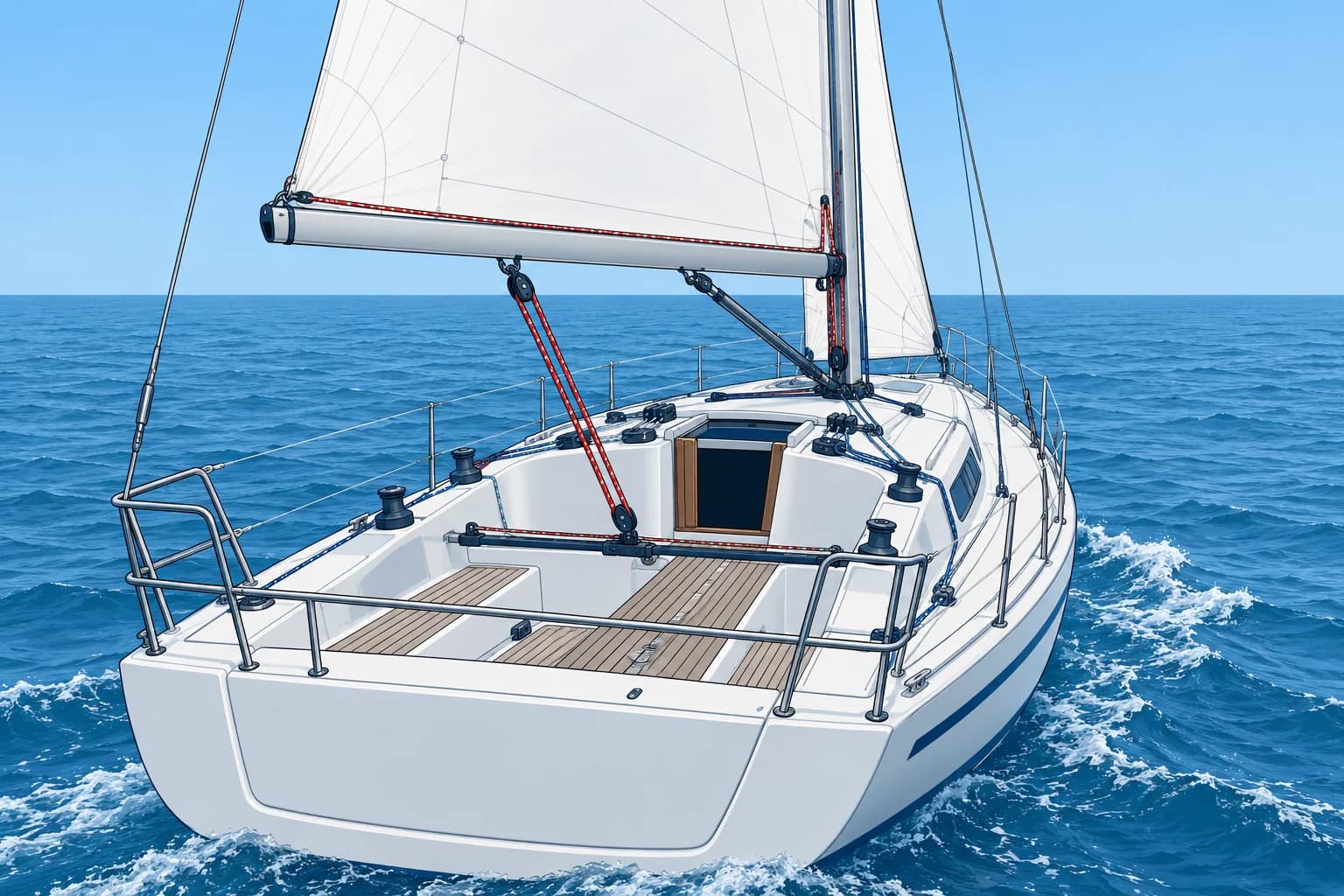
Mainsheet and traveller
The mainsheet pulls the boom in and down. Upwind it mainly sets leech tension and twist. The traveller is a car on a track across the boat that the mainsheet runs to. It moves the boom towards or away from the centreline without changing twist much. Upwind, set twist with the sheet, then the angle with the traveller.
Kicker or vang
The kicker (UK) or vang (US) pulls the boom down. When the mainsheet is eased on a reach or run, the boom lifts and the top of the sail twists away. The kicker holds the boom down and controls twist. Upwind, the mainsheet does most of this job. Never leave the kicker so tight that the boom end can dip into the sea when rolling.
Outhaul
The outhaul pulls the clew along the boom. Tighter, it flattens the lower part of the sail, for strong wind or flat water upwind. Eased, it makes the lower part deeper, for power in light wind, in waves or off the wind. A small adjustment makes a visible change.
Cunningham
The cunningham pulls the luff down near the tack (lower forward corner), like extra halyard tension. It moves the draft forward. As the wind rises, the sail's cloth stretches and the draft moves aft; the cunningham pulls it back. Ease it in light wind; small horizontal wrinkles along the luff are acceptable then.
Backstay
On rigs designed for it, tightening the backstay bends the mast forward, flattening the main and opening its upper leech. These include many fractional rigs, where the forestay meets the mast below its top. It can also increase forestay tension; the effect depends on the rig. More backstay can therefore depower the sails. Follow the rig maker's limits: too much can damage the mast.
Key figures
- Mainsheet (upwind)
- Leech tension and twist
- Traveller
- Boom angle, with little change to twist
- Kicker / vang
- Holds the boom down; controls twist off the wind
- Outhaul
- Tight: flat lower sail. Eased: deeper, more power
- Cunningham
- Pulls the draft forward
- Backstay (bendy rig)
- Bends mast, flattens main; may reduce forestay sag
Remember
- Mainsheet sets leech tension; traveller sets the boom's angle.
- Off the wind, the kicker holds the boom down and controls twist.
- Outhaul tight flattens the lower sail; eased gives power.
- Cunningham pulls the draft forward as the wind rises.
- On a suitable bendy rig, backstay tension flattens the main and may reduce forestay sag.
Common mistakes
Wrong: On a reach, ease the mainsheet and forget the kicker.
Right: Without the kicker the boom rises and the top twists away, spilling power and making the boat roll.
Wrong: Bring the boom to windward by pulling the mainsheet harder.
Right: That mostly closes the leech. Use the traveller to move the boom without over-tightening the leech.
Worked case
Close-hauled in 8 knots and flat water, on a rig whose mast bends under backstay tension, your mainsail is pulled very flat: outhaul hard, cunningham tight, backstay on. The boat feels sluggish after a tack.
Show the answer
The sail is too flat for light wind. Ease the outhaul to add depth in the lower sail. Ease the cunningham so the draft can move back, accepting small luff wrinkles. Ease the backstay to straighten the mast and add depth. Bring the traveller towards the centreline without over-sheeting. Keep the top leech telltale streaming most of the time while speed rebuilds; reassess trim once settled.
Practice question
Upwind, the leech telltales show the twist you want, but the boom needs to move out. Which control should you ease?
- Ease the outhaul
- Ease the cunningham
- Ease the traveller
- Ease the topping lift
Show the answer
Answer: C. Ease the traveller to change boom angle while largely preserving the sheet-set twist.
4 · Balance
Helm balance: weather helm and lee helm
A well-balanced boat needs only a little rudder. Too much weather helm brakes the boat; lee helm is unsafe. Trim and reefing fix both.
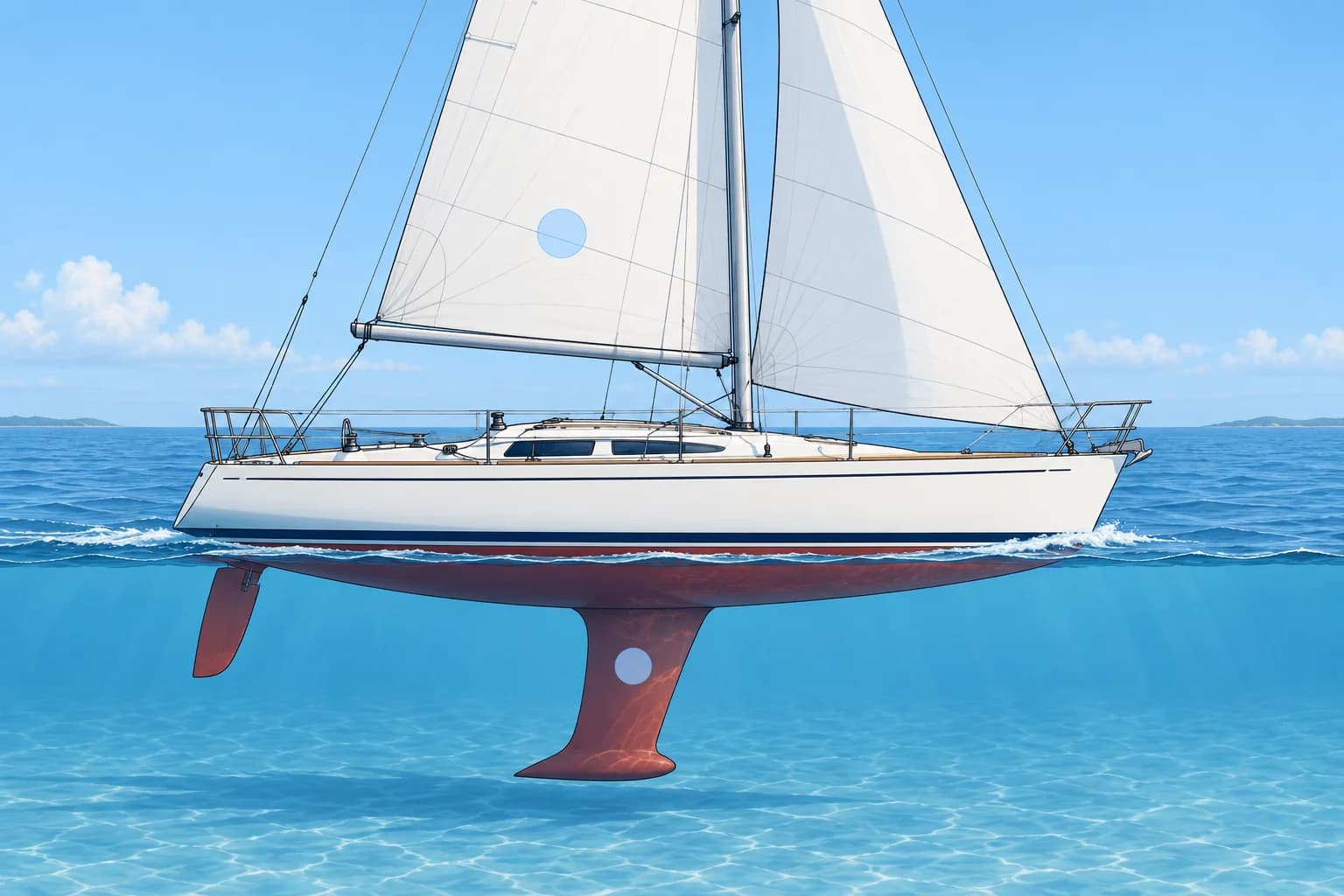
Two centres
The sails act through the centre of effort (CE). The hull, keel and rudder resist sideways motion through the centre of lateral resistance (CLR). In a simple upright model, moving sail force aft relative to the CLR increases the tendency to turn towards the wind (weather helm). Moving it forward increases the tendency to turn away (lee helm). Heel also affects actual balance.
Slight weather helm is good
With a little weather helm, a few degrees of rudder, the rudder adds lift to windward and the boat gives feedback. She normally tends to head up and lose power if you release the helm. This does not guarantee a stop: keep control of the helm. Lee helm is undesirable: a boat that bears away when you let go can gybe or run off.
Why weather helm grows
Heel moves the sail force out to leeward of the hull, which turns the bow up. The heeled hull also becomes lopsided under water. A mainsail sheeted too hard, or too deep, adds more. So weather helm usually grows with the wind. A heavy helm means a large rudder angle, which brakes the boat.
Correcting it
To reduce weather helm, reduce heel and mainsail power. Ease the mainsheet or lower the traveller; flatten and twist the main; reef the main if needed; or move the crew to windward. To reduce lee helm, if the main is under-trimmed, sheet it in until airflow is right. Otherwise consider less headsail and recheck balance.
Key figures
- Simple model: CE moves aft relative to CLR
- Greater tendency to turn towards the wind: weather helm
- Simple model: CE moves forward relative to CLR
- Greater tendency to turn away from the wind: lee helm
- Good balance
- Slight weather helm, a few degrees of rudder
- Reduce weather helm
- Ease mainsheet, lower traveller, reduce heel; reef if needed
Remember
- Weather helm: the boat turns towards the wind; lee helm: away from it.
- Slight weather helm is good; a heavy helm is a brake.
- Heel and an over-sheeted main increase weather helm.
- Reduce weather helm: ease the mainsheet, lower the traveller, flatten the main and reduce heel; reef if needed.
- Lee helm: if the main is under-trimmed, sheet in until airflow is right; otherwise consider less headsail and recheck balance.
Common mistakes
Wrong: Lee helm is safer because the boat will not round up.
Right: Lee helm encourages bearing away and can lead to a gybe. Slight weather helm is the preferred balance; keep control of the helm.
Wrong: Reefing the headsail is the best cure for weather helm.
Right: Reducing headsail shifts sail force aft but also reduces heel. The net effect varies; reassess balance after reducing either sail.
Worked case
Close-hauled in a building breeze, you need about 15° of rudder to hold course, and the boat rounds up in every gust. The genoa is full size and the main is sheeted hard with the traveller in the middle.
Show the answer
This is heavy weather helm. Lower the traveller to leeward and ease the mainsheet slightly in the gusts. Flatten the main with the outhaul, cunningham and backstay where your rig allows. Move the crew to windward. If the helm is still heavy, reef the main. The aim is a few degrees of rudder.
Practice question
Your boat keeps turning towards the wind unless you hold the helm. What is this called?
- Weather helm
- Lee helm
- Leeway angle
- Pinching up
Show the answer
Answer: A. Weather helm is the tendency to turn into the wind. A little is normal; a lot needs correcting.
5 · Depowering
Depowering: flatten, twist, then reef
Ease promptly in an overpowering gust. As wind builds, flatten, adjust twist and traveller, then reef when needed.
Why depower
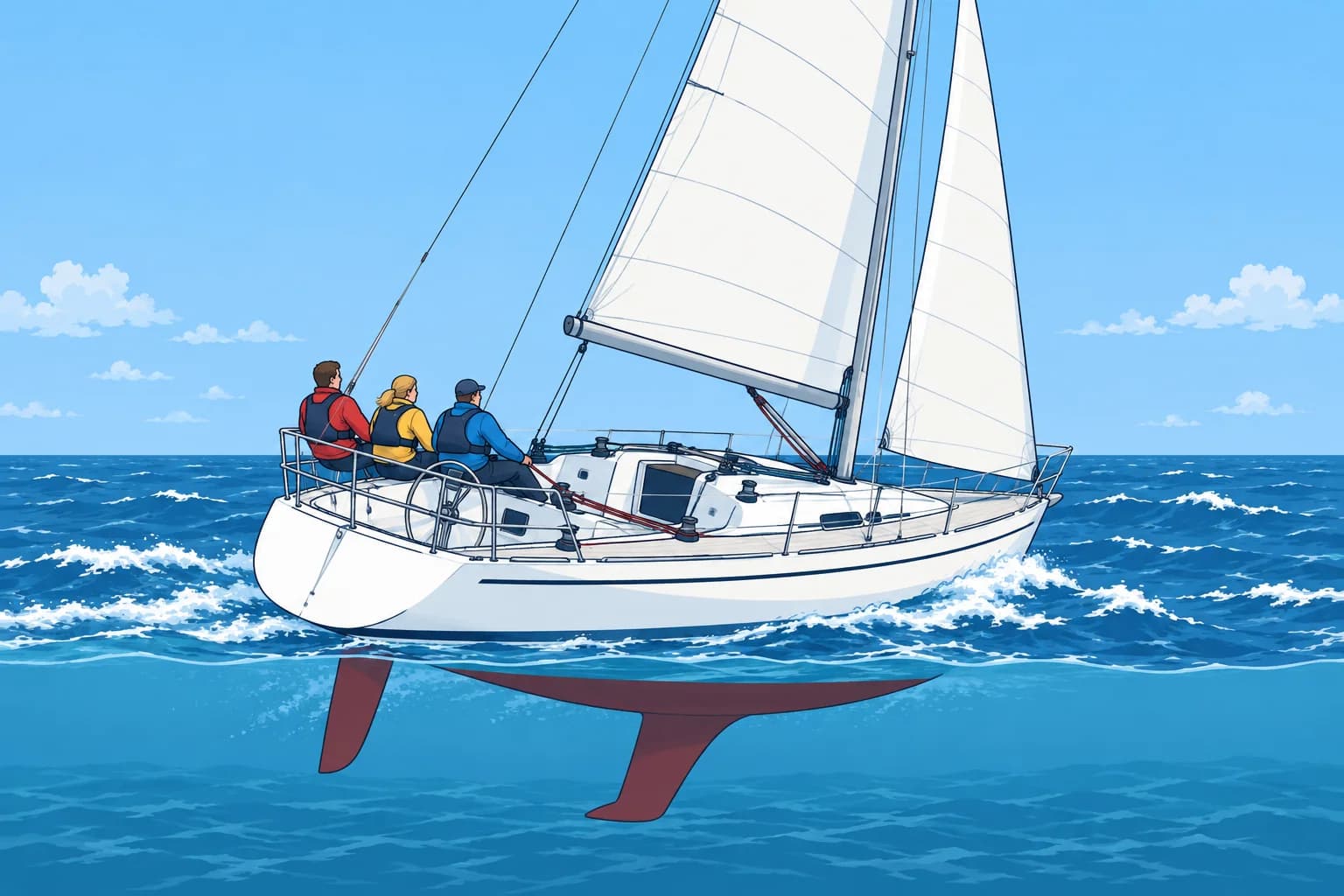
Above a certain wind strength, more sail force only adds heel, leeway and weather helm. Speed no longer rises. Your job is to keep the boat on her feet, at a steady heel, with a light helm. Ease promptly if a gust overpowers you. For a gradual increase, adjust trim while the boat remains under control; reef early if control or balance is poor.
Flatten
A flatter sail makes less force and less drag. On the main, tighten the outhaul and cunningham; add backstay if your rig allows. On the headsail, use halyard tension to keep the draft forward; use backstay adjustment, where effective, to reduce forestay sag. Move the car slightly aft to flatten the foot and open the top. Flattening reduces heel with little speed loss.
Twist and ease
Opening the top of the sails spills wind where it heels the boat most. For main twist, ease the mainsheet with the kicker free enough to let the boom rise. For headsail twist, move the jib car aft. Drop the traveller to leeward in gusts and bring it back up in the lulls. Play the mainsheet or traveller: ease in gusts and re-trim in lulls to keep heel steady.
Reduce sail
If you are easing the main most of the time, or control or balance is poor, reduce sail area. A common upwind order is to reef the main; reduce headsail too if still needed. Recheck power and helm balance. A boat with the right sail area sails faster and more comfortably than one carrying too much sail with a flogging main.
Waves and reaching
In waves, keep slightly more depth for drive. On a reach, use the kicker to control twist and ease the mainsheet in gusts, keeping the boom clear of the shrouds. Reduce sail if control remains poor.
Depowering upwind: gust response and gradual adjustments
- Ease the mainsheet or lower the traveller promptly if a gust overpowers you. — Easing restores control immediately.
- Once control is restored, flatten between gusts with outhaul and luff tension; add backstay where effective and within the rig maker's limits. — Flatter sails make less heeling force at little cost to speed.
- Move the jib car aft for headsail twist. For main twist, ease the mainsheet with the kicker free enough to let the boom rise. Play the sheet or traveller as needed in gusts. — Twist spills wind high up. Easing in gusts keeps heel and helm steady.
- Reef the main if you are easing most of the time or control or balance is poor. — Too much sail is slower and harder on the rig and crew.
- Reduce headsail too if still needed; re-check helm balance. — Only reduce further if power or balance calls for it.
Remember
- Above a certain wind, more power only adds heel and leeway.
- Between gusts, flatten with outhaul, cunningham, halyard and backstay where effective.
- Headsail twist: car aft. Main twist: ease mainsheet with kicker free enough to let the boom rise.
- Ease promptly if overpowered; play the traveller or mainsheet in gusts to keep heel steady.
- Easing the main most of the time? Reef.
Common mistakes
Wrong: Let the main flog permanently to keep the boat upright.
Right: A constantly flogging main is slow and damages the sail. Ease promptly in gusts; reef if you are easing most of the time or control or balance is poor.
Wrong: Flatten the sails as much as possible in a big sea.
Right: Waves need power. Keep slightly more depth and twist so the boat can drive through them.
Worked case
Close-hauled in 16 knots, gusting 22, your 10 m sloop heels to 28° in each gust. All controls are as they were in 10 knots: outhaul eased, cunningham off, backstay off, traveller centred.
Show the answer
Ease the main to control the gusts, then flatten between gusts: tighten the outhaul, pull on the cunningham and add backstay within the rig maker's limits. Move the jib car slightly aft to add twist. Lower the traveller and play it or the mainsheet in gusts. If easing is needed most of the time, or control remains poor, reef the main; reduce headsail too if still needed. Recheck balance.
Practice question
The wind is building gradually and the boat remains under control. Which sail-shape change is usually tried before reducing area?
- Deepen the sails
- Flatten the sails
- Close both leeches
- Move both drafts aft
Show the answer
Answer: B. Flattening reduces heeling force with little speed loss while the boat remains under control. Ease immediately if overpowered. Reef early if control or balance is poor.