
Sailing and sail trim · Level R2 · 4 parts · about 15 min
Tacking, gybing and heaving to
4 short parts: Tacking · Gybing · Accidental gybe · Heaving to. Each part explains the idea, then gives the points to remember, the common mistakes, a worked case and a practice question; the Academy unit adds all 24 check questions.
1 · Tacking
Tacking: turning the bow through the wind
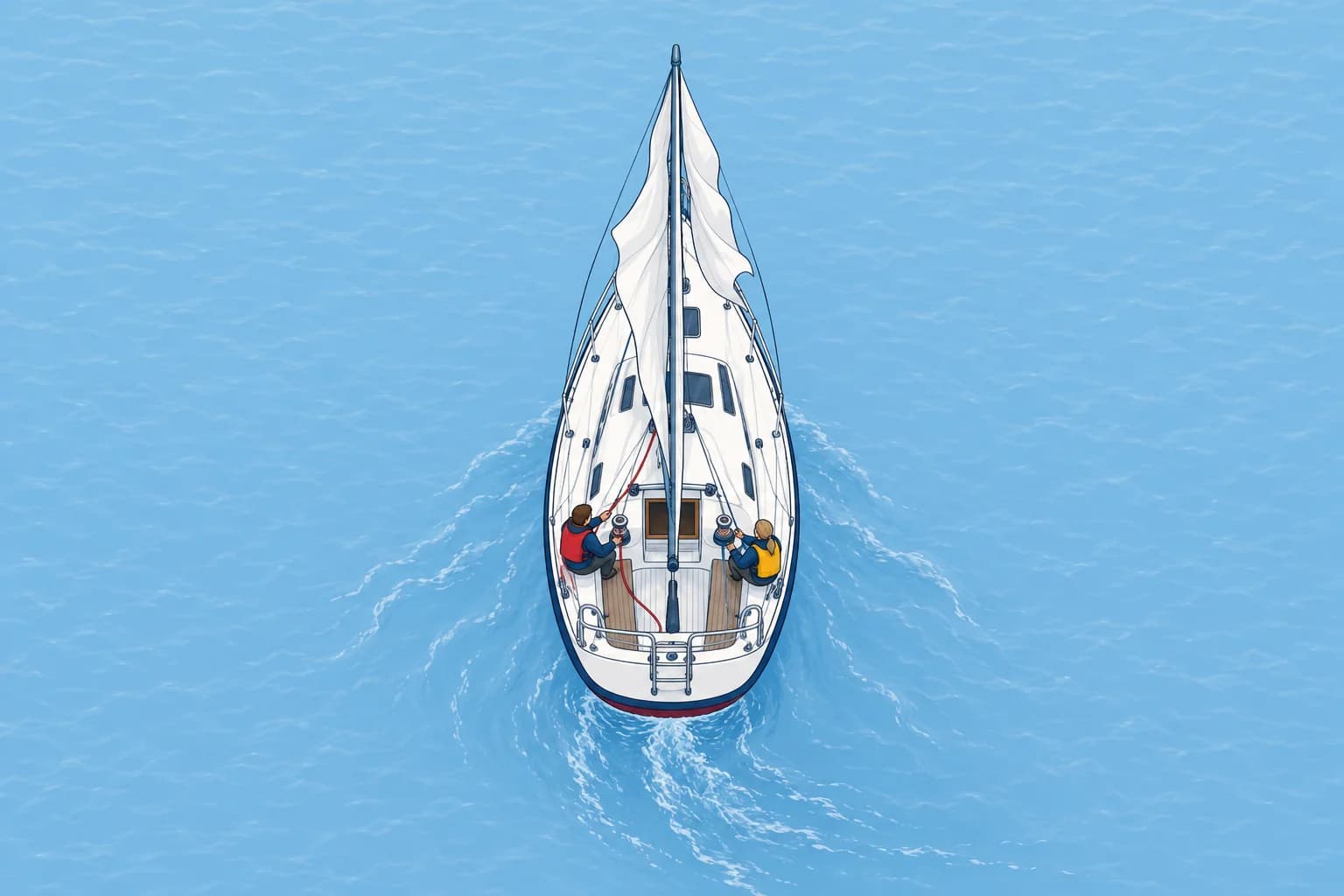
A tack turns the bow through the wind. Prepare, call it, then turn steadily with enough speed.
What a tack is
A tack turns the bow, the front of the boat, through the wind. On starboard tack, the wind comes over your starboard (right) side; on port tack, over your port (left) side. The boom, the spar holding the mainsail out, moves only a short way. You pass through the no-go zone, where the sails cannot drive you, so carry enough speed to coast through.
Before you start
Build speed close-hauled, as close to the wind as you can sail while the sails still pull. Look all round, including behind the headsail, the sail ahead of the mast. Check your new course is clear. Its sheets are control ropes: the working sheet trims (adjusts) it now; the lazy sheet is the other one. Check the working sheet runs free. Prepare the lazy sheet on its winch; use enough turns for the load before trimming under tension, following the maker’s guidance.
Commands
You call "Ready about". The crew prepares and answers "Ready". Then call "Lee-oh" (in North America also "Helm's a-lee") and begin the turn. The commands warn everyone the boom will move. Under the COLREGs, the collision rules, a port-tack sailing vessel normally keeps clear of a starboard-tack one, so check who has right of way before you tack near others.
The turn
Steer smoothly towards the wind, not with a sudden full rudder, which brakes the boat. As the headsail backs, filling from the wrong side, the crew releases the old sheet and pulls in the new one quickly. The helm keeps turning until the sails fill on the new side, then settles on a close-hauled course. Build speed before sailing closer to the wind.
When it fails
Stopped head to wind with no sail driving, you are in irons. Too little speed or a sharp turn can cause this. To turn the bow to starboard, back the headsail to port. As you gather sternway (move backwards), turn the wheel to port or move the tiller to starboard. Centre the rudder as forward motion resumes, then trim the sails. In waves, keep speed up and choose a flat patch.
Key figures
- Commands (UK/RYA)
- "Ready about" – "Ready" – "Lee-oh"
- Commands (US)
- "Ready about" – "Ready" – "Helm's a-lee"
- Turn (cruising yacht)
- About 90° of heading, close-hauled to close-hauled
- In irons
- Stopped head to wind; back the headsail to recover
Tacking a sloop, step by step
- Sail close-hauled at full speed and look all round, including behind the headsail. — Speed carries you through the no-go zone; the new course must be clear.
- Call "Ready about". Crew clears the working sheet and prepares the lazy sheet on its winch. — Everyone knows the boom will move and sheets will run free.
- Crew answers "Ready". Helm calls "Lee-oh" and steers steadily towards the wind. — A smooth turn keeps speed; a sudden full rudder brakes the boat.
- As the headsail backs, release the old sheet and pull in the new one fast. — Prompt release lets the headsail cross and regain forward drive.
- Settle close-hauled on the new tack, trim both sails, then build speed. — The keel needs water flowing past it before you can sail closer to the wind again.
Remember
- A tack turns the bow through the wind; the boat changes from one tack to the other.
- Look all round, then call "Ready about", wait for "Ready", then "Lee-oh".
- Turn steadily with full speed; do not slam the rudder over.
- Release the old headsail sheet as it backs; trim the new one fast.
- Stopped head to wind, in irons: back the headsail to push the bow off.
Common mistakes
Wrong: Tack the moment you call "Ready about".
Right: Wait for "Ready". A crew member with a jammed sheet or a hand in a winch is not ready.
Wrong: Keep the old sheet held after every tack.
Right: Brief backing can help the bow finish turning. For a normal tack, release promptly as the sail backs so it crosses and drives again.
Worked case
Close-hauled at 2 knots in a short chop, you tack with a quick, full turn of the wheel. The boat stops head to wind, sails flapping, and starts drifting backwards.
Show the answer
You are in irons: too little speed and a sharp turn stopped the boat. To turn the bow to starboard, back the headsail to port. As you gather sternway (move backwards), turn the wheel to port or move the tiller to starboard. Centre the rudder as forward motion resumes, then trim the sails. Next time, build speed before turning smoothly.
Practice question
You call “Ready about”, but the crew reports a jammed sheet. What should you do?
- Start turning while the crew clears the jammed sheet
- Wait until the sheet is clear and the crew confirms ready
- Turn sharply to carry the boat through the wind faster
- Release both headsail sheets before beginning the turn
Show the answer
Answer: B. The warning starts preparation. Begin the tack only when the crew confirms readiness.
2 · Gybing
The controlled gybe
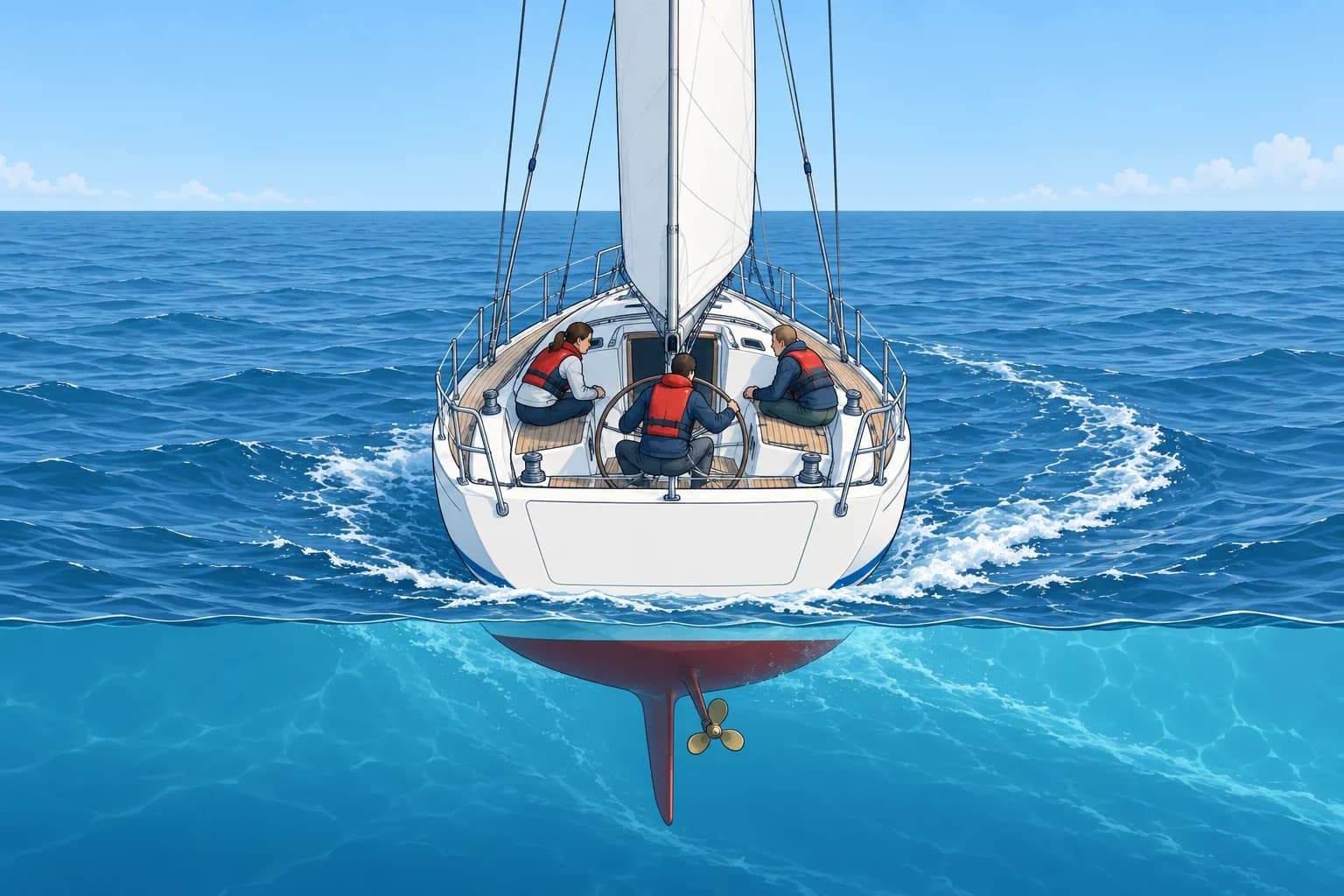
A gybe turns the stern through the wind. Control the boom's crossing, warn the crew and keep heads low.
What a gybe is
Gybing (American English: jibing) changes tack by turning the stern, the back of the boat, through the wind. The mainsail can remain loaded as the stern crosses the wind, so an uncontrolled boom can swing violently. A controlled gybe brings the boom across under your control, at the moment you choose. The headsail may collapse or be blanketed, sheltered from the wind by the main.
Before you start
Check the new course is clear. Make sure everyone knows where the boom will swing and keeps their head below it. Check the mainsheet, the rope controlling the boom, is clear and runs freely. Check the kicker (vang), the line holding the boom down, is on; without it the boom lifts and the top of the sail can flip unpredictably.
Commands
Call "Stand by to gybe" (US: "Prepare to jibe") and wait for "Ready". Keep everyone clear of the boom and mainsheet. Bear away towards a run, with the wind nearly astern, then sheet the main to the centreline. A shorter mainsheet limits the boom’s swing and shock. Call "Gybe-oh" (US: "Jibe-ho") as you turn through dead downwind.
Through the gybe
Continue the turn gently through dead downwind. When the wind reaches the other side, the boom crosses. Let the mainsheet out smoothly but quickly on the new side, without letting it run free, and meet the turn, using opposite rudder to stop the swing. The boat can otherwise round up, swinging towards the wind and heeling hard. Finally bring the headsail across and trim for the new course.
Strong winds
In strong winds, consider tacking round instead of gybing, if you have enough clear water. Turn towards the wind, tack, then bear away onto the new course. This is sometimes called a chicken gybe. It needs sea room and a boat that can safely turn upwind. If you must gybe, keep speed up so the apparent wind, the wind you feel aboard, is lowest as the main crosses.
Key figures
- Commands (UK/RYA)
- "Stand by to gybe" – "Ready" – "Gybe-oh"
- Commands (US)
- "Prepare to jibe" – "Ready" – "Jibe-ho"
- Before the gybe
- Kicker on, mainsheet centred, heads low
- Strong winds
- Tack round if there is room and you can safely turn upwind
Controlled gybe on a yacht
- Check the new course is clear, the kicker is on and the mainsheet runs free. — A loose kicker lets the boom lift; a tangled sheet stops control.
- Call "Stand by to gybe"; wait for "Ready"; heads below the boom. — The boom can swing across the whole cockpit.
- Bear away to a run and pull the mainsail into the centreline. — A short sheet gives the boom a short, gentle swing.
- Call "Gybe-oh" and steer slowly until the boom crosses. — A slow turn keeps the moment of crossing under control.
- Ease the mainsheet smoothly on the new side and meet with opposite helm. — Easing and counter-steering stop the boat rounding up.
- Bring the headsail across, then trim both sails for the new course. — The boat settles on the new gybe with both sails working.
Remember
- A gybe turns the stern through the wind; the boom swings fully across.
- Call "Stand by to gybe"; keep crew clear of boom and mainsheet and wait for "Ready" before centring the main.
- Keep the kicker on and heads low; centre the main, then call "Gybe-oh".
- After the boom crosses, ease the sheet and meet with opposite helm.
- In strong winds, tack round if you have sea room and can safely turn upwind.
Common mistakes
Wrong: Let the mainsheet run out as the boom crosses.
Right: Ease it under control. A free-running boom can hit the shrouds, the wires supporting the mast, and hurt crew or break gear.
Wrong: Gybing is just a tack the other way round.
Right: In a tack the sails flap through. In a gybe the main can stay loaded, so control the boom to prevent a violent swing.
Wrong: Release the kicker to make the boom swing more easily.
Right: Keep it on. Without it the boom rises and the upper sail can flip across violently.
Worked case
Running in 22 knots, you need to change gybe to clear a headland. A new crew member is sitting on the cabin roof beside the mainsheet.
Show the answer
Move everyone clear of the boom and mainsheet. If there is sea room and you can safely turn upwind, tack round. If gybing, call "Stand by to gybe" and wait for "Ready". Check the kicker is on, then bring the main to the centreline. Call "Gybe-oh", turn steadily, ease the mainsheet as the boom crosses and use opposite helm to check the turn.
Practice question
What passes through the wind during a gybe?
- The bow of the boat
- The stern of the boat
- The keel of the boat
- The mast of the boat
Show the answer
Answer: B. A tack turns the bow through the wind; a gybe turns the stern through it.
3 · Accidental gybe
The accidental gybe and how to prevent it
An accidental gybe can injure crew and break gear. Keep the wind clearly opposite the boom, leave room for wind shifts and rig a preventer.
What happens
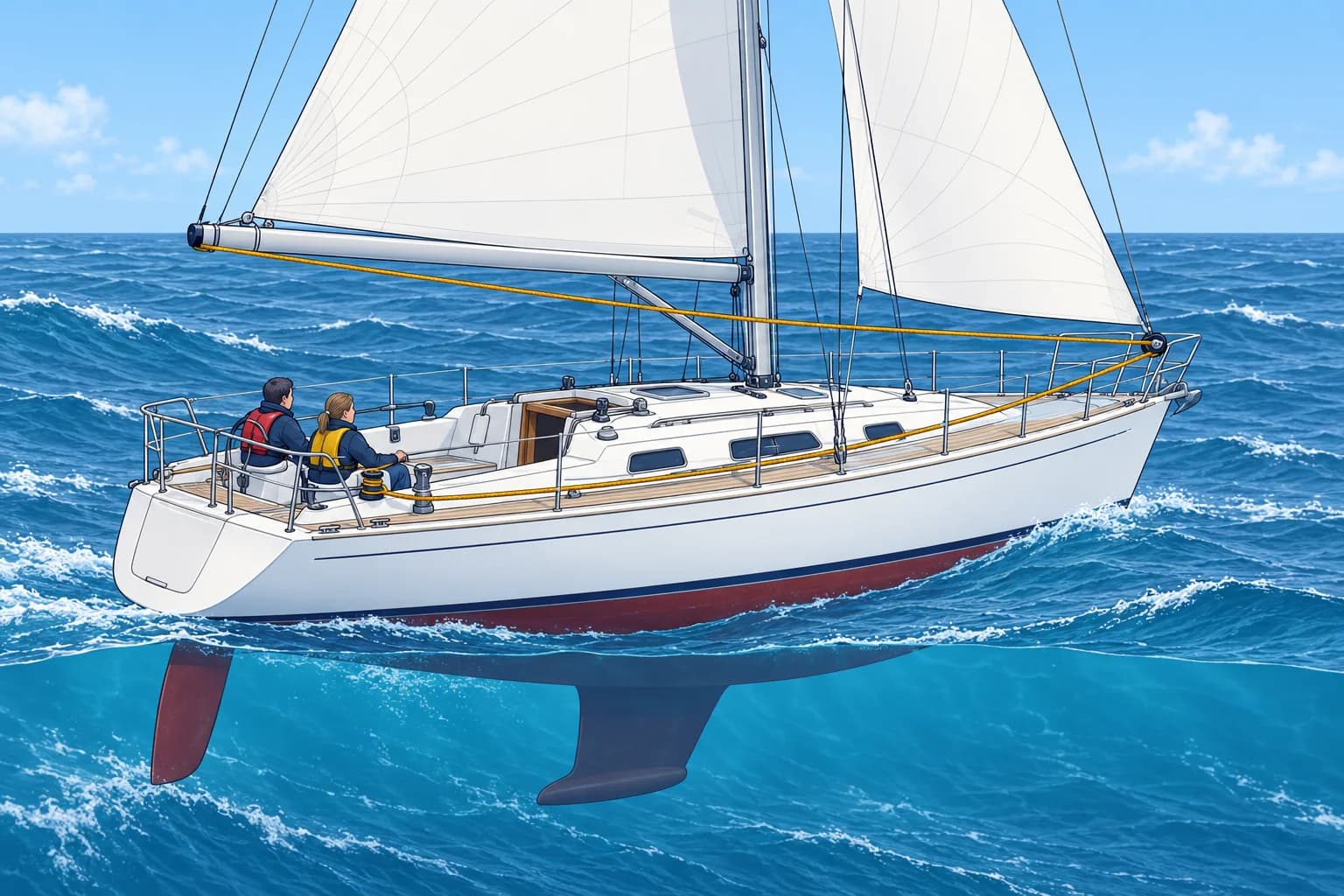
An accidental gybe happens when the wind gets behind the mainsail from the wrong side and throws the boom across without anyone choosing it. The boom can hit a head with enough force to cause serious injury or knock someone overboard. The mainsheet sweeps the cockpit, and the shock can break the boom, the gooseneck (its fitting on the mast) or the rig.
Sailing by the lee
On a run, wind coming from the boom side means you are sailing by the lee. A wave, wind shift or steering error can throw the boom across. Check the apparent-wind indicator. A lifting or fluttering leech, the mainsail's back edge, is another warning. A collapsing headsail may simply be blanketed by the main: check wind direction.
Steering to prevent it
Keep the apparent wind clearly on the side opposite the boom. Allow for yaw, the boat swinging from side to side, and wind shifts. Concentrate on steering; make small corrections early and watch the wind indicator. Head farther up onto a broad reach, with the wind over your rear quarter, if waves push you towards a gybe.
The preventer
A preventer is a line that holds the boom out so it cannot swing across. Rig it from the outer end of the boom, forward to a strong point or block near the bow, and back to the cockpit. Use strong fittings and a cockpit release that works under load. A line from mid-boom straight down to the rail can break the boom if the boat rolls the boom into the sea.
Boom brake and crew
A boom brake is a friction device that lets the boom cross slowly instead of stopping it. It is an alternative to a preventer and is useful when sailing short-handed. Whatever you rig, keep everyone's head below the boom on a run, and never sit or stand in the mainsheet's path. Control the boom with the mainsheet before easing the preventer for a gybe; rig it again on the new side.
Key figures
- By the lee
- Wind on the same side as the boom on a run
- Safer running angle
- Wind opposite the boom; allow a margin for yaw and wind shifts
- Preventer lead
- Boom end → forward block → back to the cockpit
- Boom brake
- Lets the boom cross slowly under friction
Remember
- An accidental gybe can injure crew and break the boom or rig.
- Danger zone: sailing by the lee, wind on the boom side on a run.
- Watch wind direction and the mainsail leech; a collapsing headsail alone does not prove you are by the lee.
- Rig a preventer from the boom end forward and back to the cockpit.
- Keep heads low; control the boom with the mainsheet before easing the preventer for a gybe.
Common mistakes
Wrong: Tie the preventer from the middle of the boom to the nearest cleat.
Right: Lead it from the boom end, forward, then back to the cockpit. A short mid-boom lead can snap the boom.
Wrong: A preventer can be left on through a gybe.
Right: Control the boom with the mainsheet, then ease the preventer. Gybing against it can pin the main aback and knock the boat down.
Worked case
Offshore, running in a long swell with 18 knots of true wind from dead astern. The boom is out to starboard. The helm keeps losing concentration and the genoa, a large overlapping headsail, collapses every few minutes.
Show the answer
Relieve the distracted helm. A collapsing genoa alone does not prove you are by the lee. With the boom to starboard, head up enough to keep the wind clearly over the port quarter, allowing for yaw in the swell and wind shifts. Rig a preventer with a cockpit release that works under load. Keep everyone clear of the boom and mainsheet.
Practice question
On a run with the boom out to port, the wind starts coming over the port quarter. What are you doing?
- Sailing by the lee
- Sailing close-hauled
- Lying quietly hove-to
- Sailing on a beam reach
Show the answer
Answer: A. Wind from the same side as the boom on a run is sailing by the lee, the main cause of accidental gybes.
4 · Heaving to
Heaving to: stopping under sail
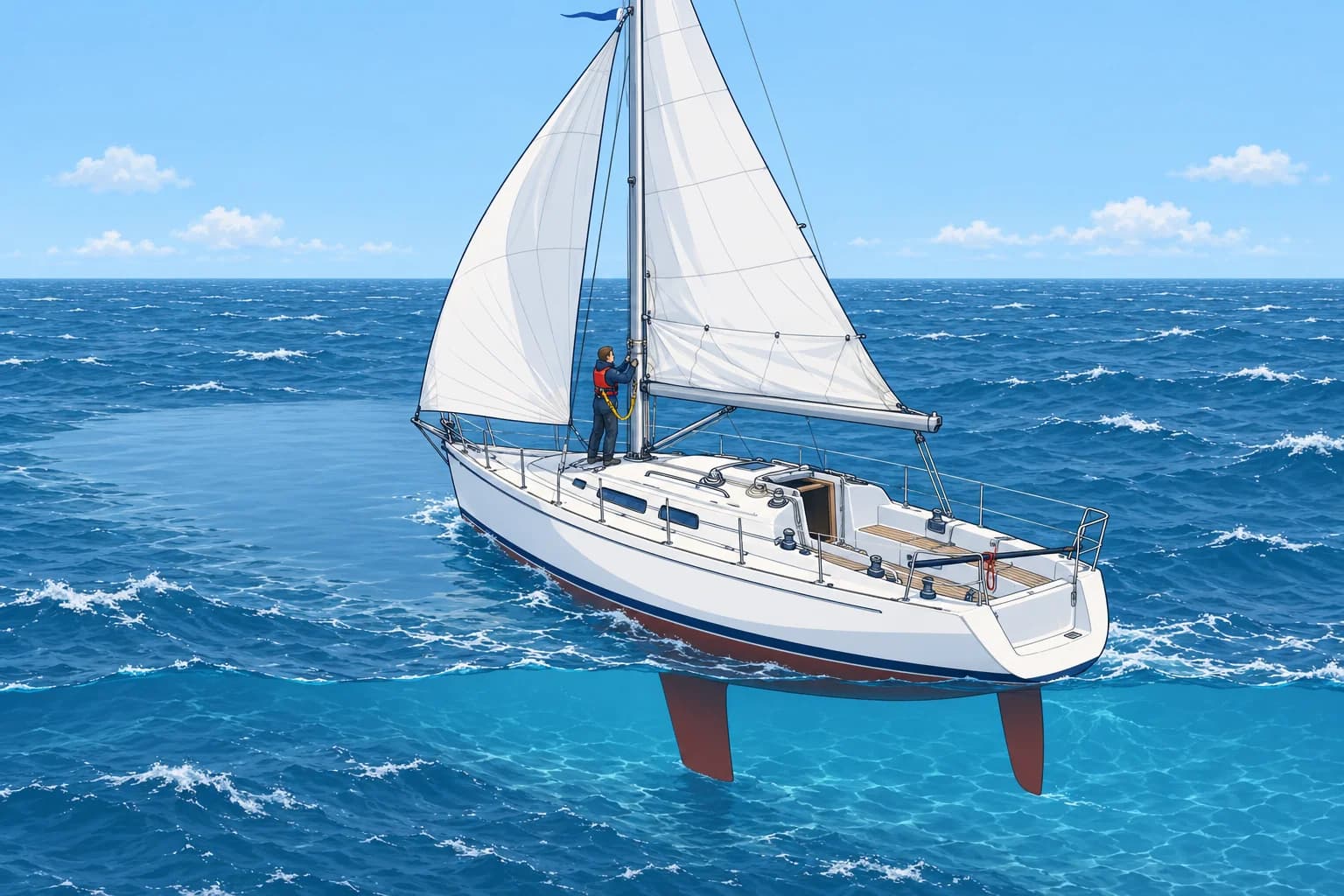
Heaving to balances a backed headsail against the mainsail and rudder. Aim for a steady pause with little forward motion; allow for drift.
What it is
When hove-to, the boat balances under sail with little forward motion. Many yachts lie roughly 45–60° to the wind, but the angle varies. The headsail is backed, sheeted on the windward side, towards the wind, pushing the bow away. The rudder turns the bow towards the wind. The partly eased mainsail balances the two. You drift to leeward, away from the wind, and may keep moving forward, called fore-reaching.
Why heave to
Heaving to gives you a pause at sea. Use it to reef, to cook or eat, to wait for daylight or a tide before entering a harbour, to sort out a problem, or to rest the crew. It is also a recognised heavy-weather tactic for many boats. The emergency use in man-overboard recovery, the crash-stop, is covered in the Emergencies module.
How to heave to
From close-hauled, tack without releasing the headsail sheet. The headsail stays on the old side and fills from the wrong side, backed. Ease the mainsheet partly. Set the rudder to turn the bow towards the wind: tiller to leeward, or wheel turned to windward, then lash it. Adjust the mainsheet and rudder for a steady balance with little forward motion. Do not force a fixed angle or speed.
Getting it right
A long keel runs along much of the hull; a fin keel is shorter and deeper. Long-keeled yachts often settle more readily; some fin-keel yachts keep fore-reaching. Ease the main; use less helm if you keep tacking. Partly furl (roll away) an overpowering genoa, a large overlapping headsail. Change one setting at a time. Check the backed sail is not rubbing on the spreaders, the struts supporting the mast’s side wires. Keep a lookout and sea room to leeward: you are still drifting.
Getting going
To sail on, free the helm, release the backed headsail sheet and sheet it in on the leeward side. Trim the main and bear away to your course. Under the COLREGs, a hove-to sailing vessel is still underway: she has not made fast to the shore or anchored. She keeps her normal lights and must still keep a lookout.
Key figures
- Heading when hove-to
- Often 45–60° off the wind; varies with the yacht and conditions
- Headsail
- Backed: sheeted on the windward side
- Helm
- Tiller to leeward (wheel to windward), lashed
- COLREG status
- Still underway; keep lookout and normal lights
Heaving to from close-hauled
- Sail close-hauled and check there is sea room to leeward. — Hove-to, you still drift with leeway and current, and may fore-reach.
- Tack without releasing the headsail sheet. — The headsail stays backed and pushes the bow away from the wind.
- Ease the mainsheet partly. — A fully sheeted main drives the boat forward; eased, it balances the headsail.
- Put the helm to leeward (tiller to leeward, wheel to windward) and lash it. — The rudder now tries to turn the bow back towards the wind.
- Adjust the main and helm for a steady balance with little forward motion. — Each boat balances differently; watch your drift and sea room rather than forcing a fixed angle or speed.
Remember
- Hove-to: backed headsail, eased main and helm to leeward balance each other.
- To heave to, tack without releasing the headsail sheet.
- Aim for a steady balance with little forward motion; your angle and drift depend on the yacht and conditions.
- Use it to reef, rest, eat, wait or sort out a problem; keep a lookout.
- Some fin-keel yachts keep fore-reaching; adjust one setting at a time and watch your drift.
Common mistakes
Wrong: Hove-to, you are stopped, so you no longer need a lookout.
Right: You are still underway and drifting. Keep a lookout, keep your lights, and watch your sea room.
Wrong: Tiller to windward keeps her pointing into the wind.
Right: Put the tiller to leeward (wheel to windward). That turns the bow towards the wind against the backed headsail.
Worked case
You need to put in a reef. You heave to, but the boat keeps sailing forward at 3 knots and occasionally tacks back through the wind.
Show the answer
Check the headsail is backed and the helm is set correctly. Try easing the main to reduce forward drive. If you repeatedly tack, reduce the helm angle slightly. Change one setting at a time and watch the result. Reduce a genoa that overpowers the balance. Aim for a steady attitude and low speed, checking drift and sea room; some fin-keel yachts keep fore-reaching. Do not force a fixed angle or speed.
Practice question
What is the simplest way to heave to from close-hauled?
- Gybe, then lower the headsail completely
- Tack, keeping the headsail sheet made fast
- Luff up until both sails flap and stop
- Bear away and centre the mainsail fully
Show the answer
Answer: B. Tacking with the headsail sheet still made fast leaves the headsail backed on the new windward side.