

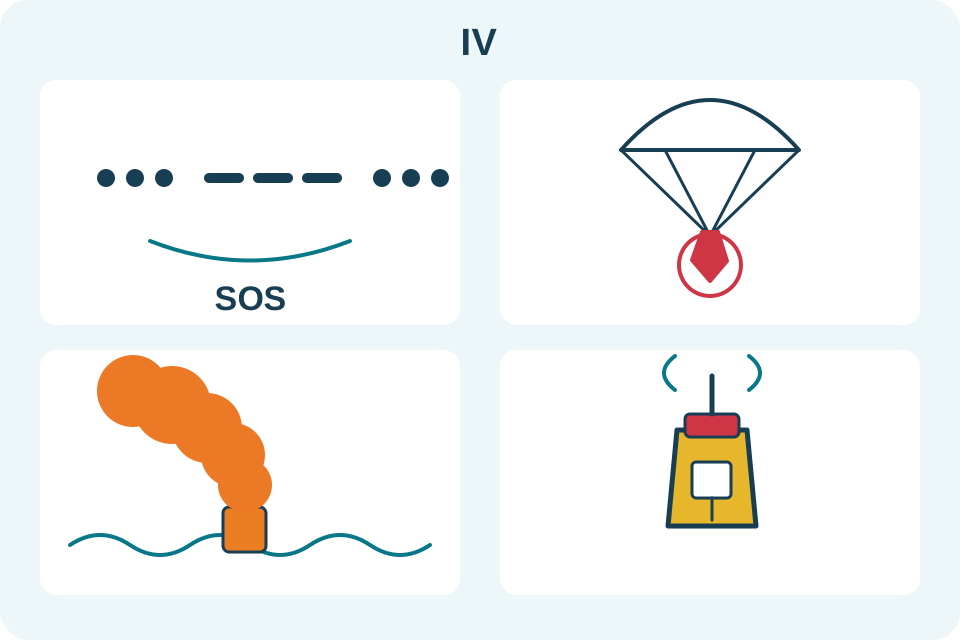
Annex IV: the distress signals
1The lesson in plain words
Annex IV lists the signals that mean distress and need of help, from red flares to DSC and EPIRB alerts. Using them for anything else is forbidden.
What Annex IV is
Rule 37 says a vessel in distress and needing help uses or shows the signals in Annex IV. The list was last replaced by resolution A.1004(25), in force on 1 December 2009. No later amendment to Annex IV is in force as of 2026.
Sound and visual signals
A gun or other explosive signal fired at intervals of about a minute. A continuous sounding of any fog-signal apparatus. Rockets or shells throwing red stars, fired one at a time at short intervals. A rocket parachute flare or a hand flare showing red. Orange smoke. Flames on the vessel. Slowly and repeatedly raising and lowering arms outstretched to each side.
Code and flag signals
SOS in Morse code by any signalling method. The spoken word MAYDAY by radiotelephony. The International Code signal NC: flags N (November) and C (Charlie). A square flag with a ball, or anything like a ball, above or below it.
Radio signals
A DSC (digital selective calling) distress alert on VHF channel 70, or on MF/HF 2187.5, 4207.5, 6312, 8414.5, 12577 or 16804.5 kHz. A ship-to-shore distress alert through Inmarsat or another mobile satellite service ship earth station. Signals from an EPIRB, an emergency position-indicating radio beacon. Approved signals from radiocommunication systems, including survival craft radar transponders.
Misuse and extras
Using any of these signals except for distress, or any signal that could be confused with them, is prohibited. Annex IV also points to the International Code of Signals, the International Aeronautical and Maritime Search and Rescue (IAMSAR) Manual, Volume III, an orange canvas with a black square and circle for aircraft, and a dye marker. How to use flares safely is in Helicopters and flares.
2Key data
- Current text
- Resolution A.1004(25), in force 1 December 2009
- DSC distress
- VHF ch 70; MF/HF 2187.5, 4207.5, 6312, 8414.5, 12577, 16804.5 kHz
- Explosive signal
- Fired at intervals of about a minute
- Code signal
- NC; or a square flag with a ball above or below
- Also referred to
- IAMSAR Vol. III; orange canvas; dye marker
3Key points
- 1
Rule 37 points to the distress signals in Annex IV.
- 2
Annex IV text is A.1004(25), in force since 1 December 2009.
- 3
Radio distress: DSC, satellite alerts, EPIRB, survival craft radar transponders.
- 4
Visual: red flares, red stars, orange smoke, flames, arms raised and lowered.
- 5
Using distress signals for any other purpose is prohibited.
4Frequent mistakes
Wrong: A single white flare means distress.
Right: A white flare is used to attract attention or warn. Distress flares show red; smoke for distress is orange.
Wrong: A distress signal only counts if you also hear MAYDAY.
Right: Recognised distress signals may be used together or separately. Each can indicate distress on its own; radio confirmation is not required.
5Practice case & exam keys
You see a square flag with a ball below it. A colleague says distress requires the ball above the flag. Is the signal valid, and must you wait for another signal?
Show the answer
It is an Annex IV distress signal with the ball either above or below the square flag. These signals may be used together or separately. This signal alone indicates distress and need of assistance; you do not need a flare or radio call to confirm its meaning.
Exam keys
- Rule 37 refers to Annex IV; A.1004(25), in force 1 December 2009.
- Visual and sound: explosive signals, continuous fog signal, red stars, red flares, orange smoke, flames, arms.
- Code/radio: SOS by any signalling method; MAYDAY by voice; NC; DSC, satellite alerts, EPIRB, approved radio signals including radar transponders.
- Misuse prohibited; IAMSAR Vol. III, orange canvas, dye marker.
Finish this unit
When you've read it, match the terms, then answer three questions. Get them all right to finish the unit; opening the page alone doesn't count.
My notes for this unit
No notes