Annex I: colours, intensity, sectors, shapes and high-speed craft
1The lesson in plain words
Annex I sets light colours, intensity and sectors, shape sizes, and special provisions for high-speed craft.
Colours
Each light's colour must fall inside a defined area of the CIE chromaticity diagram, a standard chart of colours from the International Commission on Illumination. White, green, red and yellow each have their own area. You do not measure this at sea: buy type-approved lanterns, keep the right coloured lens or LED unit, and replace faded lenses. A faded or wrong lens can put the colour outside its area.
Intensity and range
Use I = 3.43 × 10⁶ × T × D² × K⁻ᴰ. I is intensity in candelas (cd); D is range in nautical miles (NM). T = 2 × 10⁻⁷ lux is the visibility threshold. K = 0.8 is atmospheric transmissivity, the fraction of light remaining after each mile, for the standard calculation. Minimum intensities for 1–6 NM are 0.9, 4.3, 12, 27, 52 and 94 cd. Avoid glare; do not use a dimmer.
Horizontal sectors
Sidelights keep full minimum intensity ahead and reach cut-off, where the light ceases to be visible, 1–3° outside their sectors. At the other limits of masthead lights, sternlights and sidelights, full minimum intensity continues to 5° inside. It may fall to 50 % at the limit, then fades to cut-off within 5° outside. All-round lights must not be obscured over sectors greater than 6°. Anchor lights need not be raised to an impracticable height.
Vertical sectors
Electric lights on vessels other than sailing vessels under way keep full minimum intensity from 5° above to 5° below the horizontal, and at least 60 % throughout ±7.5°. On sailing vessels under way, they keep full minimum intensity throughout ±5° and at least 50 % throughout ±25°. This wider spread allows for heel: the boat leaning sideways.
Shapes
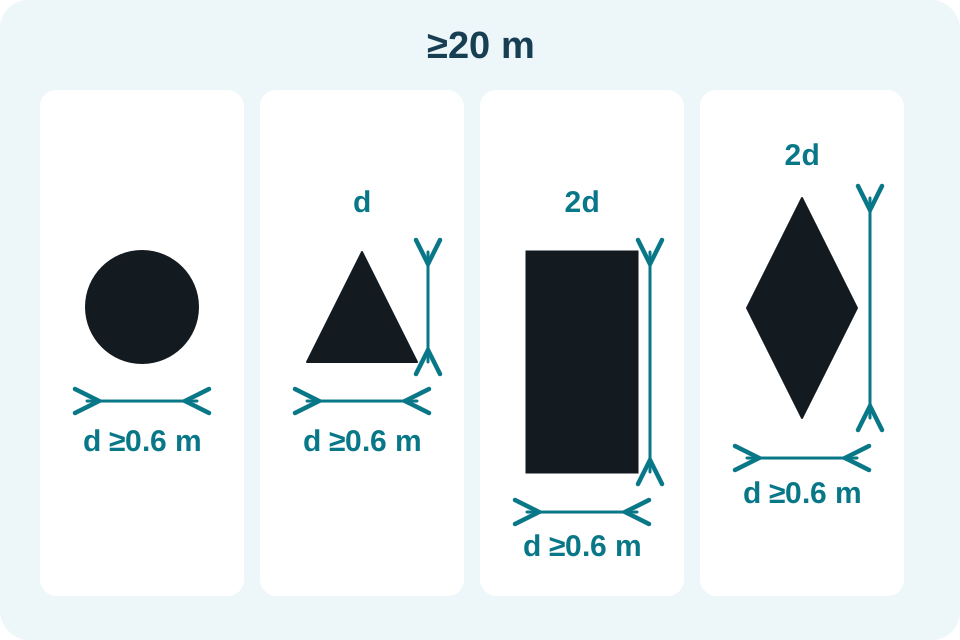
Shapes are black. On vessels of 20 m or more, a ball is at least 0.6 m across. A cone has a base diameter of at least 0.6 m and a height equal to that diameter. A cylinder is at least 0.6 m across and twice as high. A diamond is two such cones base to base. Vertical spacing is at least 1.5 m. Below 20 m, shapes may be proportionately smaller and spacing correspondingly reduced.
High-speed craft
A high-speed craft may carry its masthead light below the breadth-related height if the triangle seen end-on, with sidelights at its base, has both base angles at least 27°. For craft of 50 m or more, the 4.5 m vertical separation may be reduced only using Annex I 13(b), never below 2 m. Check the approved arrangement. The flag state approves the construction and fitting of lights and shapes.
2Key data
- Intensity formula
- I = 3.43 × 10⁶ × T × D² × K⁻ᴰ; T = 2 × 10⁻⁷ lux, K = 0.8
- Minimum intensity
- 1–6 NM respectively: 0.9, 4.3, 12, 27, 52, 94 cd
- Sidelight cut-off ahead
- Between 1° and 3° outside the sector
- Vertical sector
- Full minimum ±5°; ≥60 % ±7.5°; sail under way instead: ≥50 % ±25°
- Shapes, ≥20 m
- Ball, cone, cylinder ≥0.6 m across; spacing ≥1.5 m; black
- High-speed craft
- Lower masthead light allowed if base angle ≥27°
3Key points
- 1
Colours are fixed on the CIE chart; use type-approved lanterns.
- 2
A 6 NM masthead light needs at least 94 cd.
- 3
Sidelights cut off 1–3° outside their sector ahead.
- 4
Full minimum intensity ±5° vertically, so lights stay visible as the ship rolls.
- 5
On vessels ≥20 m, shapes are black, at least 0.6 m across and at least 1.5 m apart.
4Frequent mistakes
Wrong: Fit a dimmer on the navigation lights to avoid glare on the bridge.
Right: Annex I says glare must not be limited by variable control of intensity. Use correctly rated, type-approved lights.
Wrong: Any LED of the right colour can replace a navigation lantern.
Right: Navigation lights must be approved by the flag and meet Annex I colour, intensity and sector rules.
5Practice case & exam keys
In port, a technician replaces your 6 NM masthead lantern with a cheaper LED fitting rated at 40 cd. He says it is bright enough. Is it acceptable?
Show the answer
No. A 6 NM light needs at least 94 cd under Annex I; 40 cd corresponds to between 4 and 5 NM. Intensity alone is insufficient: the lantern must also be approved and meet the colour and sector requirements. Fit an approved 6 NM lantern.
Exam keys
- Colours: CIE chromaticity areas for white, green, red and yellow.
- I = 3.43 × 10⁶ × T × D² × K⁻ᴰ; K = 0.8; 6 NM = 94 cd.
- Sectors: sidelight cut-off 1–3° ahead; ≤5° outside for others; all-round lights not obscured over 6°.
- Shapes on vessels ≥20 m: ≥0.6 m across, ≥1.5 m apart; HSC base angles ≥27°; reduced masthead separation ≥2 m.
Finish this unit
When you've read it, match the terms, then answer three questions. Get them all right to finish the unit; opening the page alone doesn't count.
My notes for this unit
No notes