

Annex I: where the lights go on a ship
1The lesson in plain words
Annex I sets the heights and spacing of navigation lights. You use these limits to check a ship’s light arrangement.
Height above the hull
Heights are measured from the uppermost continuous deck, directly below the light. Breadth is the ship’s width; the stem is the bow’s leading edge; the gunwale is the hull’s upper edge. Trim means how deeply the bow and stern sit relative to each other.
Masthead lights, vertical
On a power-driven vessel of 20 m or more, the forward masthead light, or the only one, is at least 6 m above the hull. If her breadth is more than 6 m, it is at least the breadth, but it need not be higher than 12 m. The after masthead light is at least 4.5 m higher than the forward one. In every normal trim the after light must be seen above and separate from the forward light at 1,000 m from the stem, viewed from sea level.
Masthead lights, horizontal
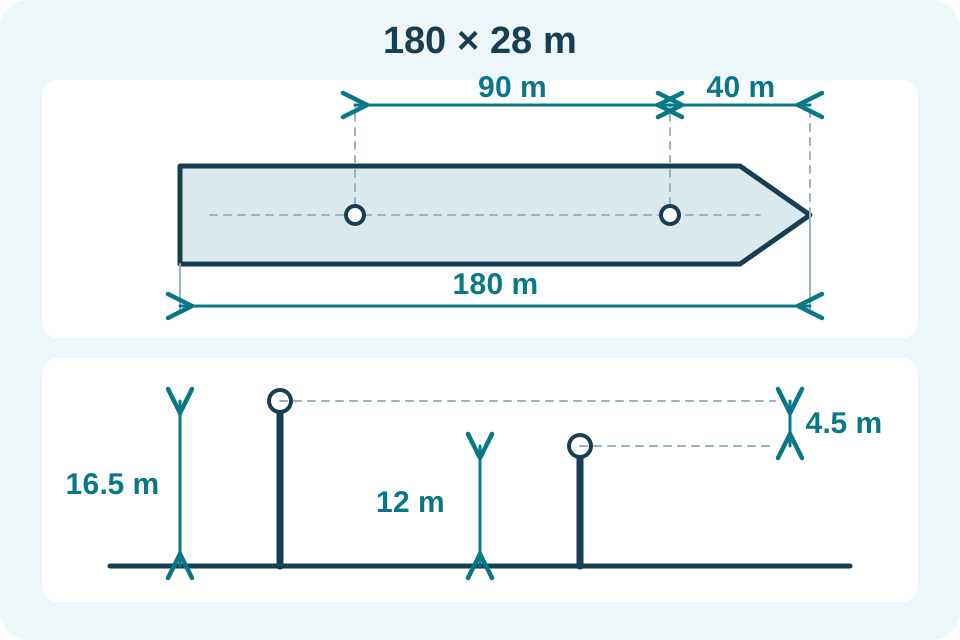
When two masthead lights are required, space them at least half the ship’s length, up to a required maximum of 100 m. The forward light is no more than a quarter of the length from the stem. Place a single masthead light ahead of the ship’s midpoint; below 20 m, as far forward as practicable. Example: 180 m long, 28 m breadth: forward light at least 12 m above the hull, after light 16.5 m, at least 90 m apart, forward one within 45 m of the stem.
Sidelights
On a power-driven vessel, sidelights are no higher than three quarters of the height of the forward masthead light, and not so low that deck lights interfere. On a vessel of 20 m or more they are not in front of the forward masthead light, they are at or near the ship's side, and they have matt black inboard screens.
Lights in a vertical line
When two or three lights are carried in a vertical line, as for a vessel not under command, a vessel of 20 m or more spaces them at least 2 m apart, with the lowest at least 4 m above the hull, except where a towing light is required. Three lights are equally spaced. At anchor, a ship of 50 m or more has her forward anchor light at least 6 m above the hull, and at least 4.5 m above the after one.
Smaller vessels
On a power-driven vessel from 12 m to under 20 m, the masthead light is at least 2.5 m above the gunwale. Under 20 m, vertical-line lights are at least 1 m apart, with the lowest at least 2 m above the gunwale, except where a towing light is required. On a power-driven vessel under 12 m, the uppermost light may be lower; a masthead or all-round white light carried with sidelights must be at least 1 m above them.
2Key data
- Forward masthead, ≥20 m
- ≥6 m above hull; ≥breadth if over 6 m; need not exceed 12 m
- After masthead, ≥20 m
- ≥4.5 m above the forward one
- When two masthead lights are required
- ≥½ length, need not exceed 100 m; forward light ≤¼ L from stem
- Sidelights
- ≤¾ height of forward masthead; not forward of it (≥20 m)
- Vertical line, ≥20 m
- ≥2 m apart; lowest ≥4 m above hull, except where towing light required
- Worked example, 180 m × 28 m
- 12 m and 16.5 m high; ≥90 m apart; forward ≤45 m from stem
3Key points
- 1
On power-driven vessels ≥20 m, forward masthead ≥6 m above hull, or breadth; need not exceed 12 m.
- 2
On power-driven vessels ≥20 m, after masthead at least 4.5 m above the forward one.
- 3
When two masthead lights are required: spacing ≥½ length, need not exceed 100 m; forward light ≤¼ length from stem.
- 4
Sidelights no higher than ¾ of the forward masthead light.
- 5
Vertical lines on ships ≥20 m: ≥2 m apart; lowest ≥4 m above hull, except where a towing light is required.
4Frequent mistakes
Wrong: On a 300 m ship the masthead lights must be 150 m apart.
Right: At least half the length, but the requirement need not exceed 100 m.
Wrong: The forward masthead light must be at least as high as the breadth, however wide the ship.
Right: It need not be higher than 12 m above the hull, even if the breadth is more.
5Practice case & exam keys
You survey a 180 m power-driven ship, 28 m in breadth. Her forward masthead light is 12 m above the hull and 50 m from the stem. The after light is 16.5 m high and 80 m aft of it. What must change?
Show the answer
Moving the forward light 10 m towards the stem puts it 40 m from the stem and makes the spacing 90 m. The heights meet the basic minima. Also check that the after light appears above and separate from the forward light at 1,000 m from the stem, viewed from sea level, in all normal conditions of trim.
Exam keys
- Height above the hull: above the uppermost continuous deck.
- ≥20 m: forward minimum 6 m, increased to breadth but no further than 12 m; after ≥4.5 m higher; separate at 1,000 m.
- When two masthead lights are required: ≥½ L, need not exceed 100 m; forward ≤¼ L from stem.
- Sidelights ≤¾ of forward masthead height; vertical lines on vessels ≥20 m: ≥2 m apart, lowest ≥4 m above hull except where a towing light is required.
Finish this unit
When you've read it, match the terms, then answer three questions. Get them all right to finish the unit; opening the page alone doesn't count.
My notes for this unit
No notes