

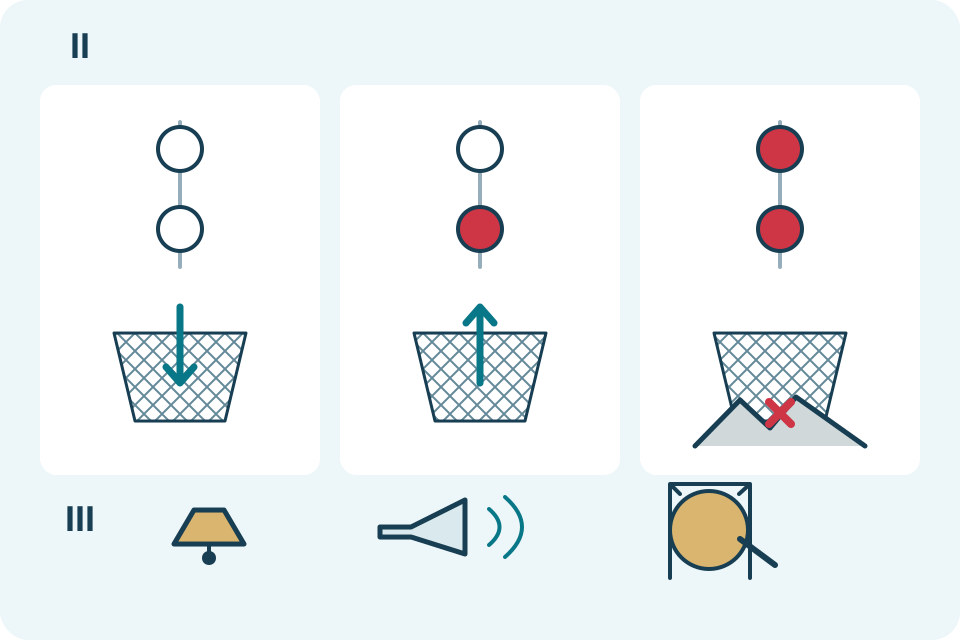
Annex II fishing signals and Annex III sound signal appliances
1The lesson in plain words
Annex II adds lights for fishing vessels working close together. Annex III sets whistle pitch, loudness and range by length, and the bell and gong.
Annex II: general
When fishing close to other fishing vessels, trawlers of 20 m or more must show the applicable Annex II signals. Smaller trawlers may show them; the purse-seine signal is optional. These extra lights are all-round, at least 0.9 m apart, below the main fishing lights, and visible for at least 1 NM (nautical mile), but less far than the main lights. They identify the gear operation, not the vessel’s speed or the exact position of all her gear.
Trawlers
A trawler of 20 m or more shows: two white in a vertical line when shooting, or paying out, the nets; white over red when hauling, or bringing them in; two red when the net is fast on an obstruction, meaning caught. In pair trawling, two vessels tow one net. By night, each vessel of 20 m or more shows a searchlight directed forward and towards the other vessel. Trawlers under 20 m may show these lights.
Purse seiners
A vessel fishing with purse seine gear may show two yellow lights in a vertical line, flashing alternately every second, with equal light and dark periods. She may show them only when hampered by her gear. A purse seine is a net used to encircle fish.
Whistles
Fundamental whistle pitch, measured in hertz (Hz), depends on length: 70–200 Hz at ≥200 m; 130–350 Hz at 75–<200 m; 250–700 Hz below 75 m. Minimum output at 1 m: 143/138/130 decibels (dB) for ≥200/75–<200/20–<75 m. For vessels ≥20 m, assess output in one-third-octave bands: narrow frequency bands within 180–700 Hz, distinct from fundamental pitch. Smaller-vessel bands and levels are in the facts. Typical still-air audibility: 2/1.5/1/0.5 NM for ≥200/75–<200/20–<75/<20 m. Wind and noise reduce it.
Placing whistles
Fit the whistle as high as practicable. At the ship's own listening posts, its sound must not exceed 110 dB(A), and so far as practicable 100 dB(A). Whistles more than 100 m apart must not sound together. A combined system, within 100 m and sounded together, counts as one whistle; each must differ in frequency by at least 10 Hz.
Bell and gong
A bell or gong gives at least 110 dB at 1 m. On vessels of 20 m or more the bell's mouth is at least 300 mm across, and the striker's mass is at least 3 % of the bell's. A power-driven striker is recommended, but manual use must stay possible. The bell and gong must have distinct tones.
2Key data
- Annex II lights
- All-round, ≥0.9 m apart, visible ≥1 NM, below main lights
- Whistle ≥200 m
- 143 dB at 1 m; typical audibility 2 NM
- Whistle 75–<200 m
- 138 dB at 1 m; typical audibility 1.5 NM
- Whistle 20–<75 m
- 130 dB at 1 m; typical audibility 1 NM
- Whistle <20 m: dB at 1 m by band
- 120/115/111 dB: 180–450/450–800/800–2,100 Hz; 0.5 NM
- Bell
- ≥110 dB at 1 m; mouth ≥300 mm for vessels ≥20 m
3Key points
- 1
Annex II lights are extra, 0.9 m apart, for fishing in close proximity.
- 2
Trawler: 2 white shooting, white over red hauling, 2 red net fast.
- 3
Purse seiner: 2 yellow, flashing alternately each second.
- 4
Whistle 70–200 Hz and 2 NM for ships of 200 m or more.
- 5
Bell mouth at least 300 mm for vessels of 20 m or more.
4Frequent mistakes
Wrong: Two red lights under a trawler's lights mean she is not under command.
Right: On a trawler fishing close to others, two red lights in Annex II mean her net is fast on an obstruction.
Wrong: A 2 NM audibility range means your whistle will be heard at 2 NM.
Right: It is a typical figure in still air. Wind and background noise can reduce it greatly; never rely on being heard.
5Practice case & exam keys
A trawler fishing close to others shows additional white-over-red lights 0.5 m apart. They are visible for 3 NM, the same range as her main fishing lights. A colleague says the display complies because it correctly means hauling. Do you agree?
Show the answer
No. White over red correctly indicates hauling, but the additional all-round lights must be at least 0.9 m apart. They must be visible for at least 1 NM, but less far than the main fishing lights. Correct meaning alone does not make the installation compliant.
Exam keys
- Annex II: extra all-round lights, ≥0.9 m apart, visible ≥1 NM, for fishing in close proximity.
- Trawlers ≥20 m: 2 white shooting, white over red hauling, 2 red fast; pair trawl searchlight by night.
- Whistles by length: 70–200, 130–350, 250–700 Hz; ranges 2, 1.5, 1, 0.5 NM.
- Bell ≥110 dB, mouth ≥300 mm (≥20 m); whistles >100 m apart not sounded together.
Finish this unit
When you've read it, match the terms, then answer three questions. Get them all right to finish the unit; opening the page alone doesn't count.
My notes for this unit
No notes