

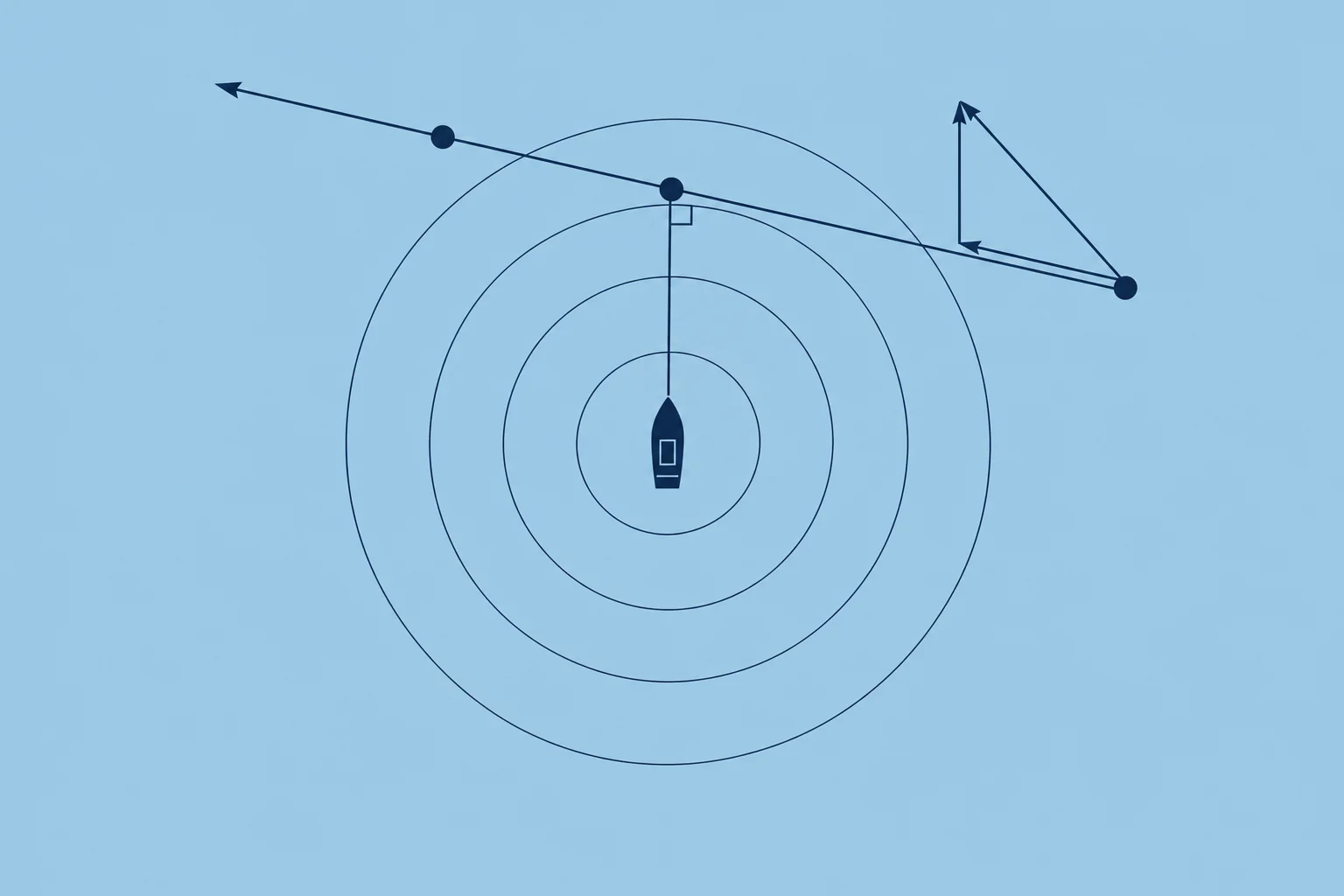
CPA and TCPA: a worked radar plot
1The lesson in plain words
Plot the echo, draw its line of relative movement and read how close it will come and when. Then work out her true course and speed.
Relative motion
A relative-motion display fixes your screen position; echoes move relative to you. A fixed buoy appears to move as you pass it. With both vessels steady, successive target plots form a relative-motion line. Extend it ahead. Drop a perpendicular from your position to it: its length is the CPA, closest point of approach. TCPA, time to closest point of approach, is the time until then. Relative trails also show relative movement.
The worked example
Use true bearings (from true north) and nautical miles (M), with no current or leeway. You steer 000° at 6 knots in fog. A target is at 050°/8.0 M at 10:00, 049°/6.8 M at 10:06 and 048°/5.6 M at 10:12. Its relative track is about 2.4 M in 12 minutes. CPA is about 0.7 M on your port bow, below this exercise’s chosen 1 M minimum. That minimum is a planning choice, not a rule.
Relative speed and TCPA
Relative speed = relative distance ÷ time: 2.4 M in 12 minutes = 12 knots. The six-minute rule helps: distance in 6 minutes × 10 = speed in knots. From the 10:12 plot to the CPA is about 5.6 M along the line. TCPA = 5.6 ÷ 12 hours, about 28 minutes, so CPA comes at about 10:40.
Her true course and speed
In 12 minutes you ran 1.2 M north. From the 10:00 plot, draw your own run backwards, 1.2 M towards 180°, to point W. The line from W to the 10:12 plot is her true movement: about 1.98 M towards 264°. Her plotted true course is about 264° at about 10 knots, crossing from your starboard side.
True or relative display
Relative motion keeps your vessel at a fixed screen position; true motion moves it across the display. Trail settings are separate: relative trails show relative movement for CPA assessment; true trails show target tracks. Ground stabilisation measures movement over the ground. In ground-stabilised true motion, fixed objects stay still between display resets. Check both the motion mode and trail setting. Practise at /navigation/radar-simulator.
2Key data
- CPA
- Closest point of approach: nearest distance on the relative line
- TCPA
- Distance along the line to CPA ÷ relative speed
- Six-minute rule
- Distance in 6 minutes × 10 = speed in knots
- Worked example, CPA
- CPA about 0.7 M on your port bow, at about 10:40
- Worked example, target
- About 264°, 10 knots
3Key points
- 1
On a relative display, echoes move along the relative-motion line.
- 2
CPA is the shortest distance from you to that line; TCPA is the time to reach it.
- 3
Six-minute rule: distance in 6 minutes × 10 = speed in knots.
- 4
Lay your own run back from the first plot to W; W to the last plot gives her true movement over the interval.
4Frequent mistakes
Wrong: The echo moves along her true course on the screen.
Right: On a relative display it moves along the relative line, which combines her motion with yours.
Wrong: A target crossing ahead is safe because she is faster.
Right: Read the CPA. In this exercise it is about 0.7 M, below the chosen passing margin.
Wrong: TCPA is the range divided by her speed.
Right: Use the relative speed, from the plots, and the distance along the line to the CPA.
5Practice case & exam keys
In fog, with the target not visually in sight, you steer 180° at 5 knots. It plots at 200°, 6 M at 14:00 and 200°, 5 M at 14:06. Your crew says the 30-minute TCPA means action can wait.
Show the answer
Assuming steady motion, CPA is near zero. The echo moves 1 M in six minutes: 10 knots relative speed. At 14:06, TCPA is 5 ÷ 10 hours = 30 minutes, giving CPA at 14:36. That is assessment time, not permission to wait. Treat the steady closing bearing as risk now, continue observations and choose early effective action under Rule 19.
Exam keys
- CPA: closest distance of the relative-motion line from own ship; TCPA: time to it.
- Relative speed from the plots; six-minute rule: distance × 10 = knots.
- Steady bearing and closing range: CPA near zero, risk of collision.
- True course and speed: W to last plot gives direction and distance; divide distance by the plot interval in hours.
Finish this unit
When you've read it, match the terms, then answer three questions. Get them all right to finish the unit; opening the page alone doesn't count.
My notes for this unit
No notes