

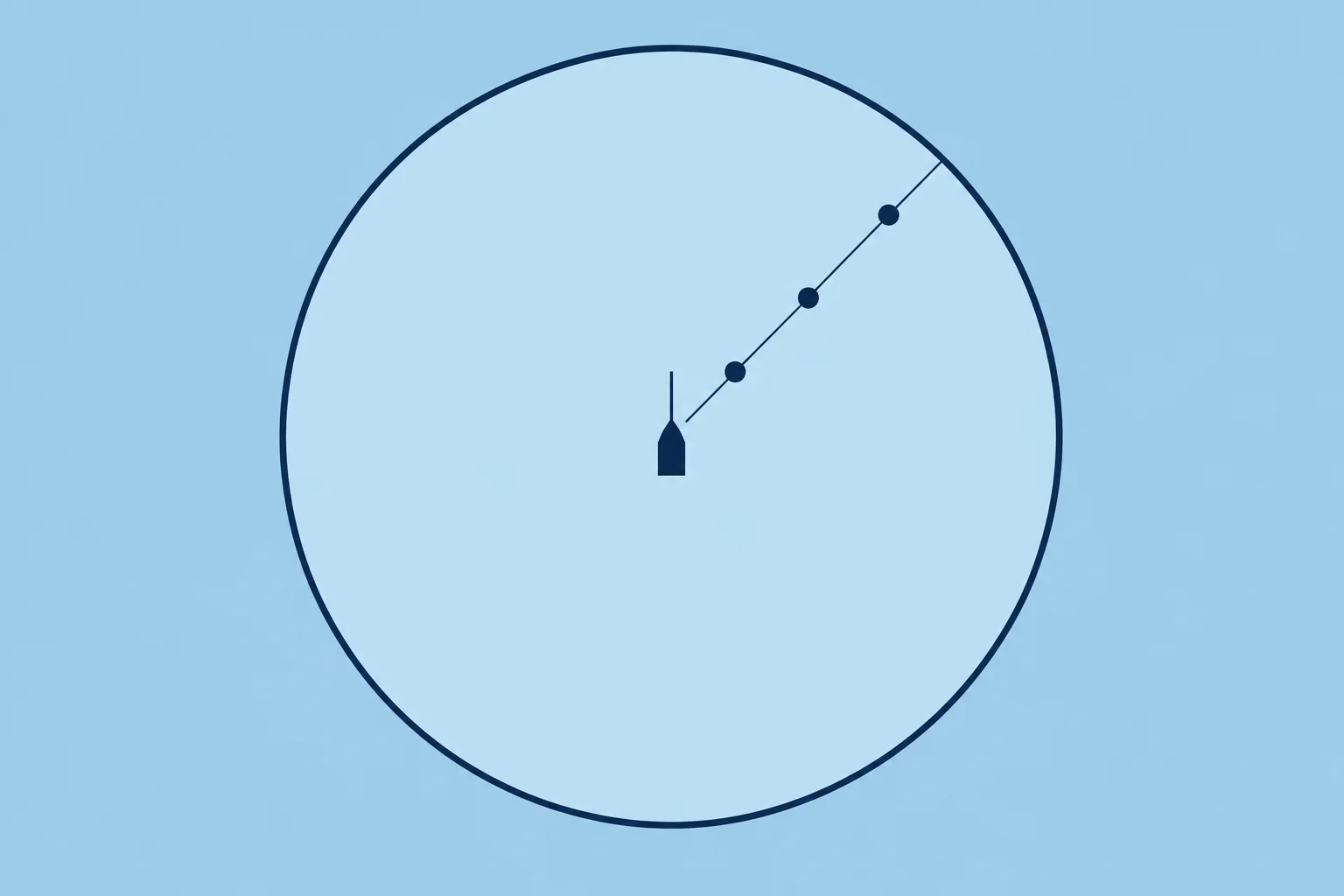
Is there a risk of collision? Rule 7 with radar
1The lesson in plain words
Use every means you have, plot, not guess, and if in doubt, treat the risk as real. A steady bearing is the classic warning sign.
All available means
Rule 7(a): every vessel uses all available means appropriate to the circumstances to decide whether risk of collision exists. If there is any doubt, such risk shall be deemed to exist. You never need proof of danger before you act; you need proof of safety before you relax.
The steady bearing
Risk of collision is deemed to exist if the compass bearing of an approaching vessel does not appreciably change (Rule 7(d)(i)). Use compass bearings rather than bearings relative to your bow when your own heading changes. A small bearing change alone does not establish safety.
When a changing bearing lies
Risk may exist even with an appreciable bearing change (Rule 7(d)(ii)), especially with a very large vessel, a tow or a vessel at close range. A changing bearing to the bow or tug does not prove that you will clear the whole vessel or tow. At close range, an appreciable bearing change can still leave too little passing distance, even if neither vessel alters course. Watch the range too.
Scanty information
Assumptions shall not be made on the basis of scanty information, especially scanty radar information (Rule 7(c)). A single observation, a quick look at a trail, or an AIS number alone cannot establish safety. Several observations improve confidence; never delay necessary action for a fixed plot count. Reassess a target first seen at close range or one that may have altered.
Systematic observation
Rule 7(b) requires radar plotting or equivalent systematic observation. Repeat at intervals suited to the closing speed. Keep course and speed steady only while safe. An automatic radar plotting aid (ARPA), mini automatic radar plotting aid (MARPA) or AIS supports assessment. Check predictions against observations. CPA means closest point of approach; TCPA means time to CPA. Continue checking after either vessel manoeuvres. Full text: /colreg/rule-7.
2Step by step
Systematic observation of a radar target
- 1
Assess risk immediately; if in doubt, deem risk to exist.
Do not wait for a fixed plot count before taking necessary avoiding action.
- 2
Repeat observations at intervals suited to the closing speed.
Build a reliable trend. Keep course and speed steady only while safe; shorten intervals as needed.
- 3
Cross-check automatic predictions against current observations.
A displayed CPA or TCPA assumes unchanged motion. If observations disagree, reassess immediately.
- 4
Continue assessment after either vessel manoeuvres, until past and clear.
Changes can invalidate earlier predictions. Check that avoiding action remains effective.
3Key points
- 1
If in doubt, risk of collision is deemed to exist (Rule 7(a)).
- 2
A compass bearing that does not appreciably change, on a closing target, means risk.
- 3
Large ships, tows and close range can be dangerous even with a changing bearing.
- 4
Use repeated observations to check the trend; never delay necessary action to complete a plot.
4Frequent mistakes
Wrong: The bearing has moved 2°, so she will pass clear.
Right: A small change does not establish safety, especially at close range or with a large ship. If in doubt, deem risk to exist now.
Wrong: We must complete three plots before taking action.
Right: Rule 7 sets no minimum plot count. Several observations improve confidence; never delay necessary action to finish a plot.
Wrong: ARPA shows CPA, so plotting is unnecessary.
Right: ARPA is equivalent systematic observation only if you check its data and watch for changes.
5Practice case & exam keys
In fog, a vessel detected by radar alone at 7 M on your starboard bow moves from 040° to 038° in 6 minutes while closing. Your crew says the bearing change means no risk.
Show the answer
The small bearing change does not establish safety. If in doubt, deem risk to exist now. Continue systematic observation at intervals suited to the closing speed, but do not hold course and speed just to finish three plots. Take avoiding action in ample time under Rule 19 and check its effect until past and clear.
Exam keys
- Rule 7(a): all available means; if any doubt, risk is deemed to exist.
- Rule 7(d)(i): risk if the compass bearing does not appreciably change.
- Rule 7(d)(ii): risk may exist despite a bearing change: very large vessel, tow, close range.
- Rule 7(c): no assumptions on scanty radar information; plot systematically (7(b)).
Finish this unit
When you've read it, match the terms, then answer three questions. Get them all right to finish the unit; opening the page alone doesn't count.
My notes for this unit
No notes