

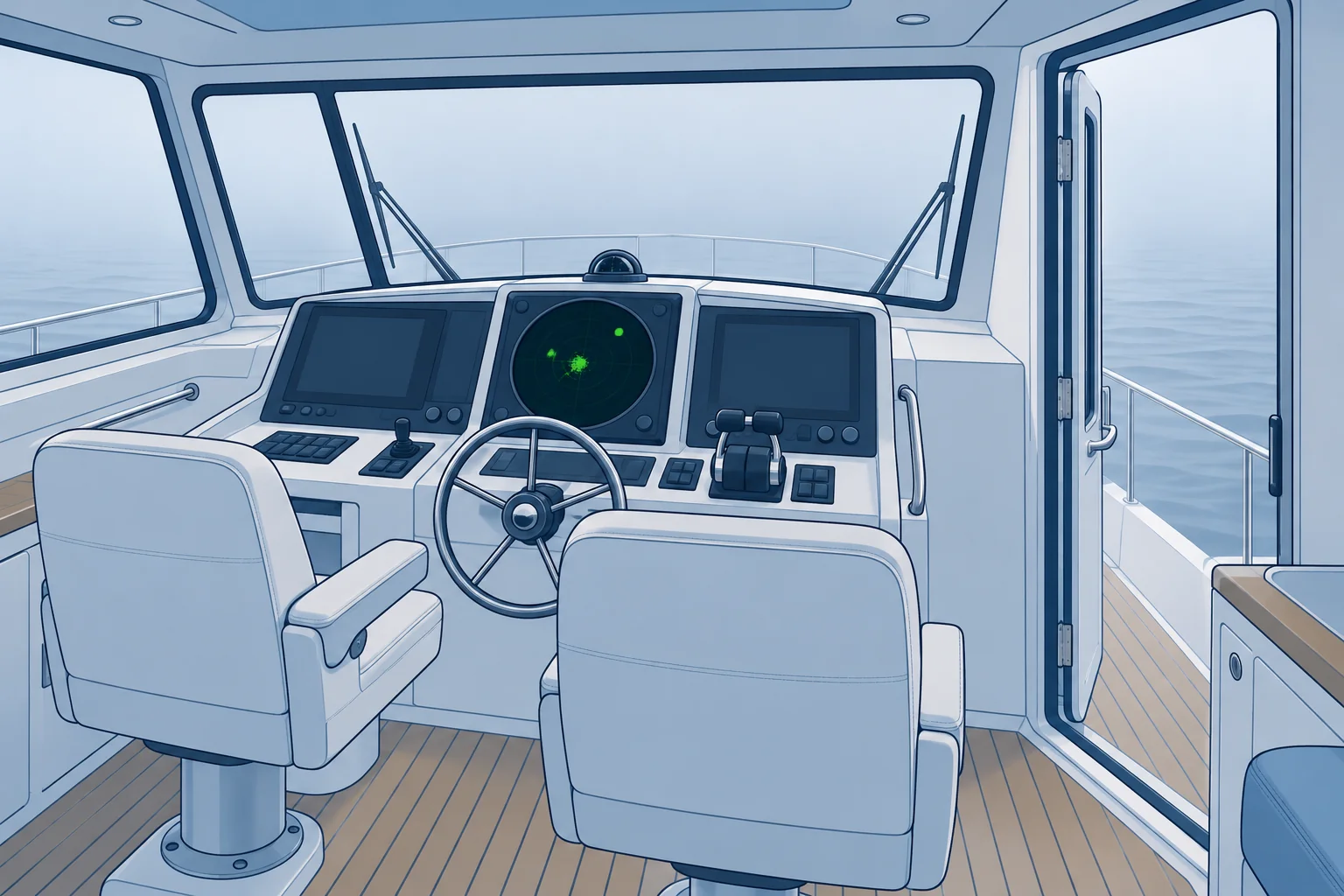
Look-out and safe speed with radar: Rules 5 and 6
1The lesson in plain words
Radar is part of a proper look-out, not a replacement for eyes and ears. It adds to what you must weigh when you choose a safe speed.
All available means
Rule 5 requires a proper look-out at all times, by sight and hearing and by all available means. Radar and the Automatic Identification System (AIS) support it when available and appropriate. In fog, assign a dedicated look-out when crew are available, and share helm, navigation and radar duties so none is neglected.
Radar adds factors
Rule 6(a) lists the factors for all vessels. With operational radar, Rule 6(b) adds six: equipment characteristics, efficiency and limits; range-scale constraints; sea state, weather and interference; small craft, ice and floating objects possibly missed at adequate range; detected vessels’ number, location and movement; and a better visibility estimate by comparing radar ranges with what you can see. Radar measures range, not fog thickness.
What radar misses
A wooden or glass-reinforced plastic (GRP) yacht, a kayak or a small fishing boat can return a weak echo, lost among waves near you in sea clutter or behind heavy rain in rain clutter. A mast or a funnel can hide a sector, called a blind sector. Too much anti-clutter wipes out real echoes along with the noise. Radar does not show everything; its presence alone does not justify a higher speed.
Long-range scanning
Rule 7(b) asks for long-range scanning to get early warning. Look at a longer range, say 12 nautical miles (M) on a yacht radar, to see ships coming early. Then work on a shorter range, 3 to 6 M, to plot them and to see small echoes. Changing scale now and then is part of the look-out. The Radar on a small vessel unit teaches the controls.
AIS helps, but
AIS supports your look-out. Many small craft carry no AIS, and reports can be late or wrong. Its predicted closest passing distance assumes unchanged motion. Cross-check with radar, sight and hearing; never base avoiding action on AIS alone. Full text: /colreg/rule-5 and /colreg/rule-6.
2Key data
- Rule 5
- Look-out by sight, hearing and all available means
- Rule 6(a)
- Six factors for all vessels
- Rule 6(b)
- Six more for vessels with operational radar
- Rule 7(b)
- Long-range scanning and systematic observation
- Typical yacht radar ranges
- Scan at about 12 M; plot at 3–6 M
3Key points
- 1
Radar and AIS are part of a proper look-out when the conditions call for them.
- 2
Operational radar adds factors; choose speed from all prevailing conditions.
- 3
Small craft can hide in sea and rain clutter or in a blind sector.
- 4
Scan at long range for early warning, then plot on a shorter range.
4Frequent mistakes
Wrong: With radar on, we can keep our normal speed in fog.
Right: Radar adds factors to Rule 6. It may miss small craft, so speed must still suit the visibility.
Wrong: AIS shows every vessel near you.
Right: Many small craft carry no AIS, and reports may be late or wrong. Radar and eyes remain essential.
5Practice case & exam keys
Fog closes in during a crossing. Your crew wants to keep 7 knots because the radar is on and the 3 M range looks empty.
Show the answer
An empty screen does not prove an empty sea: small boats can hide in clutter, and 3 M gives little warning of a fast ship. Reduce to a speed at which you can avoid collision and stop in time, have the engine ready, and post a look-out. Scan at 12 M for early warning, then plot targets on a shorter range.
Exam keys
- Rule 5: look-out by sight, hearing and all available means, including radar.
- Rule 6(b): equipment characteristics, efficiency and limits; range scale; sea, weather and interference; small craft, ice and floating objects missed at adequate range; detected vessels’ number, location and movement; visibility from radar ranges compared with visual detection.
- Rule 7(b): long-range scanning for early warning and systematic observation.
- AIS supports radar; never use it alone for avoiding action.
Finish this unit
When you've read it, match the terms, then answer three questions. Get them all right to finish the unit; opening the page alone doesn't count.
My notes for this unit
No notes