

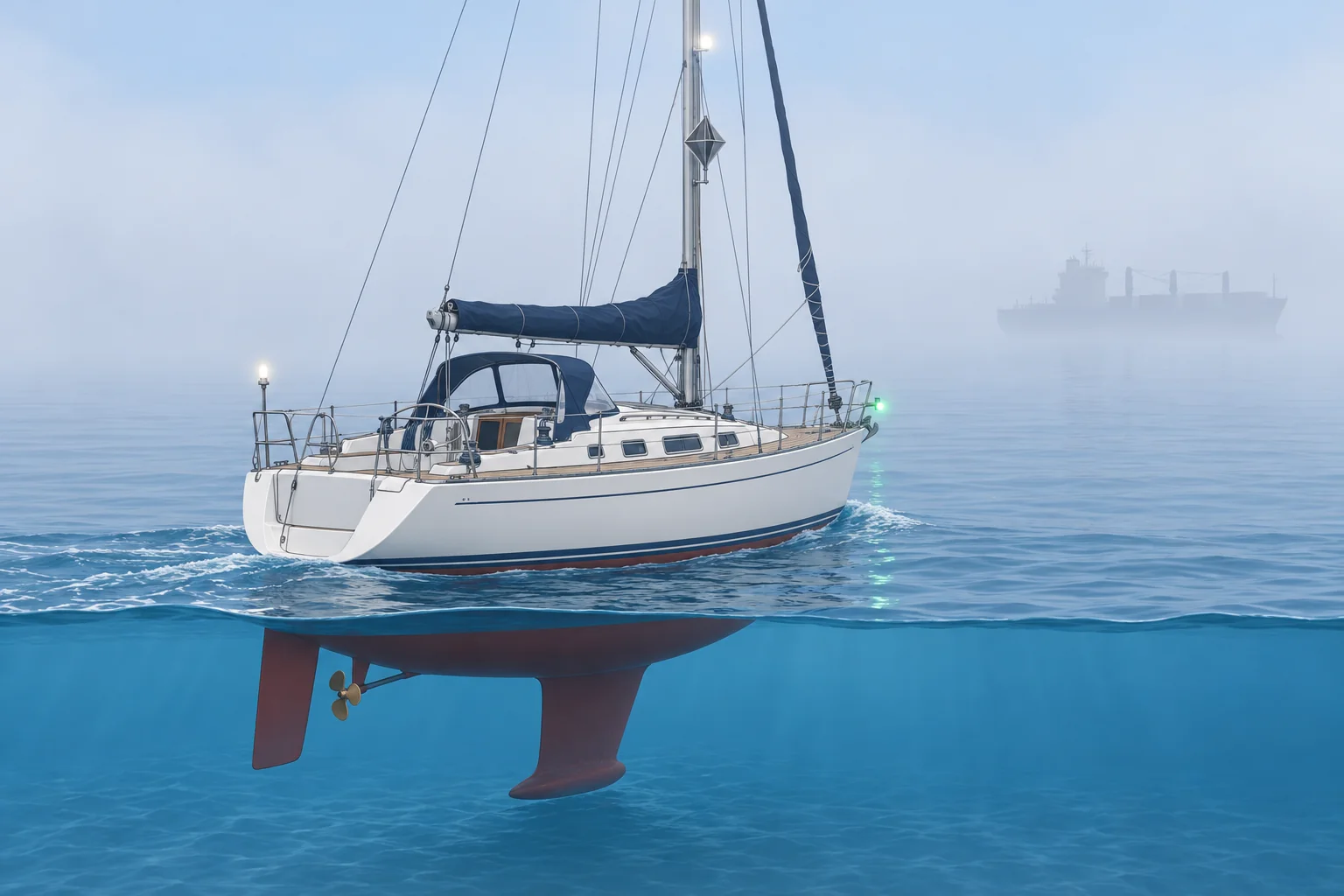
Rule 19: action when vessels are not in sight
1The lesson in plain words
When vessels are not in sight in or near restricted visibility, neither is stand-on. Assess risk and act in ample time.
When Rule 19 applies
Rule 19 covers vessels not in sight of one another in or near an area of restricted visibility. You may be in clear air near a fog bank and still be under it. Once either vessel can be observed visually from the other, Rules 11 to 18 apply instead. Under Rule 19 there is no stand-on and no give-way vessel: whoever detects risk acts.
Speed and engines
Every vessel proceeds at a safe speed for the conditions, and a power-driven vessel keeps her engines ready for immediate manoeuvre (Rule 19(b)). For a sailing yacht, having auxiliary propulsion ready is prudent seamanship; Rule 19(b) does not require every sailing yacht to keep its engine running. An engine running without propelling you does not make you power-driven. Every vessel applies Rules 4 to 10 with poor visibility in mind (Rule 19(c)).
Detected by radar alone
A vessel that detects another by radar alone decides whether a close-quarters situation is developing or risk of collision exists. If so, she acts in ample time. The Rules set no distance for close quarters. Choose a passing margin suited to the conditions; no fixed CPA guarantees safety.
The two turns to avoid
The beam runs across your boat: abeam means alongside; abaft means behind the beam. When altering course, so far as possible avoid: (i) a port alteration for a vessel forward of the beam, except one you are overtaking; (ii) an alteration towards a vessel abeam or abaft the beam. These restrictions do not make the remaining choices safe. Check that your action gives a safe passing distance, with room for other traffic.
A fog signal ahead
Unless you have found that no risk exists, slow down when you hear a fog signal apparently forward of the beam, or cannot avoid close quarters with a vessel forward of the beam. Go to the minimum speed at which you can keep your course (Rule 19(e)). If necessary, take all way off (remove your forward movement), and navigate with extreme caution until danger of collision is over. Full text: /colreg/rule-19.
2Step by step
A radar contact in fog
- 1
Assess risk and close quarters now; continue systematic observation.
Treat doubt as risk. Do not wait for more plots before necessary action.
- 2
Decide early whether the CPA is acceptable.
Action must be taken in ample time.
- 3
Note where she is: forward of the beam, abeam or abaft.
That decides which turns Rule 19(d) tells you to avoid.
- 4
Choose and verify an early action that respects Rule 19(d), safe speed, sea room and other traffic.
A permitted turn or speed change can still worsen CPA. Check for a safe passing distance without creating another close-quarters situation.
- 5
Unless you have established that no risk exists, a fog signal or unavoidable close quarters forward of the beam requires minimum course-keeping speed.
Take all way off if necessary; navigate with extreme caution until danger is over.
- 6
Keep plotting until she is past and clear.
She may act too; Rule 8(d) requires you to check.
3Key points
- 1
Rule 19 applies to vessels not in sight in or near restricted visibility; no one stands on.
- 2
Keep a safe speed; power-driven vessels need engines ready for immediate manoeuvre.
- 3
So far as possible, avoid a port turn for a vessel forward of the beam (unless overtaking her).
- 4
So far as possible, avoid turning towards a vessel abeam or abaft the beam.
- 5
Unless risk is ruled out: fog signal or unavoidable close quarters ahead; minimum course-keeping speed; all way off if needed.
4Frequent mistakes
Wrong: A radar target on your port bow in fog must give way to you, as in Rule 15.
Right: Rules 11 to 18 apply only in sight. Under Rule 19 every vessel acts when she detects risk.
Wrong: Turn to port to pass astern of a radar contact crossing from port.
Right: So far as possible, avoid a port alteration for a vessel forward of the beam unless overtaking her. Check any alternative against safe speed, sea room, other traffic and predicted CPA.
Wrong: After hearing a fog signal ahead, keep your speed so you clear the area fast.
Right: Unless you have established that no risk exists, a fog signal or unavoidable close quarters forward of the beam requires minimum course-keeping speed. Take all way off if necessary; use extreme caution until danger is over.
5Practice case & exam keys
In fog, a vessel detected by radar alone is 30° abaft your starboard beam at 3 M, closing with a steady bearing. You are motoring at 5 knots.
Show the answer
So far as possible, avoid a starboard alteration towards her. A port alteration may be suitable, but bearing alone cannot establish its effect. Choose early action giving a safe passing distance, with sea room and other traffic checked. Increase speed only if it remains safe for the visibility. Keep plotting until she is past and clear, and keep engines ready.
Exam keys
- Rule 19 applies to vessels not in sight in or near restricted visibility; there is no stand-on vessel.
- 19(d)(i): so far as possible, avoid a port turn for a vessel forward of the beam, except one being overtaken.
- 19(d)(ii): so far as possible, avoid turning towards a vessel abeam or abaft the beam.
- 19(e): unless it has been established that no risk exists, fog signal or unavoidable close quarters forward of the beam: minimum course-keeping speed; take all way off if necessary; extreme caution until danger is over.
Finish this unit
When you've read it, match the terms, then answer three questions. Get them all right to finish the unit; opening the page alone doesn't count.
My notes for this unit
No notes