

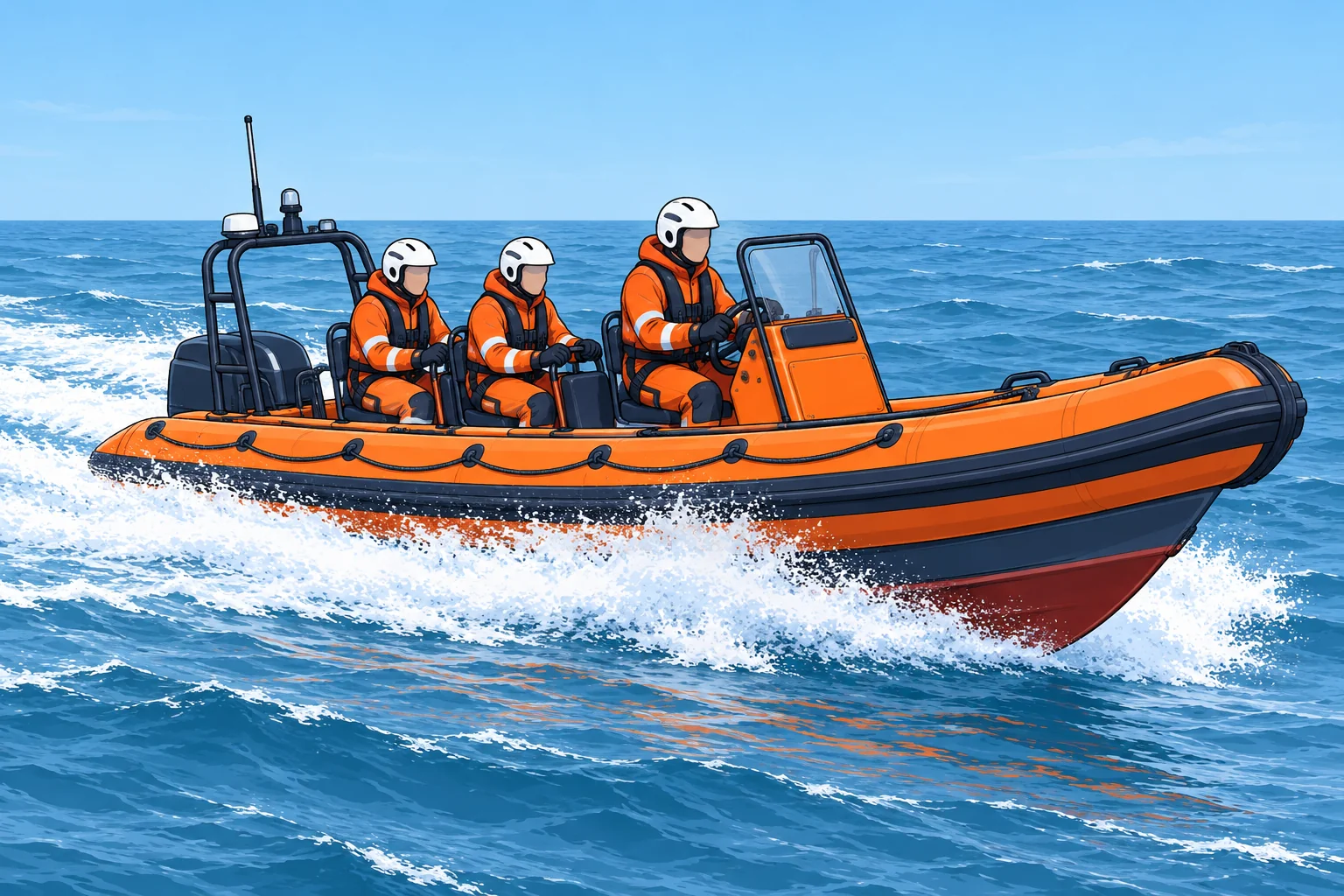
The fast rescue boat, its crew and their kit
1The lesson in plain words
A fast rescue boat is a powerful small craft built to be launched and recovered in bad weather. It needs a trained crew of at least three, properly dressed.
What makes it fast
A fast rescue boat (FRB) is a rescue boat built to the extra rules of LSA Code 5.1.4. Its hull is 6 to 8.5 m long, including inflated tubes or fenders. It can run for at least 4 hours at 20 knots in calm water with a crew of three, and at 8 knots fully loaded. It must be launched and recovered safely in adverse weather and sea conditions. Ro-ro passenger ships must carry one; offshore and other ships often do too.
Built to survive a capsize
An FRB is self-righting, designed to return upright after a capsize using its righting system, or can be quickly righted by no more than two crew. It drains itself or is quickly cleared of water. On capsize, the engine stops automatically or through the helmsman's kill cord, an emergency stop switch on a lanyard. Once upright, follow the maker's checks and reset any tripped emergency stop before restarting. It has a steering wheel, emergency steering and hands-free watertight very high frequency (VHF) radio.
The crew
The crew are at least three: a coxswain in charge, who steers, and two crew who handle lines, the casualty and the radio. Each holds the STCW certificate of proficiency in fast rescue boats (Code section A-VI/2-2), which needs the survival craft and rescue boat certificate first, and shows every five years that they have kept up their competence. On ro-ro passenger ships at least two crews per boat are trained.
Dress for speed and cold
Your personal protective equipment (PPE) includes an immersion suit or anti-exposure suit with a lifejacket, helmet, gloves, boots and eye protection. An immersion suit limits heat loss in water; an anti-exposure suit protects rescue crews against cold and spray. Clip the kill cord to your body before starting the engine if you are the coxswain. Falls and impacts in the boat can cause serious injuries. Brace, hold on and avoid standing.
2Key data
- Hull length
- 6–8.5 m including inflated tubes or fenders
- Speed
- 20 knots for 4 h with crew of 3; 8 knots fully loaded
- Capsize
- Self-righting or righted by no more than 2 crew
- Engine on capsize
- Stops automatically or by the kill cord; restartable
- Crew
- At least 3: coxswain and two crew, STCW A-VI/2-2
- Competence
- Evidence of maintained competence every 5 years
3Key points
- 1
An FRB is 6–8.5 m long and runs 4 hours at 20 knots with three crew (LSA Code 5.1.4).
- 2
It is self-righting or righted by two crew; the engine stops on capsize.
- 3
At least three FRB crew; STCW A-VI/2-2 competence must be evidenced every five years.
- 4
Suit, lifejacket, helmet, gloves and eye protection; the coxswain wears the kill cord.
4Frequent mistakes
Wrong: The kill cord gets in the way, so hook it to the console.
Right: Clip it to your body: if you are thrown from the helm, the engine must stop.
Wrong: A lifejacket is enough for a short trip in summer.
Right: Wear a suit, lifejacket, helmet and eye protection: speed, spray and impacts injure crews in any season.
Wrong: Any rescue-boat crew can take the FRB out.
Right: FRB crews need the A-VI/2-2 certificate and regular practice in that boat.
5Practice case & exam keys
Your ro-ro ferry's FRB is ordered away to a capsized dinghy. One trained crew member is ashore; a deckhand without FRB training volunteers.
Show the answer
Use the second trained crew, not an untrained volunteer: the boat needs a coxswain and two trained crew. Each dresses in a suit, lifejacket, helmet, gloves and goggles. The coxswain clips the kill cord on, checks the VHF headset and engine, and reports ready to the officer in charge of the launch.
Exam keys
- LSA Code 5.1.4: 6–8.5 m; 20 knots for 4 h with 3 crew; 8 knots fully loaded.
- Self-righting or righted by no more than 2 crew; engine stops on capsize; follow maker's checks and reset any tripped emergency stop before restart.
- Crew of at least 3 with STCW A-VI/2-2; maintained competence every 5 years.
- PPE: immersion or anti-exposure suit, lifejacket, helmet, gloves, eye protection, kill cord.
Finish this unit
When you've read it, answer three questions. Get all three right to finish the unit; opening the page alone doesn't count.
My notes for this unit
No notes