

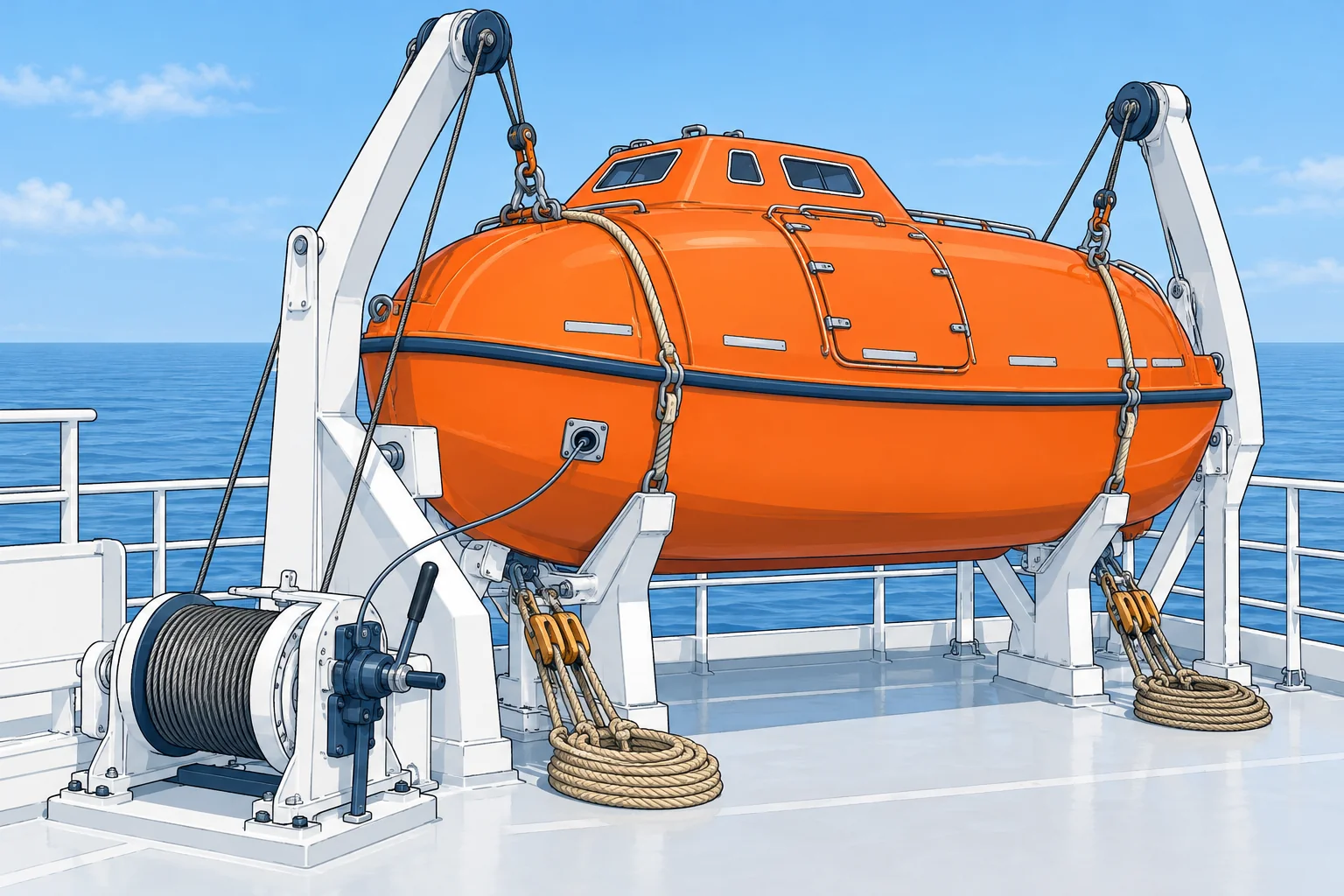
Davits, falls and the winch brake
1The lesson in plain words
With gravity davits, the boat’s weight lowers it. You control descent with a brake that stops the boat when you let go.
Gravity davits
Most lifeboats hang in gravity davits: when the brake is lifted, the boat's own weight swings the davit arms out and lowers it, with no power needed. The falls, rotation-resistant steel wire ropes from the winch drum over the davit heads, carry the boat by its two hooks. Rescue boats and davit-launched liferafts usually hang from a single-arm davit, a small crane, on one hook.
The winch brake
The dead-man brake applies automatically unless you hold its control in the lowering position. Release the control and the boat stops (LSA Code 6.1.2.12). One person can operate it from deck or inside the boat using a remote control wire. A centrifugal governor, an automatic speed limiter, prevents excessive lowering speed. LSA Code 6.1.2.10 requires a speed limiter, without prescribing this design.
Lowering speed
Use S = 0.4 + 0.02H metres per second to calculate the minimum for a fully loaded boat. H is the vertical distance in metres from the davit head to the waterline at the lightest permitted loading for a sea voyage. For appliances installed from 1 January 2026, the minimum is S or 1.0 m/s, whichever is lower. Their maximum is 1.3 m/s unless the flag-state authority approves another maximum.
Hoisting
A powered winch hoists (lifts) the boat. Hand gear provides manual backup. Limit switches stop powered hoisting before the davit arms reach their stops.
Secured for sea
At sea the boat sits in its cradle held by gripes, lashings with a quick-release slip. Harbour pins, or safety pins, lock the davit arms against moving in port and during maintenance. Before any launch, the pins come out and the gripes are released, otherwise the davit cannot move.
Tricing and bowsing
For a boat boarded at embarkation level, connect tricing pendants before lowering, as the manual directs. These lines draw the boat in as it lowers. Rig bowsing tackles, rope-and-pulley gear, to hold it alongside. Transfer the inward holding load and disconnect unloaded tricing pendants in the maker's sequence before boarding; keep the boat supported by the falls. Ease bowsing tackles out under control before lowering farther. Boats boarded in stowage use their own sequence.
2Key data
- Brake
- Always applied unless the operator holds it off
- Minimum lowering speed
- From 2026: minimum = lower of (0.4 + 0.02H) and 1.0 m/s
- Maximum lowering speed
- New installations from 2026: 1.3 m/s unless flag approves otherwise
- Rescue boat hoisting
- Powered winch: ≥0.3 m/s with all assigned people and equipment
- Launched by
- One person, from the deck or from inside the craft
3Key points
- 1
Gravity davits lower by the boat's own weight; the falls carry it by the hooks.
- 2
The winch brake is a dead-man brake: let go and the boat stops.
- 3
Minimum S = 0.4 + 0.02H m/s. For installations from 2026: cap the minimum at 1.0 m/s; max 1.3 m/s, unless flag approves.
- 4
Remove harbour pins and release gripes before launching; tricing pulls in, bowsing holds.
4Frequent mistakes
Wrong: Tie the brake lever up so the boat lowers on its own.
Right: Never defeat the dead-man brake; someone must hold it off and be ready to let go.
Wrong: Release the bowsing tackles all at once when everyone is aboard.
Right: Ease them out gently, so the boat swings off the ship's side under control.
Wrong: Start lowering with the harbour pins still in to test the brake.
Right: Pins and gripes must be clear before the davit moves; follow the launching sequence.
5Practice case & exam keys
At a drill, the boat swings out and stops at the embarkation deck, hanging 1 m from the ship's side. The crew are waiting to board.
Show the answer
Stop boarding. Do not improvise hauling on the tricing pendants. Use the maker's arrangement to bring and hold the boat alongside. Keep its weight on the falls, secure the bowsing tackles and disconnect the unloaded tricing pendants as instructed. Board only when secure; ease the tackles under control before lowering.
Exam keys
- Gravity davits: the boat's weight swings out and lowers it; falls carry it by its hooks.
- Dead-man brake (LSA 6.1.2.12): applied unless held off; launch by one person from deck or craft.
- Minimum S = 0.4 + 0.02H m/s. For installations from 2026: cap the minimum at 1.0 m/s; max 1.3 m/s unless flag approves.
- Gripes and harbour pins secure the boat; tricing pendants pull in, bowsing tackles hold.
Finish this unit
When you've read it, answer three questions. Get all three right to finish the unit; opening the page alone doesn't count.
My notes for this unit
No notes