

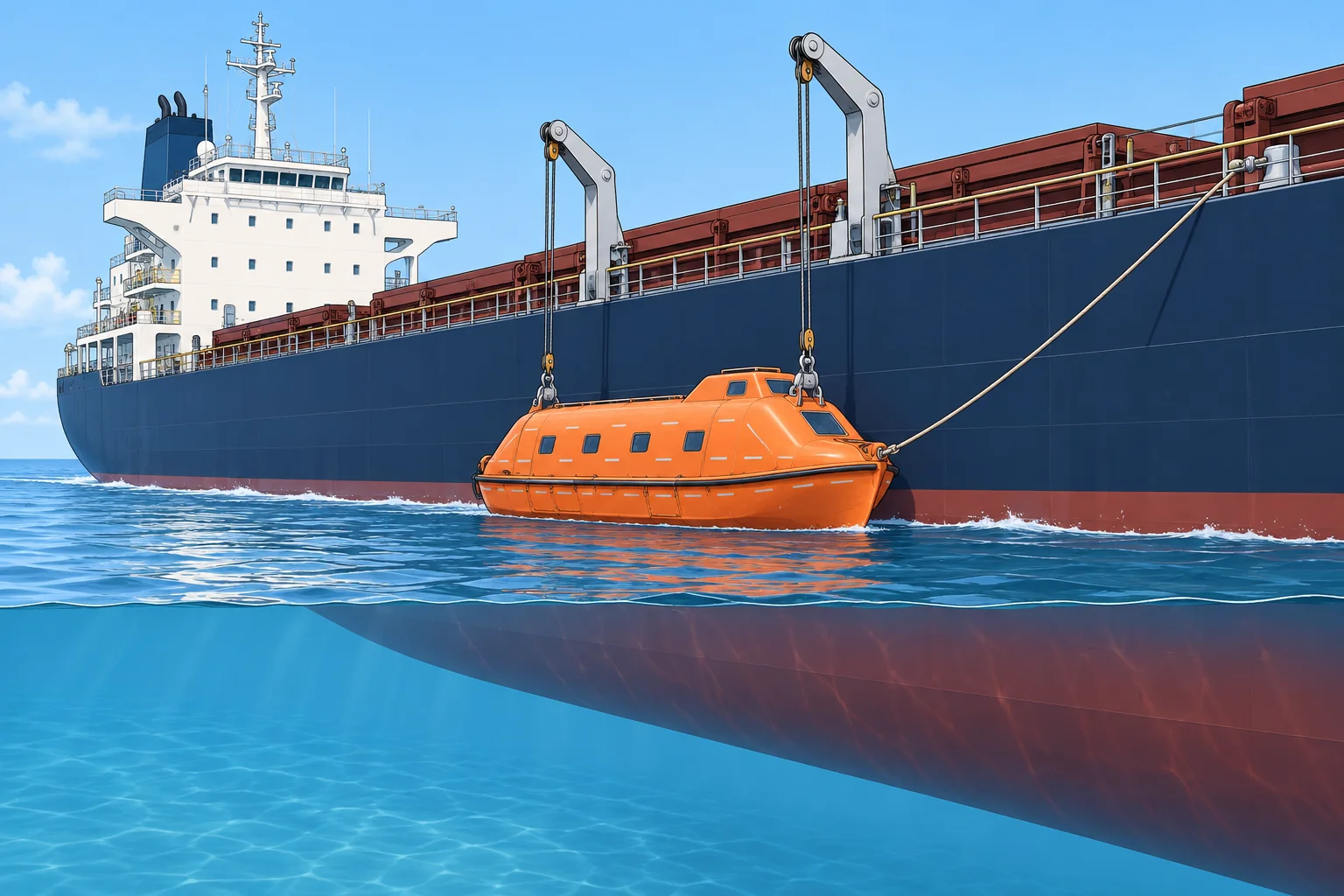
Launching a davit lifeboat and a davit-launched liferaft
See it in 3D
Drag to orbit, scroll to zoom. Use ←/→ to change step and space to play or pause.
1The lesson in plain words
Prepare, lower under control and release when fully waterborne. Follow the maker’s painter-release and steering sequence to get clear.
Before lowering
The boat's crew prepare it as the muster list says: harbour pins out, gripes released, drain plug in where fitted, painter (a bow line to a point forward on the ship) led and secured, falls and the water below clear. Choose the lee side if you can, out of the wind and sea. The person in charge counts heads and checks seat belts before giving the order to lower.
Into the water
Start the engine as the boat nears the water. Follow the maker's running-time and cooling limits when operating it out of water. Release the hooks promptly when fully waterborne, using the maker’s sequence; for off-load release, confirm the falls are slack. Clear fitted FPDs before release as instructed. Do not let the boat drop into a trough still hooked on: a sudden pull can damage the falls or the boat.
Getting clear
The equipment is designed for launch at up to 5 knots of headway (forward speed through the water) in calm water. Reduce headway if possible and follow the ship's launch procedure. The painter keeps the boat from moving astern relative to the ship. Follow the maker’s painter-release and steering sequence. Some boats prohibit steering while it is connected. Release it from inside when instructed, then motor clear of the hull and propeller.
Davit-launched liferafts
Check that the hook is fully reset before loading. Inflate the raft on its hook at embarkation level, hold it alongside with bowsing lines and board dry. Ease and clear these lines as instructed before lowering. Arm automatic release only at the stage specified by the maker; it frees the raft when fully waterborne. The separate on-load control needs two deliberate actions. Deck crew must be able to see that the hook is correctly set.
2Step by step
Launching a davit lifeboat
- 1
Remove harbour pins, release gripes, check the plug and lead the painter forward.
The davit cannot move with pins in, and the painter must be ready before the boat is in the water.
- 2
For embarkation-deck boarding, first lower to that level and secure alongside as instructed. Board, strap in, close hatches and count heads.
Unsecured people are thrown about as the boat lands.
- 3
Ease and clear any bowsing tackles as instructed, then lower steadily with the brake control.
Release the control to apply the brake and stop lowering if you see a hazard.
- 4
Start the engine just before the boat reaches the water.
You need power to move clear the moment you release.
- 5
When fully waterborne, clear fitted FPDs as instructed, then release the hooks in the maker’s sequence.
Off-load release needs slack falls; a boat still hooked can be snatched by waves.
- 6
Follow the maker’s painter-release and steering sequence, then motor clear.
Some boats prohibit steering with the painter connected. Release it from inside when instructed.
3Key data
- Launch with headway
- Design capability: up to 5 knots in calm water
- Painter
- Bow to forward on the ship; released from inside the boat
- Release
- Fully waterborne; off-load normally, on-load only as instructed
- Raft hook
- Automatic release when waterborne; on-load needs 2 actions
- Engine design requirement
- Designed to run ≥5 min from cold out of water; follow maker’s limits
4Key points
- 1
Prepare: pins out, gripes off, plug in, painter forward, falls and water below clear.
- 2
Start the engine near the water; release the hooks when the boat is fully waterborne.
- 3
The 5-knot calm-water launch capability is a design requirement; use the ship's launch procedure.
- 4
A davit-launched raft's automatic release hook frees it when it floats.
5Frequent mistakes
Wrong: Release the hooks a metre above the water to save time.
Right: Release only when the boat is fully waterborne. A drop injures people and damages the boat.
Wrong: Every boat uses the same painter-release sequence.
Right: Follow your boat’s manual. Some boats require painter release before you steer away.
Wrong: Run the engine for a long check while the boat is in its davits.
Right: Run it out of the water only as long as the maker allows, with cooling arranged as the manual says.
6Practice case & exam keys
The master orders abandon ship. Headway cannot be stopped and is 3 knots. The sea is calm, with wind from port. Your starboard lifeboat and launching area are clear.
Show the answer
Starboard is the lee side, so launch there. Check the painter is led well forward and secured. Lower under control, start the engine near the water and release the hooks when fully waterborne. Follow the maker’s painter-release and steering sequence; some boats prohibit steering while it is connected. Release it from inside when instructed, then motor clear of the hull and propeller.
Exam keys
- Preparation: harbour pins, gripes, plug, painter, falls and water below clear.
- Normal launch: release when fully waterborne. Emergency on-load release or override: only as instructed by the maker and person in charge.
- Design capability: up to 5 knots headway in calm water. Follow the maker’s painter-release and steering sequence to clear the ship.
- Davit-launched liferaft: automatic release hook when waterborne; separate on-load control with two actions.
Finish this unit
When you've read it, answer three questions. Get all three right to finish the unit; opening the page alone doesn't count.
My notes for this unit
No notes