

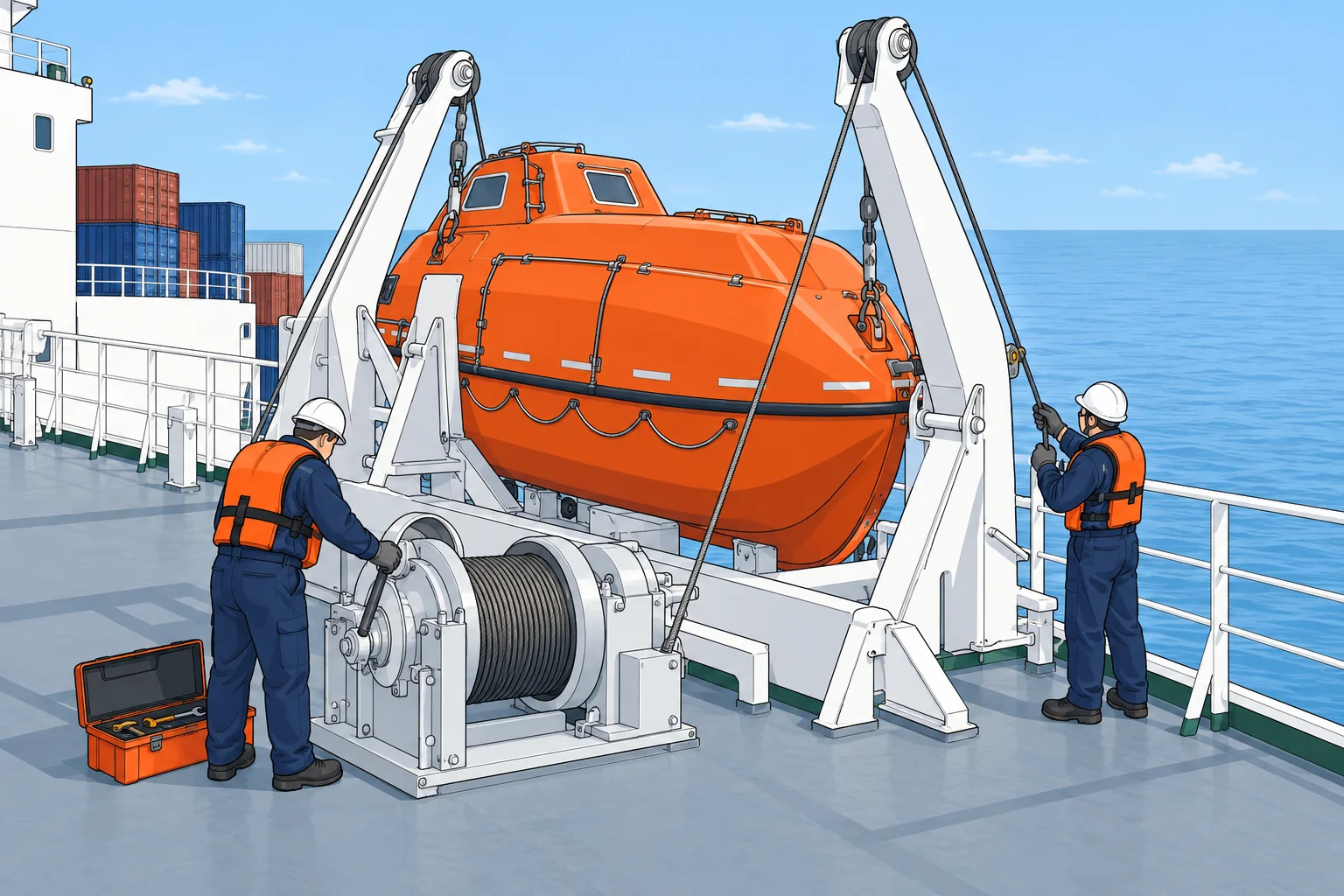
Inspections, engine checks and servicing (SOLAS III/20, MSC.402(96))
1The lesson in plain words
You check boats and davits weekly and monthly. Certified personnel examine and test them annually and overhaul release gear at least every five years.
Weekly
Each week, visually inspect craft and launching appliances, including hook attachments and complete release-gear reset. Run lifeboat and rescue-boat engines for at least 3 minutes in total, provided ambient temperature is above the minimum required for starting. Check gearbox engagement safely and provide required cooling. For rescue-boat outboards that need the propeller submerged, provide a suitable water supply as instructed. Move cargo-ship lifeboats, except free-fall, uncrewed from stowage, weather and sea permitting. Test the general emergency alarm. Log the results.
Monthly
Turn out (swing out from stowage) every lifeboat except free-fall, without people aboard, weather permitting. Inspect the life-saving appliances, including lifeboat equipment, with the ship's checklist (SOLAS III/36). Check the engine: fuel, battery charge, cooling and oil. Check the equipment inventory: water and food dates, pyrotechnics, first-aid kit, bailer, sea anchor and the operating instructions. Log the inspection results.
Falls
Inspect falls periodically, with special regard to where they pass over sheaves (grooved pulley wheels). Renew them when deterioration requires it, or at intervals of not more than 5 years, whichever is earlier (SOLAS III/20.4). Turning falls end for end every 30 months is a pre-2008 rule.
Annual examination
MSC.402(96), mandatory since 1 January 2020, requires an annual thorough examination and operational tests by certified personnel of the maker or an authorised service provider. These cover the boat, launching appliance and release gear.
Five-yearly
At least every five years: overhaul the release gear, dismantling the hooks. Use test weights for release-gear and winch-brake tests at 1.1 times the fully loaded boat’s mass. Reports are signed by the technician and countersigned by the master or company, and kept on board for the equipment’s life. Never adjust release gear with load on the hooks.
2Key data
- Weekly engine run
- ≥3 min; above minimum starting temperature; required cooling
- Monthly
- Turn out lifeboats (not free-fall); checklist inspection
- Falls
- Inspect near sheaves; renew if deteriorated, or within 5 years
- Annual
- Thorough examination and tests by certified personnel
- Five-yearly
- Release gear overhaul; tests at 1.1 × fully loaded mass
- Rules
- SOLAS III/20; MSC.402(96) since 1 January 2020
3Key points
- 1
Weekly: hooks; engine ≥3 min with temperature/cooling limits; move cargo-ship lifeboats (not free-fall) uncrewed if safe; alarm.
- 2
Monthly: lifeboats turned out and the checklist inspection, equipment included.
- 3
Falls: inspect periodically, especially at sheaves; renew when deteriorated or within 5 years.
- 4
Annual and five-yearly work under MSC.402(96) is done by certified service personnel.
4Frequent mistakes
Wrong: The crew can overhaul the release gear if they follow the manual.
Right: Overhaul, repair and the annual and five-yearly tests need certified personnel of an authorised service provider.
Wrong: Run the lifeboat engine only in harbour, once a month.
Right: Run engines weekly for at least 3 minutes, with the required starting temperature and cooling. Check gearbox engagement safely.
Wrong: Falls last until they break.
Right: Inspect them periodically, especially over sheaves, and renew them when deteriorated or within 5 years at most.
5Practice case & exam keys
At your weekly check you find one lifeboat hook's indicator halfway between set and released. The boat is stowed in its davits. The annual service is due in two months.
Show the answer
Treat the boat as unavailable and report to the responsible officer and master. Keep people clear and record the defect. Do not operate, adjust or reset the suspect hook under load. Arrange approved support to remove the hook load, following the maker's procedure. Only personnel authorised for that work may investigate and restore it. Call an authorised service provider where required.
Exam keys
- Weekly (III/20.6): hooks; engine ≥3 min with temperature/cooling limits; move cargo-ship lifeboats (not free-fall) uncrewed if safe; alarm.
- Monthly (III/20.7): turn out lifeboats, checklist inspection of LSA and lifeboat equipment.
- Falls (III/20.4): inspect periodically, esp. at sheaves; renew when deteriorated or ≤ 5 years.
- MSC.402(96): annual examination and 5-yearly overhaul and 1.1 × load tests by certified personnel.
Finish this unit
When you've read it, answer three questions. Get all three right to finish the unit; opening the page alone doesn't count.
My notes for this unit
No notes