

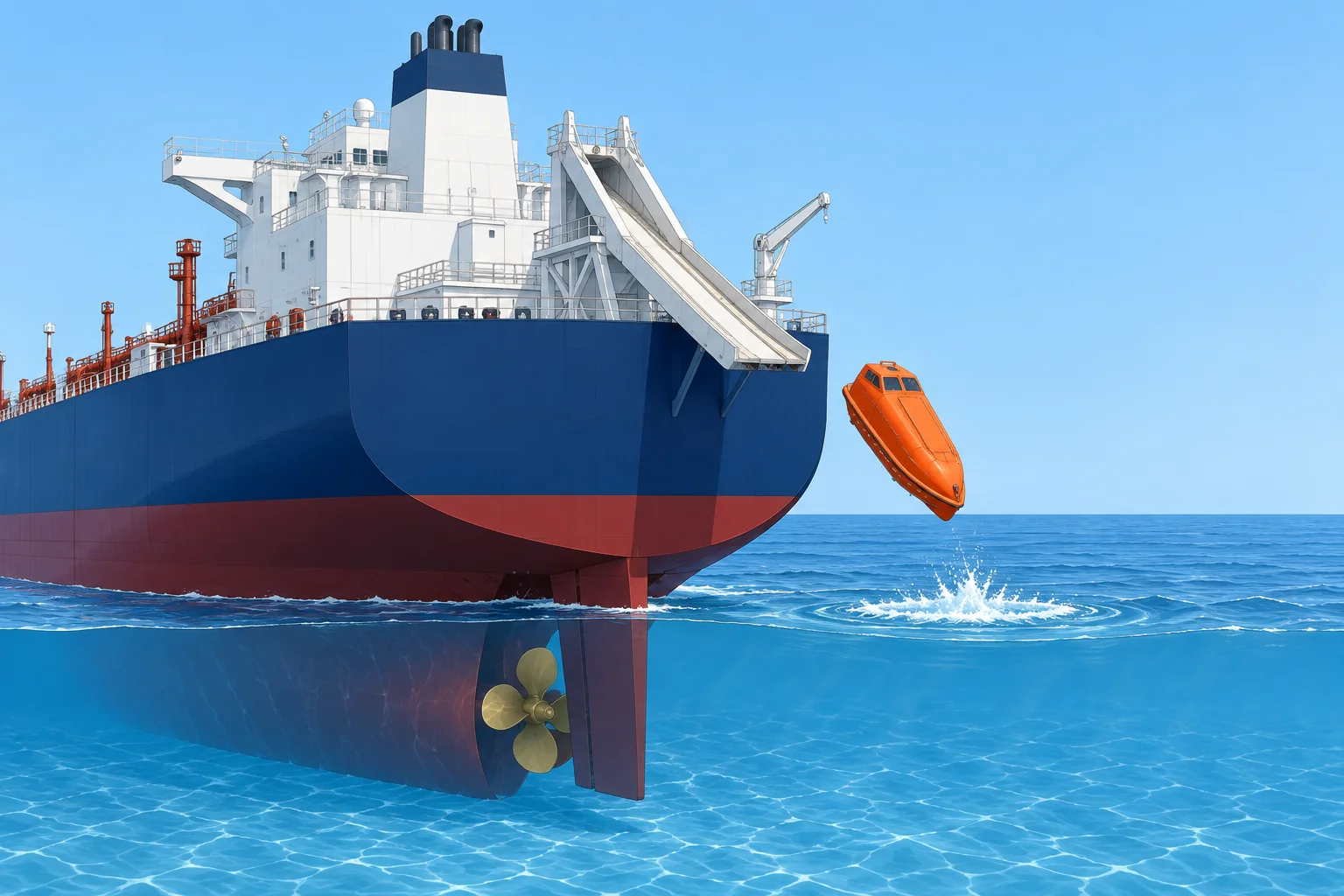
Free-fall lifeboats: launch, simulated launch and recovery
1The lesson in plain words
A free-fall lifeboat drops from a stern ramp. You secure every harness, check the approved limits and follow the maker’s launch and recovery procedures.
How it works
A free-fall lifeboat sits on an inclined ramp, usually at the stern, pointing down at the sea. Released, it slides and falls, enters the water bow first and drives clear. Passenger seats usually face the lifeboat’s stern; use your assigned launch seat and harness. The free-fall certification height is the maximum approved drop measured from the water surface to the boat's lowest point in launching position. Check the actual drop height and the ship's trim and list against approved limits before launch.
Launching
Board, strap in, close the hatches and check every belt. Start the engine as instructed. On the warning from the coxswain, the person in charge of the boat, everyone braces. Then operate the release from inside, normally by a hydraulic hand pump. It needs at least two independent actions to reduce the risk of unintended release. The boat makes headway as soon as it lands.
Drills
Under an experienced supervising officer, board, check harnesses and practise the launch sequence. A simulated launch rehearses the release procedure without physically activating the release mechanism. Use the maker's approved restraints and simulation instructions (MSC.1/Circ.1578/Rev.1). If these are unavailable, stop and obtain them. Restore normal readiness afterwards. Release-system testing is separate maintenance work. Drill frequencies are covered in Emergencies: musters and alarms.
Secondary launching and recovery
Each free-fall launching appliance has a secondary means to lower the boat by falls, usually a davit or crane, with off-load release. It is used for drills, maintenance and recovery. Recovery is high-risk: carry only essential operating crew if the approved procedure requires them. Hook on carefully in calm conditions. Disembark before final securing on the ramp, following the maker's sequence.
2Key data
- Release
- At least two independent actions from inside the boat
- Seating
- Use assigned launch seat and harness; brace on command
- Certification height
- Maximum approved drop: water to boat's lowest point at launch
- Simulated launch
- Approved restraints; no physical release; restore normal readiness
- Simulated launch guide
- MSC.1/Circ.1578/Rev.1 (6 July 2026)
- Secondary means
- Lowering by falls with off-load release; used for recovery
3Key points
- 1
Strap in, close hatches and brace before release; start the engine when the maker specifies.
- 2
Release needs two independent actions from inside the boat.
- 3
A simulated launch trains the procedure without activating the release.
- 4
Recover with the secondary means; carry only essential operating crew if the approved procedure requires them.
4Frequent mistakes
Wrong: Release first, then strap in while the boat slides.
Right: Secure every harness, close hatches and brace before release. Follow the maker’s engine-start sequence.
Wrong: Full crew aboard for the recovery to share the work.
Right: Carry only essential operating crew if the approved recovery procedure requires them. An approved uncrewed recovery may be possible.
Wrong: Use a simulated launch drill to test the release system.
Right: A simulated launch does not activate the release; testing it is separate maintenance work.
5Practice case & exam keys
Your bulk carrier must abandon. The free-fall lifeboat is at the stern; everyone has mustered. The ship is settling by the bow and the stern ramp is rising. The second officer is coxswain.
Show the answer
Check actual drop height, trim and list against the boat's approved limits; the rising stern can increase the drop. If outside limits, hold release and tell the master so an approved alternative can be used. If within limits, board as trained, secure every harness and close hatches. Start the engine as instructed. On the coxswain's warning, brace and complete both independent release actions. After entry, drive clear, count heads and report.
Exam keys
- Free-fall: stern ramp; assigned launch seats and harnesses; certification height.
- Release needs at least two independent actions from inside.
- Simulated launch: approved restraints, no physical release, restore normal readiness; separate from release-system testing.
- Secondary means by falls, with off-load release, for lowering in drills and recovery.
Finish this unit
When you've read it, answer three questions. Get all three right to finish the unit; opening the page alone doesn't count.
My notes for this unit
No notes