

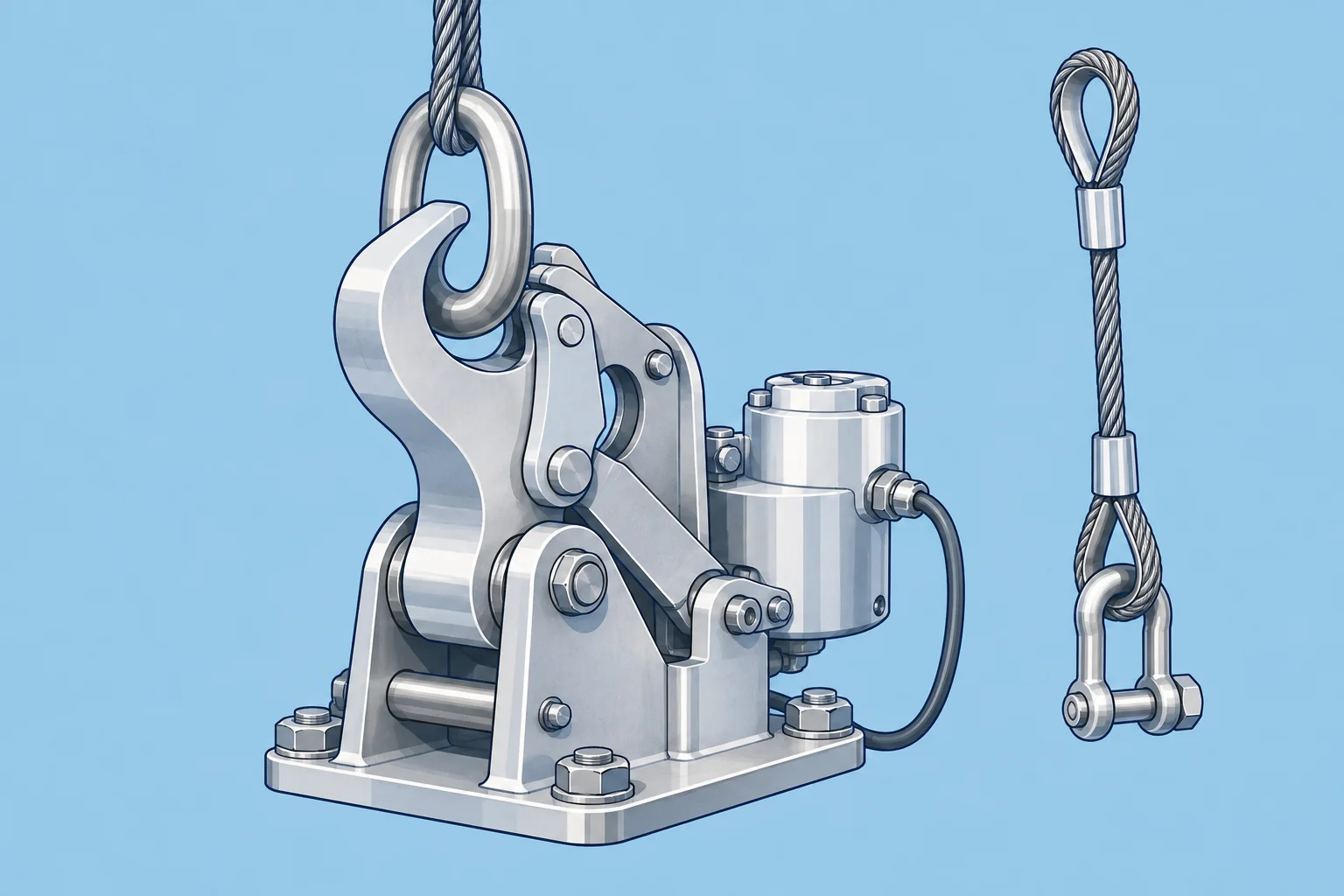
On-load release hooks, resetting and hanging-off gear
1The lesson in plain words
A hook can look closed without being safely reset. Understand both release modes, the interlock and the checks before hoisting.
Two ways to let go
On a twin-fall davit lifeboat, suspended by two falls, the release gear has off-load and on-load capabilities (LSA Code 4.4.7.6). Off-load release frees the waterborne boat with no hook load. On-load release works with load still on the hooks. Both hooks open together from one control in the boat. Some single-fall systems have off-load release only.
The waterborne safeguard
A hydrostatic interlock, a water-pressure safeguard, or approved equivalent prevents normal on-load release operation until the boat is waterborne. A protected override is for emergencies only, following the maker’s instructions. Mechanical protection, such as a breakable cover, and a danger sign guard it against accidental use. Operation requires several deliberate, sustained actions. On-load release with the boat in the air drops it.
Why hooks changed
MSC.320(89) tightened the hook rules on 1 January 2013 after fatal drill accidents. A hook must stay closed until deliberately released, at loads from 0 to 100% of its working load. This applies at up to 10° trim (fore-and-aft tilt) and 20° list (sideways tilt). SOLAS III/1.5 required existing hooks to be evaluated under MSC.1/Circ.1392. Non-compliant hooks had to be replaced by 1 July 2019.
Resetting
After release, reset both hooks as the maker instructs. Check locks, indicators, interlock and fall connections. A partly reset hook can look closed and still open under load. Follow the approved recovery procedure: carry only essential operating crew if required, pause just clear of the water for prescribed checks, and have everyone disembark before final turning-in, when the davits bring the boat into stowage.
Hanging-off gear and fall preventers
Fall preventer devices (FPDs) add protection. Approved strops (short safety slings) provide another load path; approved pins block hook opening. MSC.1/Circ.1327 introduced interim protection. Follow flag, maker and ship procedures for continued use, including fitted secondary safety systems. When fitted, remove FPDs before release once waterborne; refit after hook-on before hoisting. Hanging-off gear supports the boat to unload release gear for maintenance (LSA 6.1.2.13). Disconnect it for drills and sea stowage. Never maintain or adjust loaded release gear.
2Key data
- Release gear
- Twin-fall: off-load and on-load; some single-fall: off-load only
- On-load protection
- Hydrostatic interlock or equivalent; protected emergency override
- Hook standard
- MSC.320(89), in force 1 January 2013
- Existing hooks
- Evaluated; non-compliant gear replaced by 1 July 2019
- Hanging-off gear
- Maintenance only (LSA 6.1.2.13), not drills
3Key points
- 1
Twin-fall: off-load needs no hook load; on-load works with load. Some single-fall systems have off-load release only.
- 2
A hydrostatic interlock or equivalent blocks normal on-load release until waterborne; the override is for emergencies.
- 3
Compliant hooks stay closed from zero to 100% of their approved working load until deliberately released.
- 4
Check the reset and refit fitted FPDs before hoisting; hanging-off gear is for maintenance only.
4Frequent mistakes
Wrong: Break the override cover in a drill when the interlock is slow.
Right: The override is for emergencies. In a drill, stop and report the fault.
Wrong: The hook looks closed, so it is reset.
Right: Check every locking part and indicator as the manual shows; a partly reset hook can open under load.
Wrong: Leave the hanging-off gear on during the drill for extra safety.
Right: Hanging-off gear is for maintenance only. Use fitted FPDs and secondary safety systems as flag, maker and ship procedures require.
5Practice case & exam keys
After a drill the boat is waterborne alongside, falls released. The engine runs. The second officer wants to hook on and hoist at once with the crew inside.
Show the answer
Do not hoist with the whole drill party aboard. Reset both hooks; check locks, indicators, fitted interlock and fall connections as instructed. Refit fitted FPDs after hook-on, before hoisting. Use fitted secondary safety devices as required. Carry only essential operating crew if required. Pause just clear of the water for prescribed checks; stop if any indication is doubtful. Have everyone disembark before final turning-in.
Exam keys
- Twin-fall gear: off-load release with no hook load; on-load with load. Some single-fall systems have off-load release only.
- Hydrostatic interlock or equivalent prevents normal on-load release until waterborne; protected override for emergencies.
- MSC.320(89): hooks stay closed from 0 to 100% of approved working load; existing hooks evaluated under MSC.1/Circ.1392; non-compliant gear replaced by 1 July 2019.
- Full reset check and fitted FPDs refitted before hoisting; remove FPDs when waterborne before release. Hanging-off gear: maintenance only.
Finish this unit
When you've read it, answer three questions. Get all three right to finish the unit; opening the page alone doesn't count.
My notes for this unit
No notes