

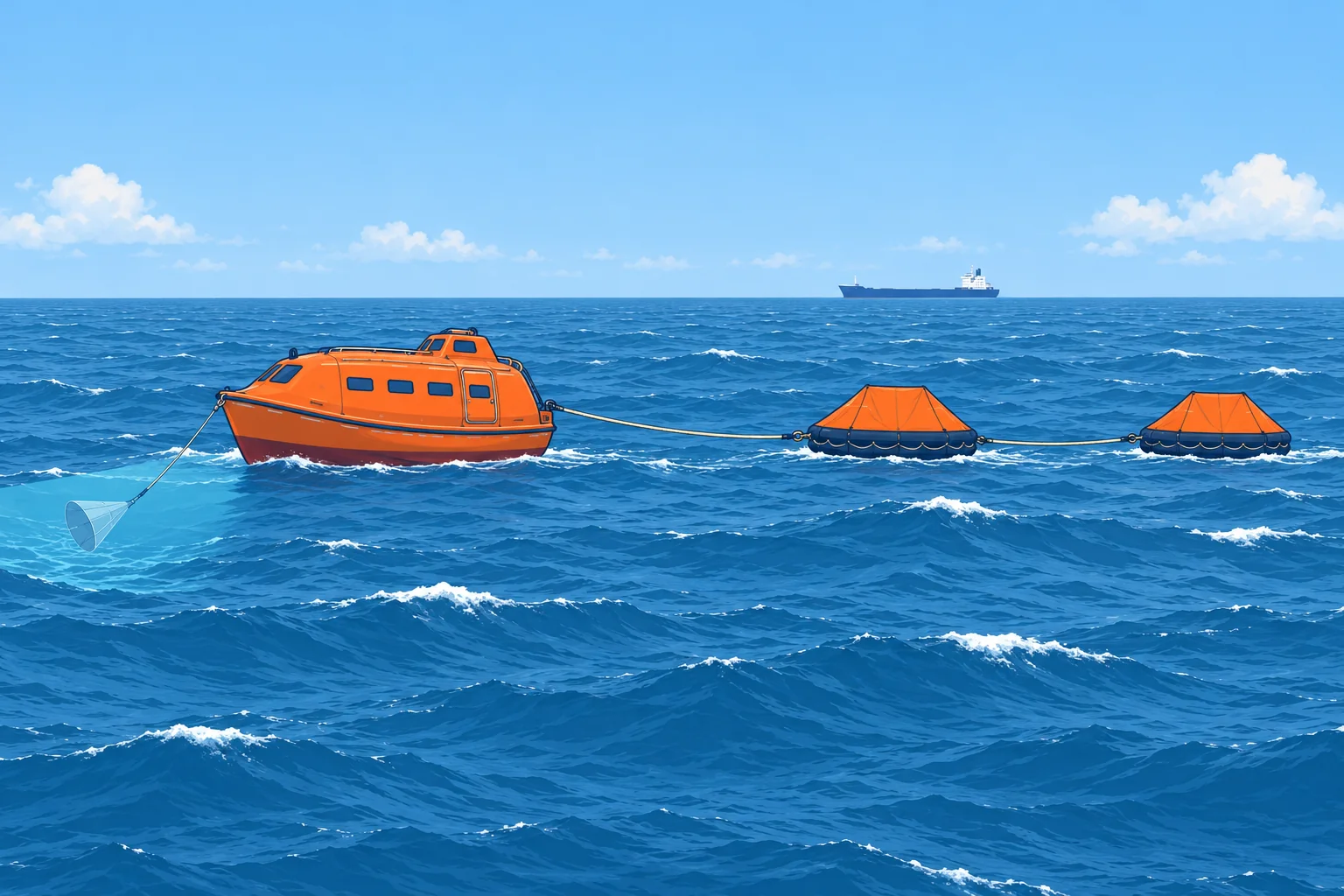
Taking charge after launch: clear, gather, tow and ride it out
1The lesson in plain words
Once afloat, take charge: get clear of the ship, count everyone and gather the other craft. Keep everyone safe and visible until rescue.
Get clear
Motor clear of the hull, propeller and burning oil. Stay near the distress position when safe. Keep hatches closed near smoke or fire. Where fitted, the self-contained air system supplies air to occupants and engine; sprinklers cool the outside of the boat. Closed hatches alone do not make a boat fire-protected. Operate these systems as the maker instructs while clearing the danger. Count everyone, assign jobs and post a lookout. Report by VHF radio, the boat’s short-range voice radio.
Leading the group
Take charge and gather the other craft. To tow is to pull another craft by a line. First check the boat and rafts’ towing limits and approved attachment points. Where approved, lead rafts in line astern, one behind another, and take up slack slowly. Adjust tow length to waves so craft rise and fall together where practicable, reducing snatching, sudden towline jerks. Tow slowly within approved limits.
Survivors in the water
Choose the approach for your craft, wind, current and waves. When approaching from downwind in flat water, head slowly into wind. Stop the propeller before coming alongside the survivor. Use the boat's approved recovery aid and lifting points. Support the head, trunk and legs to keep the person as horizontal as practicable. A single lifejacket lifting loop alone does not provide horizontal support; use one only if approved for lifting, with lower-body support.
Riding it out
Deploy the sea anchor, a canvas cone on a line from the bow, to steady the boat and slow drift. It keeps the bow towards the seas. In heavy weather keep entrances and openings watertight and everyone strapped in. A totally enclosed lifeboat is self-righting: it returns upright after capsize if openings are watertight and occupants secured. If it capsizes, stay strapped in. Once upright, check for flooding, remove any water and restart the engine if it stopped.
2Key data
- First actions
- Clear the ship, count everyone, lookout, report by VHF
- Towing liferafts
- Check limits and towing points; tow slowly, take up slack gently
- Sea anchor
- From the bow: head to sea, less drift
- Capsize
- Totally enclosed: openings watertight, occupants strapped in
- Person in water
- Choose approach for conditions; go slowly; stop propeller alongside
3Key points
- 1
Clear the ship's side and propeller, but stay near the position.
- 2
Count everyone, set a lookout, report by VHF and gather the other craft.
- 3
Check towing limits and attachment points; tow slowly in the approved arrangement, adjusting tow length to reduce snatching.
- 4
Use the sea anchor to face seas. In a totally enclosed lifeboat, keep openings watertight and stay strapped in during capsize.
4Frequent mistakes
Wrong: Head for land at full speed as soon as you are clear.
Right: Stay near the position, where rescuers will search, unless the person in charge decides otherwise.
Wrong: Tow liferafts close astern at speed to get them clear quickly.
Right: Check approved limits and attachment points. Tow slowly and adjust tow length to waves; a short, fast tow can tear the raft’s towing point.
Wrong: Unbuckle and climb out as the boat rolls over.
Right: Stay strapped in; a totally enclosed lifeboat rights itself with occupants secured and entrances and openings watertight.
5Practice case & exam keys
You command a lifeboat clear of the ship. Two intact liferafts nearby have everyone safely aboard. A man in a lifejacket is in the water 50 m downwind. The water is flat with a steady wind and no current. You choose to approach from downwind.
Show the answer
Recover the man first: he is exposed; raft occupants have shelter. Count everyone and assign a lookout. Pass clear, turn downwind of him and approach slowly into wind. Stop the propeller before coming alongside. Use approved recovery aids and lifting points; support head, trunk and legs as horizontally as practicable. Gather the rafts; tow slowly within approved limits. Stay near the distress position, deploy the sea anchor and report by VHF.
Exam keys
- After launch: clear the side and propeller, stay near the position, count everyone, lookout, report.
- Check towing limits and attachment points; use the approved arrangement, tow slowly and adjust tow length to reduce snatching.
- Choose approach for craft and conditions. From downwind in flat water: slowly into wind; stop propeller; use approved aids and body support.
- Sea anchor keeps head to sea; totally enclosed lifeboats self-right with openings watertight and occupants strapped in.
Finish this unit
When you've read it, answer three questions. Get all three right to finish the unit; opening the page alone doesn't count.
My notes for this unit
No notes