

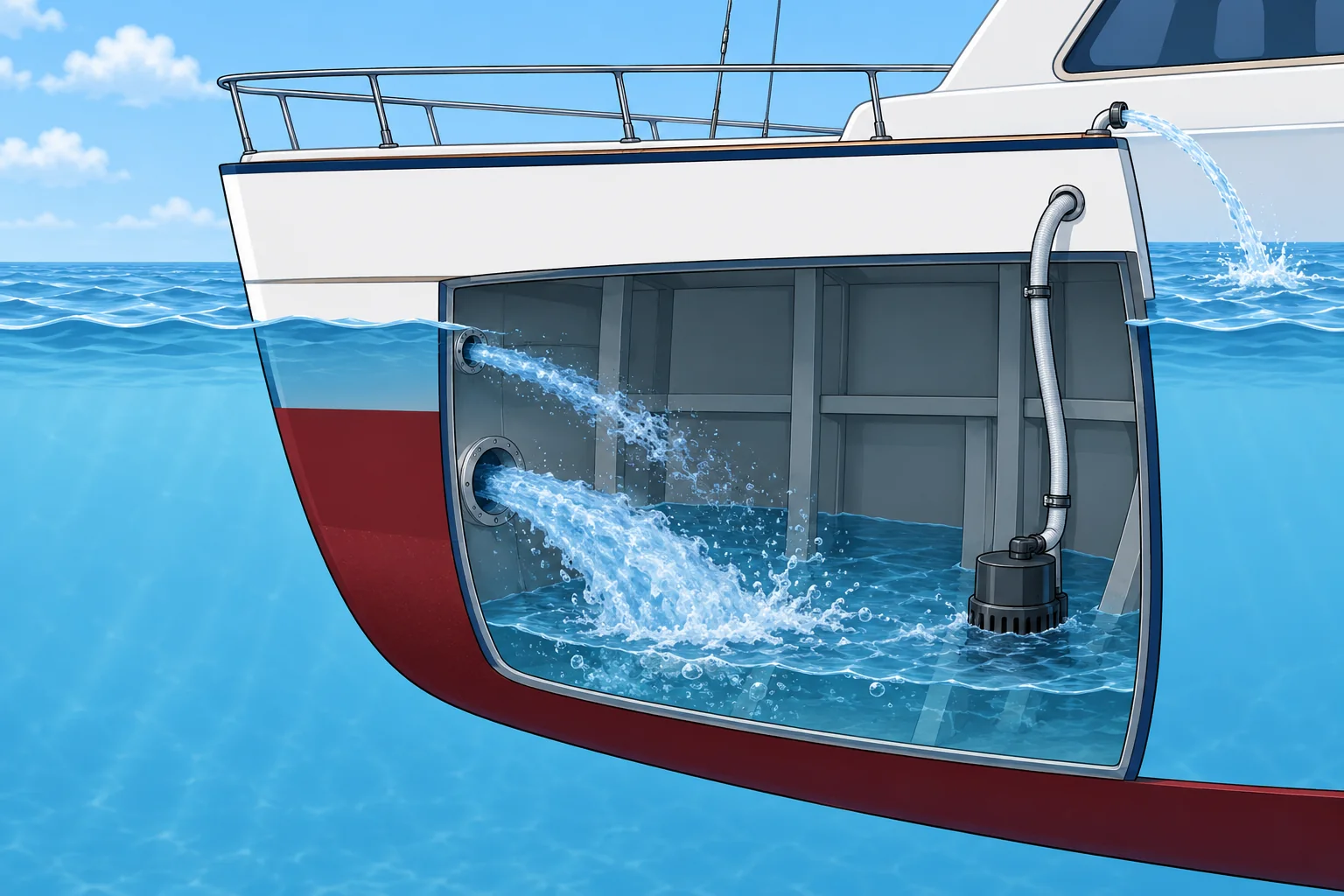
How fast a hole floods, and how fast you can pump
1The lesson in plain words
A submerged hole a few centimetres across can exceed your pumps’ output. Reduce the leak while pumping, and call early if safety is threatened.
The inflow formula
Estimate Q = 0.6 × A × √(2gh). Q is inflow in cubic metres per second (m³/s); A is hole area in square metres (m²); g is gravitational acceleration (9.81 m/s²). If the hole discharges into air, h is its depth below the outside waterline, in metres. If water inside covers it, h is the difference between outside and inside water levels. For a round hole, A = πd²/4; d is diameter in metres. Multiply Q by 60,000 for litres/minute. The factor 0.6 allows approximately for flow restrictions.
What it means
With water discharging into air, a 38 mm hose fitting, 0.5 m below the waterline, lets in about 130 litres a minute. A 50 mm hole at 1 m lets in about 310 litres a minute, nearly 19 tonnes an hour. Double the diameter and the flow goes up four times, because area grows with the square. Four times deeper only doubles it, because flow grows with the square root of depth.
Pump reality
A large manual bilge pump may move about 50–70 litres a minute, but output depends on the pump and operator. People tire quickly. A pump rated at 500 US gallons an hour delivers about 32 litres a minute before losses from lifting water and resistance in hoses. Flooding can disable its power supply, wiring or controls. Buckets can help.
Reduce, don’t just pump
Keep pumping while you reduce the inflow: close the seacock, fit a bung, stuff and brace the hole, or raise it by heeling. Reducing inflow is the priority because a submerged hole can exceed their combined output. Once the flow slows, pumping may catch up. Slow down: speed drives water through a hole in the bow.
Mayday or Pan-Pan
Send Mayday for grave and imminent danger needing immediate assistance, such as uncontrolled flooding threatening the boat. Use Pan-Pan for an urgent safety problem below distress level. An optional escort request can be routine. Call early. The calling procedure is in GMDSS: distress calls.
2Key data
- Inflow estimate
- Q = 0.6 × A × √(2gh), m³/s
- 38 mm at 0.5 m
- About 130 L/min
- 50 mm at 1 m
- About 310 L/min (about 19 t/h)
- Hole diameter ×2
- Inflow ×4
- Depth ×4
- Inflow ×2
- Typical manual pump
- Roughly 50–70 L/min while pumped hard
3Key points
- 1
Inflow grows with hole area and the square root of depth.
- 2
Double the hole diameter, four times the water.
- 3
A submerged hole a few centimetres across can exceed pump output.
- 4
Keep pumping while you reduce the inflow; slow down.
- 5
Mayday: grave and imminent danger needing immediate assistance. Pan-Pan: urgent safety help below distress level.
4Frequent mistakes
Wrong: The electric pump’s label tells you what it will move.
Right: Check the maker’s test head and voltage. Installed flow can be much lower because of lift, hose resistance and voltage drop.
Wrong: A hole twice as deep lets in twice as much water.
Right: Flow grows with the square root of depth. Twice as deep gives about 1.4 times as much.
Wrong: Wait until the boat is nearly sinking before calling for help.
Right: Call as soon as uncontrolled flooding threatens safety. Do not wait for the pumps to fail.
5Practice case & exam keys
A 25 mm cockpit drain fitting breaks off, 0.4 m below the waterline, discharging into air. Your manual pump moves about 50 L/min. Can you keep up, and what should you do?
Show the answer
Inflow ≈ 0.6 × 0.00049 × √(2 × 9.81 × 0.4) ≈ 0.00083 m³/s, about 50 L/min. That just matches your pump, so you will not gain. Keep pumping while you fit the bung. Send Mayday for grave and imminent danger needing immediate assistance; use Pan-Pan for urgent safety help below distress level.
Exam keys
- Inflow Q ≈ 0.6 × A × √(2gh); grows with area and the square root of depth.
- A few-centimetre hole low down can exceed 100 L/min.
- Typical yacht pumps move only tens of litres a minute; prioritise reducing inflow while pumping.
- Mayday: grave and imminent danger needing immediate assistance. Pan-Pan: urgent safety help below distress level.
Finish this unit
When you've read it, answer three questions. Get all three right to finish the unit; opening the page alone doesn't count.
My notes for this unit
No notes